Quantum Computing Courses for Software and AI Engineers (2026): Where to Start and What to Pick

Key Insights
- The best quantum computing course depends on your technical background, career goals, learning format, budget, and available study time.
- For applied quantum computing and AI: IIT Delhi CEP combines quantum foundations, programming, algorithms, quantum-AI topics, hands-on labs, and capstone projects in a structured programme.
- For quantum machine learning: EICTA’s Advanced Certificate Programme in Quantum Computing and Machine Learning is an option to investigate, subject to verification of its current syllabus, fees, and delivery details.
- For free foundational learning: IBM Quantum Learning offers a self-paced learning path covering quantum information, computation, and algorithms.
- For software developers: Short courses from Edureka on Coursera and the Packt specialisation on Coursera provide routes into quantum programming, Python, Qiskit, and algorithm implementation.
- For specialised learning: UChicagoX / edX offers a beginner-oriented introduction, while DelftX’s semiconductor-focused course is intended for more advanced learners.
- Before enrolling: Compare curriculum, practical projects, prerequisites, live teaching hours, fees, certificate requirements, and current availability. A certificate does not guarantee employment, and quantum machine learning does not automatically outperform classical AI.
The right quantum computing course depends on what you already know and what you want to build. Software engineers should prioritise quantum programming and algorithms, AI/ML engineers should explore quantum machine learning, and physics or mathematics graduates can focus on turning theoretical knowledge into working circuits and simulations. A good quantum computing course online should match your background, offer the right level of practical work, and fit your budget and schedule.
This guide compares eight quantum computing courses, from free self-paced learning paths to structured professional programmes. It considers curriculum, hands-on learning, duration, fees, certificates, and suitability for different technical roles.
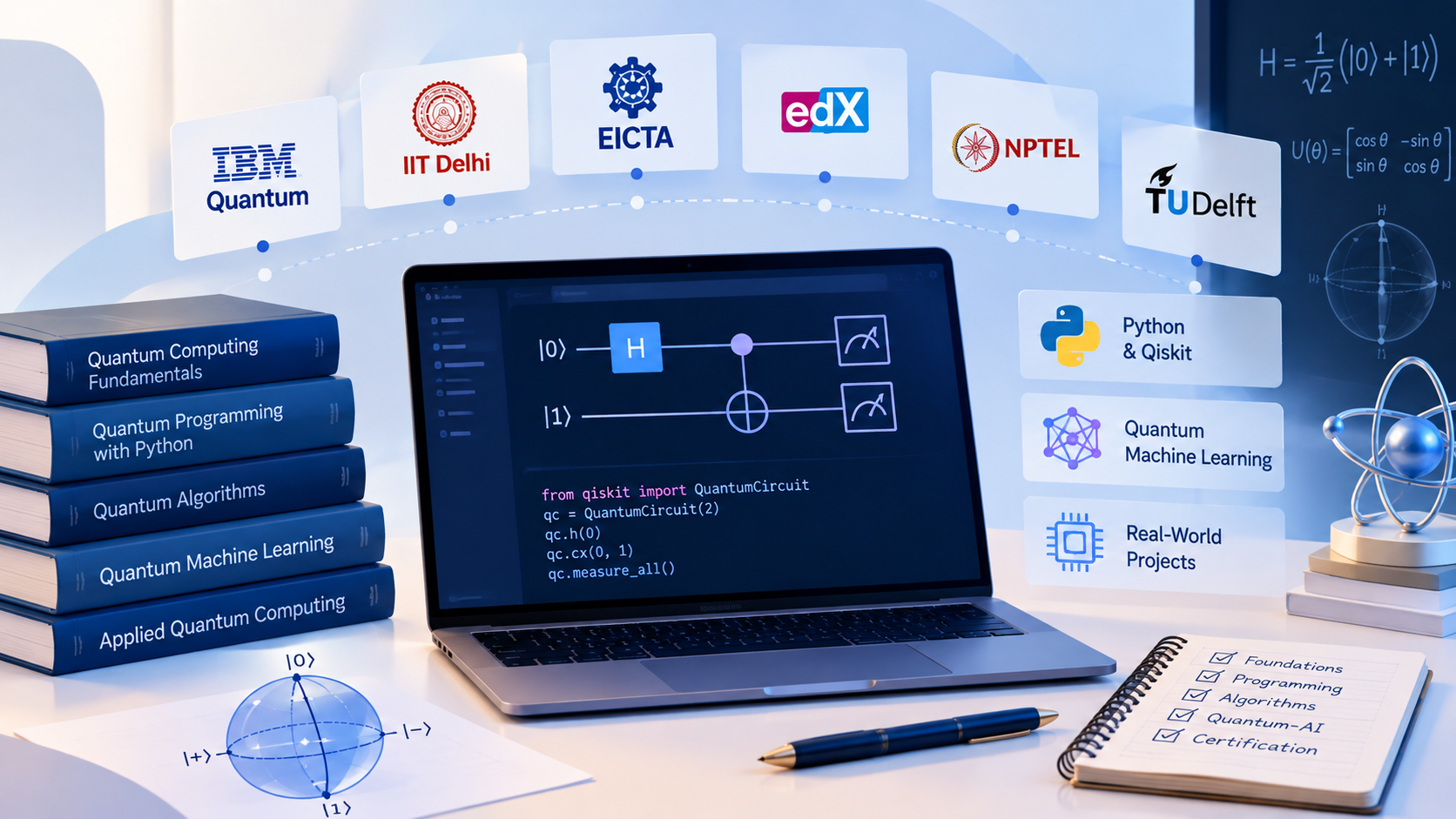
Best Quantum Computing Courses for Software and AI Engineers at a Glance
The best quantum computing courses in 2026 vary in depth, flexibility, and cost. The table distinguishes estimated self-study time from scheduled live instruction. Fees and availability can change, so verify the current listing before enrolling.
| Rank | Institute / programme | Duration | Mode | Fee |
|---|---|---|---|---|
| 1 | IIT Delhi CEP – Certification in Applied Quantum Computing and AI | 6.5 months, per listing | Live online + recordings | Verify current fee |
| 2 | EICTA – Advanced Certificate Programme in Quantum Computing and Machine Learning | 8 months, as listed in the brief | Live online, weekends | ₹94,990 including GST, as listed in the brief; verify |
| 3 | IBM Quantum Learning – Understanding Quantum Information and Computation | About 29 hours | Self-paced online | Free |
| 4 | UChicagoX / edX – Quantum Computing for Everyone | 3 months; 3–5 hours/week | Self-paced online | Around US$398 before discounts; verify |
| 5 | Coursera / Edureka – Quantum Computing Algorithms and Programming | About 5 hours | Self-paced online | Varies by enrolment option |
| 6 | DelftX / edX – Quantum 301: Quantum Computing with Semiconductor Technology | 3 months; 6–7 hours/week | Self-paced online | Around US$370 before discounts; verify |
| 7 | NPTEL / IIT Madras and IBM – Introduction to Quantum Computing: Quantum Algorithms and Qiskit | 4 weeks for Jan–Feb 2026 offering | Online | Check next offering and exam fees |
| 8 | Coursera / Packt – The Complete Quantum Computing Course for Beginners Specialization | 4 weeks; about 10 hours/week, per listing | Self-paced online | Varies by subscription or purchase |
Note: The ranking is an editorial comparison published by Varsity, not an official ranking issued by the institutions. Some programmes are broader or more technical than others.
1. IIT Delhi CEP – Certification in Applied Quantum Computing and AI
This applied quantum computing course is designed for learners seeking a structured connection between quantum foundations, programming, algorithms, hardware, security, and AI applications. The programme listing describes live online learning, recordings, hands-on work, and a sequence of mini-capstones leading to a final capstone.
Programme snapshot
- Institute: IIT Delhi Continuing Education Programme (CEP)
- Duration: 6.5 months, as listed
- Live learning: 156 hours, as listed
- Mode: Live online with recordings; optional campus immersion is listed
- Fee: Verify current fee and payment terms
- Certificate: IIT Delhi CEP certificate, subject to attendance and evaluation requirements
- Best for: Software and AI professionals looking for structured, applied learning
Why it ranks #1: Its stated combination of instructor-led learning, hands-on projects, and quantum-AI coverage aligns closely with this guide’s focus. The trade-off is the substantial time and financial commitment compared with free or short courses. The listing references an October 2026 cohort; check the page for the next available intake before applying.
Explore the IIT Delhi CEP – Certification in Applied Quantum Computing and AI.
2. EICTA – Advanced Certificate Programme in Quantum Computing and Machine Learning
This option is relevant to ML engineers who want a more specialised quantum computing and machine learning course. The supplied brief lists an eight-month duration, 100 live hours, weekend sessions, and a fee of ₹94,990 including GST. Confirm these details, the syllabus, and certificate requirements on EICTA’s current official listing before publication or enrolment.
Programme snapshot
- Institute: EICTA
- Duration: 8 months
- Live learning hours: 100 hours
- Mode: Live online, weekends
- Fee: ₹94,990, including GST, as listed in the supplied brief; verify current fee
- Certificate: EICTA Consortium certificate; verify current requirements
- Best for: ML engineers and professionals seeking applied quantum-AI learning
Look for explicit coverage of quantum information, algorithms, optimisation, quantum ML, labs, mentoring, and a capstone rather than relying on the programme title alone.
3. IBM Quantum Learning – Understanding Quantum Information and Computation
IBM’s free learning path estimates around 29 hours and covers quantum information, circuits, and algorithms, with hands-on tutorials and course-specific badge opportunities. It is a useful quantum computing course for beginners who have basic Python and linear algebra knowledge and want to test their interest before paying for a longer programme.
- Provider: IBM Quantum Learning
- Duration: Approximately 29 hours for the learning path
- Live learning hours: Not applicable
- Mode: Self-paced online
- Fee: Free
- Certificate: Course-specific badge options, subject to assessment
- Best for: Software engineers and learners building strong quantum foundations
4. UChicagoX / edX – Quantum Computing for Everyone
This self-paced Professional Certificate offers a conceptual introduction to quantum computing, simple quantum operations, and quantum programming. The listing estimates three months at three to five hours per week. The displayed price is around US$398 before discounts, but verify the current price and whether an audit option is available.
Programme Snapshot
- Institute: University of Chicago, via edX
- Duration: 3 months, at 3–5 hours per week
- Live learning hours: Not applicable
- Mode: Self-paced online
- Fee: Around US$398 before discounts, as listed; verify current price
- Certificate: edX Professional Certificate
- Best for: Beginners building conceptual foundations
5. Coursera / Edureka – Quantum Computing Algorithms and Programming
This short course focuses on quantum circuits and algorithms using Python, Qiskit, and Qiskit Aer. Its current listing estimates five hours and includes topics such as superposition, measurement, entanglement, Grover’s search, Quantum Fourier Transform, and phase estimation. It also introduces hybrid algorithms and circuit evaluation.
Programme Snapshot
- Provider: Edureka, via Coursera
- Duration: About 5 hours
- Live learning hours: Not applicable
- Mode: Self-paced online
- Fee: Varies by enrolment option
- Certificate: Shareable Coursera certificate
- Best for: Developers seeking a compact, practical introduction
6. DelftX / edX – Quantum 301: Quantum Computing with Semiconductor Technology
This is an advanced, specialised programme rather than a first quantum computing course. The listing estimates three months at six to seven hours per week and covers semiconductor quantum technologies, including Germanium qubits and machine learning for device control.
Programme Snapshot
- Institute: Delft University of Technology, via DelftX / edX
- Duration: 3 months, at 6–7 hours per week
- Live learning hours: Not applicable
- Mode: Self-paced online
- Fee: Around US$370 before discounts, as listed; verify current price
- Certificate: edX Professional Certificate
- Best for: Advanced learners interested in quantum hardware and machine-learning applications
7. NPTEL / IIT Madras and IBM – Introduction to Quantum Computing: Quantum Algorithms and Qiskit
This academic course introduces superposition, entanglement, quantum circuits, algorithms, and quantum error correction, with hands-on Qiskit sessions. The January–February 2026 offering has concluded, so check NPTEL for a new run rather than assuming enrollment is open.
Programme Snapshot
- Institute: IIT Madras and IBM, via NPTEL
- Duration: 4 weeks for the January–February 2026 offering
- Live learning hours: Not publicly listed
- Mode: Online
- Fee: Check the current offering and examination fees
- Certificate: NPTEL certificate, subject to assessment requirements
- Best for: Learners seeking academic foundations and guided Qiskit practice
8. Coursera / Packt – The Complete Quantum Computing Course for Beginners Specialization
This three-course specialisation combines introductory quantum concepts with Python and Qiskit practice. Coursera’s listing estimates four weeks at around ten hours per week. The fee depends on subscription or purchase terms, and the certificate is a platform credential rather than a university degree.
Programme Snapshot
- Provider: Packt, via Coursera
- Duration: Verify the current course estimate
- Live learning hours: Not applicable
- Mode: Self-paced online
- Fee: Varies by subscription or purchase option
- Certificate: Shareable specialisation certificate, subject to completion requirements
- Best for: Beginners who want a guided, self-paced introduction
Which Quantum Computing Learning Path Fits Your Background?
Software engineers, AI/ML engineers, and physics or mathematics graduates need similar foundations, but their learning priorities differ.
For Software Engineers
Start with qubits, quantum gates, measurement, superposition, and entanglement. Then learn to build and simulate circuits using Python and Qiskit before progressing to quantum algorithms and hybrid workflows. A quantum programming course should include implementation practice, not just explanations of theory.
For AI and ML Engineers
Build a foundation in quantum circuits before exploring quantum kernels, variational quantum circuits, quantum classifiers, and hybrid quantum-classical machine learning. Look for opportunities to compare quantum approaches with classical baselines instead of assuming quantum methods will perform better.
For Physics and Mathematics Graduates
Use your knowledge of linear algebra, complex numbers, probability, and quantum mechanics to study quantum information, algorithms, and programming tools. Focus on implementing concepts through circuits, simulations, and projects. Beginners should check prerequisites before enrolling in an advanced course.
How do Quantum Computing and AI Overlap?
Quantum machine learning explores how quantum circuits may be applied to selected machine-learning tasks. Topics include quantum kernels, variational quantum circuits, quantum classifiers, and hybrid quantum-classical workflows. For AI engineers, the goal is to understand when these approaches are useful – not to assume they outperform conventional ML. IBM’s learning resources also distinguish potential applications from demonstrated quantum advantage.
What should AI Engineers Learn About Quantum Machine Learning?
Learn how classical data can be encoded into quantum circuits, how variational circuits are trained, and how quantum kernels can be evaluated. A quantum machine learning course should explain limitations such as noise, circuit depth, and the cost of preparing and measuring data.
What Project Should You Build First?
Try a small quantum-kernel or variational-classifier experiment. Use the same dataset to train a classical baseline, then compare accuracy, runtime, noise sensitivity, and resource requirements. Treat the result as an experiment, not proof of quantum advantage.
How should You Choose a Quantum Computing Course?
Match the course to your next learning goal. Software engineers should prioritise Python, Qiskit, circuit construction, and algorithms. AI/ML engineers should look for quantum ML and hybrid workflows. Physics and mathematics graduates should focus on implementing theory. Beginners should check prerequisites before choosing advanced hardware courses.
Also assess labs, graded work, simulator or hardware access, and capstone requirements. Compare the total cost—including taxes and exam fees—with the time commitment. A longer or more expensive course is not automatically better, and a certificate does not guarantee employment.
How we Ranked the Best Quantum Computing Courses?
The ranking uses the following editorial framework. It compares published programme features rather than measuring employer preference or predicting career outcomes.
| Criterion | Weight | What it evaluates |
|---|---|---|
| Curriculum and technical relevance | 30% | Foundations, algorithms, programming, quantum ML, and role fit |
| Practical learning and assessment | 25% | Labs, circuits, simulations, hardware, and projects |
| Fit for the target learner | 20% | Relevance to software, AI/ML, or physics and mathematics backgrounds |
| Credential and provider clarity | 15% | Certificate issuer and completion requirements |
| Cost and flexibility | 10% | Fees, duration, schedule, and flexibility |
| Total | 100% |
IIT Delhi CEP ranks first because its listed structure combines quantum computing and AI with live instruction and applied projects. Fees, live hours, certificates, and intake dates should still be verified. Where a provider does not disclose a detail clearly, it should be treated as unverified—not assumed to be an advantage.
Conclusion
The best quantum computing course depends on your technical background and what you want to learn next. Software engineers can start with programming and algorithms, AI/ML engineers can explore quantum-AI methods, and physics or mathematics graduates can turn theoretical knowledge into implementations. Free learning paths are useful for building foundations, while structured programmes may provide live teaching and integrated projects. Always verify current fees, syllabus, prerequisites, certificate requirements, and enrolment availability.
If you want a structured route connecting quantum computing with AI and applied projects, explore the IIT Delhi CEP – Certification in Applied Quantum Computing and AI delivered through Varsity on InterviewBit. Review the latest programme details to decide whether its format and commitment suit your goals.
Frequently Asked Questions
Can I learn quantum computing while working full-time?
Yes. Self-paced courses let you schedule study around work, while live weekend programmes provide structure. Check the weekly workload and project commitments before enrolling.
How much linear algebra do I need before starting?
Vectors, matrices, complex numbers, and basic probability are useful foundations. A beginner course may help you revise these alongside quantum concepts.
Do I need access to a real quantum computer to practise?
No. Simulators let you build and test many small circuits. Cloud hardware can provide additional experience with real devices and their limitations.
Should I learn Qiskit, Cirq, or PennyLane first?
Choose based on your goal. Qiskit is closely associated with IBM’s quantum ecosystem, Cirq supports quantum circuit development, and PennyLane focuses on quantum computing workflows that can integrate with machine learning.
Can quantum computing knowledge help me understand cybersecurity?
Yes. Quantum computing is relevant to the future security of some existing cryptographic systems and to post-quantum cryptography. A general course alone, however, does not qualify someone to design secure systems.
What quantum computing project can I add to my portfolio?
Build a circuit demonstration, implement Grover’s algorithm, run a QAOA optimisation experiment, or test a quantum-kernel classifier against a classical baseline. Document your method and limitations.
Are free quantum computing courses enough to get started?
They can be enough to build foundations and test your interest. Structured paid programmes may add live instruction, mentoring, feedback, or integrated projects.
Is quantum machine learning a replacement for conventional machine learning?
No. Quantum ML remains an active research area, and most everyday machine-learning workloads are still handled using classical methods. Compare approaches rather than assuming quantum advantage.
How can I assess whether a course is technically rigorous?
Look for mathematical explanations, circuit construction, algorithm implementation, simulator or hardware experiments, assessments, and discussion of practical limitations.
Does a quantum computing certificate guarantee a job in the quantum industry?
No. A certificate documents learning according to the provider’s requirements, but employment depends on relevant skills, experience, project evidence, and the requirements of each role.