Quantum Computing Could Change Drug Discovery Forever

Key Insights
- Quantum computing could improve molecular simulation by modelling complex electronic interactions that are challenging for classical computers to handle efficiently.
- The Variational Quantum Eigensolver (VQE) combines quantum circuits with classical optimisation to estimate molecular energy, making it a key approach in quantum chemistry research.
- Quantum computing could support molecular docking, protein–ligand interaction analysis and virtual screening, but these applications still face technical limitations.
- St. Jude researchers demonstrated a quantum-enhanced machine learning approach for identifying KRAS-targeting molecules, with two candidate molecules experimentally validated.
- Collaborations involving AstraZeneca, IonQ, AWS and NVIDIA have explored hybrid quantum–classical computing for chemical reactions relevant to drug synthesis, demonstrating progress in specific computational tasks rather than end-to-end drug discovery.
- Practical adoption will depend on better quantum hardware, reliable benchmarking against classical methods and evidence of measurable improvements in pharmaceutical research.
Quantum computing in drug discovery could help researchers model molecular structures, chemical reactions and protein interactions at a quantum-mechanical level, potentially addressing challenges that classical computers find difficult to handle efficiently. Classical computing and AI already play an important role in compound screening, molecular modelling and drug design, but accurately simulating complex electronic interactions remains challenging. Quantum computing could complement these existing methods by offering new approaches to molecular simulation and pharmaceutical research, although its practical capabilities are still being explored.
From the Variational Quantum Eigensolver (VQE) to molecular docking and quantum machine learning, researchers are investigating where quantum methods could contribute to drug discovery. This article explores how quantum computing could support different stages of the drug discovery pipeline, examines current pharmaceutical research initiatives, and outlines the limitations and advances that will shape its future.
Why Is Drug Discovery So Hard for Classical Computers?
Drug discovery involves searching large chemical spaces and predicting how molecules interact with biological targets. The challenge is finding useful candidates while balancing computational accuracy, cost and research time.
The Molecular Complexity Problem
Molecules contain interacting electrons whose behaviour influences chemical bonds, stability and reaction energies. As molecular systems become more complex, accurately representing these interactions can require substantial computational resources. Researchers must often balance higher-fidelity calculations against the time and computing power available.
Where Classical Simulation Hits Its Limits
Classical methods remain essential to computational chemistry, but some complex electronic-structure problems are difficult to solve accurately at scale. Quantum computing could help with selected calculations, although its practical advantage over the best classical methods must be demonstrated for each problem.
Why AI Does Not Solve Every Drug Discovery Problem
AI can identify patterns, predict molecular properties and help generate candidate compounds. Quantum computing may eventually support particular physics-intensive calculations. Rather than competing, these technologies could complement one another: AI predicts, classical high-performance computing (HPC) handles large workloads, and quantum algorithms target selected bottlenecks.
How Can Quantum Computing Help With Molecular Simulation?
Quantum simulation could help researchers investigate molecular electronic structures and chemical energies. Hybrid quantum-classical algorithms such as VQE are an important research pathway for exploring these applications.
What Is VQE in Drug Discovery?
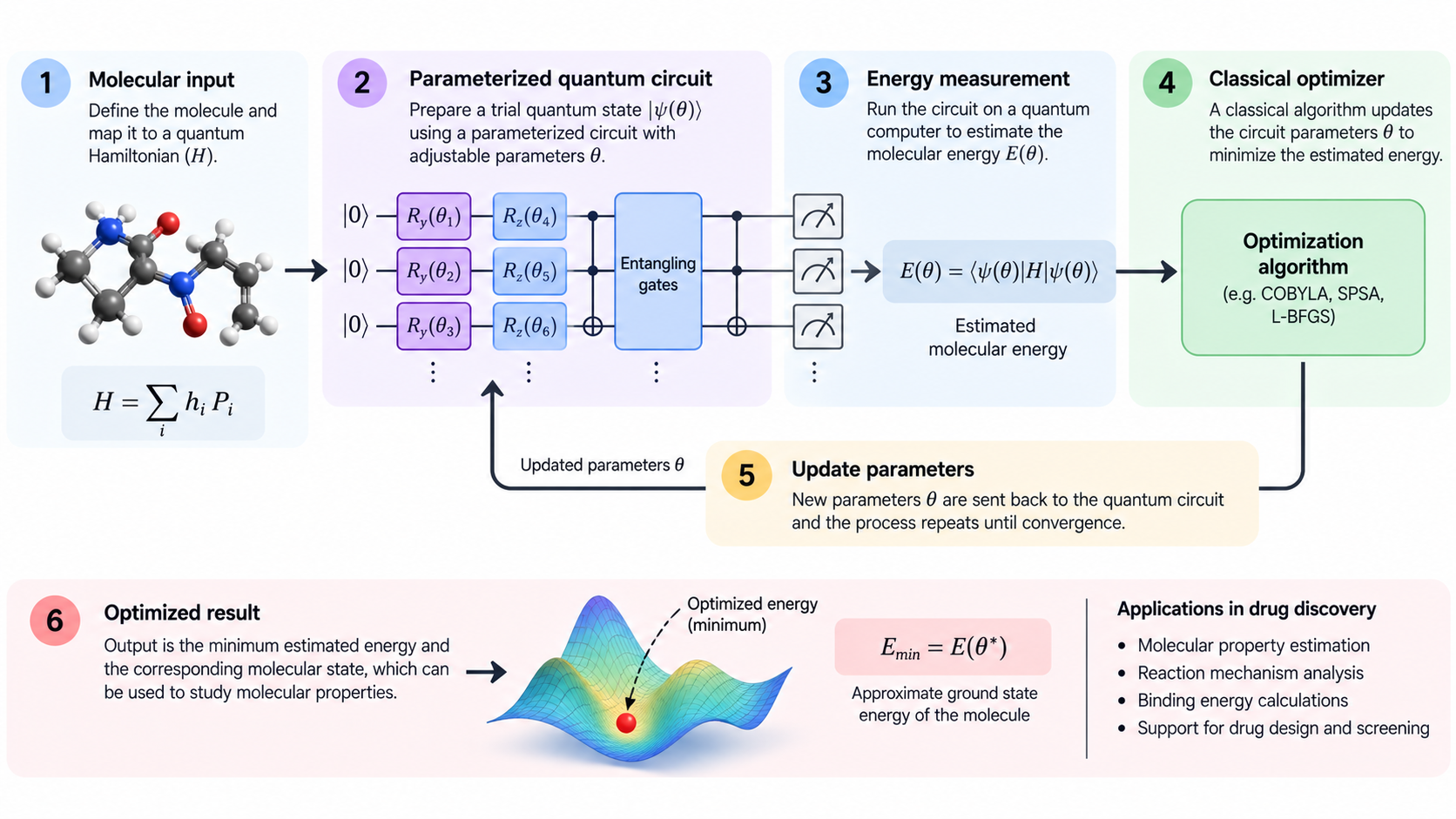
The Variational Quantum Eigensolver (VQE) estimates a quantum system’s ground-state energy through an iterative process. Researchers represent the molecular problem using a Hamiltonian, prepare a quantum state with a parameterised circuit and estimate its energy. A classical optimiser then adjusts the circuit parameters to improve the result.
This quantum-classical loop repeats until the calculation converges or meets a stopping condition. VQE drug discovery research explores whether this approach can help solve selected quantum chemistry problems, although noise, measurement costs and circuit complexity remain important limitations.
What Molecular Properties Could Quantum Simulation Predict?
Potential applications include molecular energies, electronic structure, reaction pathways and chemically difficult systems, including some involving transition metals. These calculations could eventually improve the information available for evaluating candidate compounds, but they cannot establish a medicine’s safety or clinical effectiveness on their own.
Why Hybrid Quantum-Classical Computing Matters
Current quantum computers are not replacing classical chemistry software or HPC. Instead, molecular simulation using quantum computing may become part of a hybrid workflow in which classical systems manage large-scale calculations, AI supports prediction and quantum subroutines address selected problems.
Where Could Quantum Computing Fit in the Drug Discovery Pipeline?
The main quantum computing drug discovery applications under investigation involve molecular simulation, drug–target interactions, protein-related problems and candidate optimisation.
Molecular Docking and Drug–Target Interactions
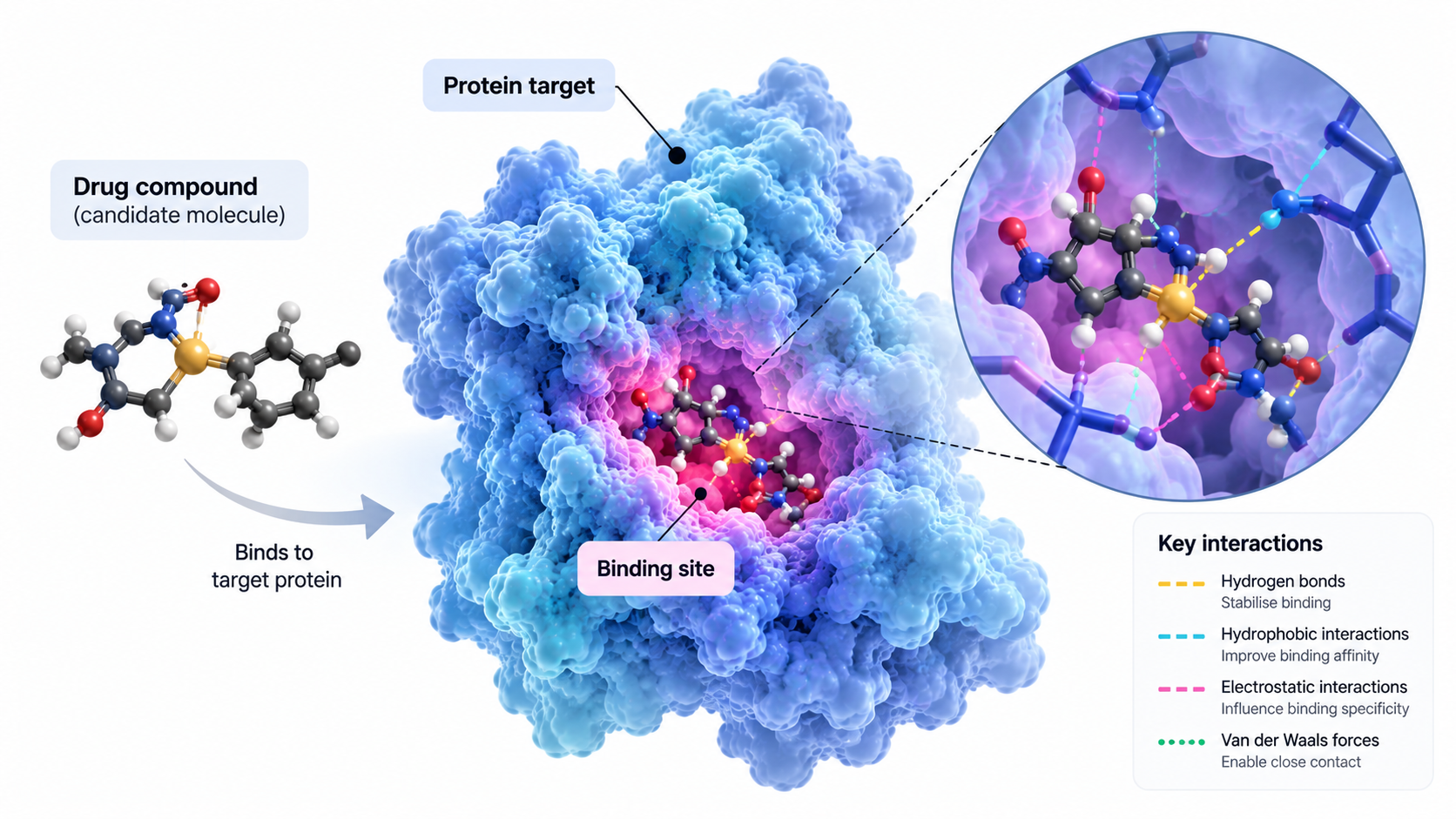
Molecular docking predicts how a candidate compound might bind to a biological target, helping researchers compare binding poses and prioritise molecules. Quantum computing molecular docking research explores whether quantum approaches could improve selected calculations involved in molecular interactions or scoring. These methods have not replaced established classical docking systems.
Protein Folding and Protein–Ligand Interactions
Protein structure prediction, protein dynamics and protein–ligand interactions are distinct problems. AI systems such as AlphaFold have advanced protein-structure prediction, so quantum computing protein folding should not be presented simply as an attempt to replace AlphaFold. Quantum methods may instead contribute to specific molecular interactions or quantum-mechanical calculations that remain challenging.
Virtual Screening and Molecule Design
Quantum computing virtual screening and quantum machine learning drug discovery could eventually support molecular property prediction, candidate ranking, chemical-space exploration and lead optimisation. However, broad claims that quantum computers can already screen billions of compounds faster than classical systems are not established. Quantum drug design remains an active research area.
What Is Quantum Computing Actually Doing in Drug Discovery Today?
Quantum computing in pharma is progressing through research, pilot projects and hybrid proof-of-concept workflows. Some projects have reported experimental validation, but broad, repeatable quantum advantage has not been established.
St. Jude’s Quantum-Enhanced KRAS Research
In April 2025, St. Jude and University of Toronto researchers reported combining classical and quantum machine learning to identify candidate ligands for KRAS, a challenging cancer target. The team experimentally validated two molecules, making the project a notable proof of principle. The result does not mean a new medicine has been approved or that quantum computing has transformed drug discovery at commercial scale.
AstraZeneca, IonQ, AWS and NVIDIA
In June 2025, IonQ announced a collaboration with AstraZeneca, AWS and NVIDIA involving a hybrid quantum-GPU workflow for simulating a Suzuki–Miyaura reaction, used in small-molecule drug synthesis. The collaborators reported more than 20× improvement in end-to-end time-to-solution compared with previous implementations. This was a specific computational-chemistry demonstration, not evidence that the complete drug-discovery process became 20 times faster.
Other Pharma–Quantum Collaborations
IBM and Moderna are exploring quantum computing for mRNA medicine design, including mRNA secondary-structure problems. Cleveland Clinic and IBM also collaborate on quantum computing, AI and HPC for healthcare and life-sciences research. These pharmaceutical quantum computing partnerships demonstrate active research interest, not widespread production deployment.
When Will Quantum Computing Become Useful for Drug Discovery?
The quantum computing drug discovery timeline depends on advances in hardware, error correction and algorithms. Near-term work is likely to focus on targeted hybrid applications, while broader value depends on more capable and reliable quantum systems.
What Can NISQ-Era Quantum Computers Do?
Today’s noisy intermediate-scale quantum (NISQ) systems support experiments involving small molecular systems, variational algorithms, quantum machine learning and hybrid calculations. Noise and limited circuit depth can restrict the size and accuracy of useful computations.
What Requires Fault-Tolerant Quantum Computing?
More ambitious applications may require error-corrected logical qubits, deeper circuits and greater computational scale. These capabilities could support larger molecular simulations and demanding chemical-accuracy calculations, but the requirements will vary by problem.
A Realistic Roadmap: Now, Next and Later
| Stage | Likely focus |
|---|---|
| Now | Research, benchmarking, hybrid algorithms and pilots |
| Next | Early fault-tolerant applications to selected chemistry problems |
| Later | Larger-scale molecular simulation and potential integration into drug discovery |
This is a qualitative roadmap, not a prediction of specific dates. No single year can reliably define when quantum drug discovery will deliver broad commercial value.
What Skills Are Needed to Work in Quantum Drug Discovery?
Quantum computing in pharmaceutical research combines quantum technology with chemistry, biology and scientific computing. Relevant skills depend on the role.
Quantum Computing Skills
Useful foundations include qubits, quantum circuits, quantum algorithms, VQE, quantum machine learning, programming frameworks and an understanding of NISQ limitations.
Chemistry and Computational Biology Skills
Molecular modelling, quantum chemistry, molecular docking, protein structure, drug–target interactions and computational drug design help connect quantum methods to practical research problems.
AI, HPC and Hybrid Computing Skills
Machine learning, classical optimisation, scientific programming, high-performance computing and quantum-classical workflows are valuable for developing and evaluating integrated systems.
Who Is Hiring or Building These Teams?
The emerging field brings together computational chemists, quantum algorithm developers, AI/ML specialists and life-sciences researchers. Quantum computing drug discovery careers are likely to involve interdisciplinary collaboration rather than quantum expertise alone.
What Could Quantum Computing Change in Drug Discovery?
If fault-tolerant systems deliver useful computational advantages, quantum computing could improve molecular modelling and help researchers investigate difficult chemical problems.
Faster Candidate Evaluation
More accurate molecular calculations could eventually help researchers prioritise promising candidates earlier. Any improvement in speed or cost must be demonstrated against strong classical alternatives.
Better Modeling of Difficult Chemistry
Potential applications include electronic structure, strongly correlated systems, catalytic reactions and complex molecular interactions. These remain research opportunities rather than guaranteed outcomes.
More Targeted Drug Design
Better molecular information could support lead optimisation, drug–target modelling and molecule design. Experimental testing, clinical trials and regulatory review would remain essential.
Quantum Computing in Drug Discovery: What Happens Next?
The immediate priority is identifying problems where quantum methods deliver reproducible value against competitive classical approaches.
Benchmarking Quantum Against Classical Methods
Progress should be measured through accuracy, runtime, resource requirements, reproducibility and the quality of downstream research decisions – not speedup claims alone.
From Proof of Concept to Production Workflow
A research demonstration must become a validated workflow before it can be trusted in pharmaceutical operations. Production deployment also requires reliable performance and evidence that the method improves research decisions.
Why Quantum + AI Could Be More Important Than Quantum Alone
Quantum AI drug discovery is best understood as a potential convergence of complementary technologies: AI supports data-driven prediction, classical HPC handles large workloads, and quantum computing may target selected computational bottlenecks.
Conclusion
Quantum computing could become a specialised tool in drug discovery, but its impact will depend on reproducible evidence rather than promise alone. The next milestone is demonstrating reliable improvements on meaningful pharmaceutical problems and integrating them into validated research workflows.
Ready to explore the convergence of quantum computing and AI? The Applied Quantum Computing & AI programme by IIT Delhi, delivered on Varsity by InterviewBit, introduces quantum computing fundamentals, algorithms, real-world applications and hands-on projects to help you build a foundation for emerging computational technologies.
Frequently Asked Questions
Can quantum computing discover a new drug by itself?
No. Drug discovery involves biology, chemistry, experiments, clinical research and regulatory review. Quantum computing could contribute to selected computational tasks within this wider process.
Is quantum computing better than AI for drug discovery?
They serve different purposes. AI learns patterns and makes predictions, while quantum computing may help with specific computationally difficult problems. They can complement each other.
Can quantum computers replace molecular docking software?
Not currently. Quantum approaches are being explored for selected docking calculations rather than replacing established classical systems.
Does quantum computing make protein folding faster?
A general speed advantage has not been established. Protein-structure prediction differs from modelling protein dynamics and protein–ligand interactions, where quantum methods may have specialised applications.
What is VQE used for in pharmaceutical research?
VQE estimates a quantum system’s ground-state energy using a quantum circuit and classical optimisation. Researchers investigate it for molecular-energy and electronic-structure calculations.
Which pharmaceutical companies are using quantum computing?
Documented efforts include IBM and Moderna, the AstraZeneca–IonQ–AWS–NVIDIA collaboration, and Cleveland Clinic and IBM. These initiatives differ in scope and maturity and do not indicate widespread commercial deployment.
Is quantum computing being used in drug discovery right now?
Yes, mainly through research, pilots and hybrid proof-of-concept workflows. Some projects include experimental validation, but broad, repeatable quantum advantage remains unproven.
What is the biggest limitation of quantum computing for drug discovery?
Current challenges include hardware noise, limited computational scale, error correction, algorithmic constraints and the difficulty of demonstrating reproducible advantages over classical methods.
Will quantum computing reduce the cost of developing drugs?
Potentially, if it improves specific calculations or research decisions. A general reduction in drug-development costs has not yet been established.
Should pharmaceutical researchers learn quantum computing?
It may be useful for researchers in computational chemistry, molecular simulation, AI/ML and scientific computing, particularly those exploring hybrid workflows.
Resources
- St. Jude: Quantum Computing Makes Waves in Drug Discovery
- IBM Quantum Learning: Variational Quantum Eigensolver (VQE)
- IBM Quantum Learning: Examples and Applications of Variational Algorithms
- IonQ: Accelerating Drug Development with AstraZeneca, AWS and NVIDIA
- IBM: Moderna Case Study on Quantum Computing
- Moderna and IBM to Explore Quantum Computing and Generative AI for mRNA Science
- Cleveland Clinic: Discovery Accelerator
- Cleveland Clinic: Quantum Computing Research