The Ultimate Quantum Computing Roadmap for Developers in 2026

Key Insights
- Developers can learn quantum computing without an advanced physics degree by building a foundation in linear algebra, probability, Python, and basic quantum concepts such as superposition, entanglement, and measurement.
- A structured quantum computing roadmap progresses through four phases – foundations, quantum algorithms, hardware and security, and quantum-AI – with approximately 156 hours across 16 modules.
- Qiskit, Cirq, and PennyLane support different learning goals, from quantum circuit programming and hardware experimentation to hybrid quantum-classical workflows and quantum machine learning.
- Hands-on quantum computing projects should progress from beginner circuits and algorithm implementations to hardware, security, and quantum-AI experiments, with each project documenting its approach, results, classical baseline, and limitations.
- Understanding NISQ hardware, quantum error correction, quantum key distribution, and post-quantum cryptography helps developers connect theoretical quantum computing concepts with real-world hardware and security challenges.
- Developers can explore careers in quantum software, algorithm development, quantum machine learning, applications, and security by combining programming fundamentals and mathematical understanding with practical projects and structured learning resources.
Developers can learn quantum computing without becoming quantum physicists first. A practical quantum computing roadmap progresses from programming noisy intermediate-scale quantum (NISQ) systems to hybrid classical-quantum workflows and, eventually, more advanced quantum applications. With a foundation in Python, linear algebra and probability, you can move from basic quantum circuits to algorithms, hardware, security and quantum machine learning. The key is to follow a structured learning path instead of jumping between advanced concepts and tools.
This quantum computing roadmap for developers in 2026 breaks the journey into four phases, with approximately 156 hours of structured learning, hands-on projects and practical resources. Whether you want to explore quantum programming, build quantum applications or understand how quantum computing intersects with AI, this roadmap will help you decide what to learn, in what order, and how to apply it.
What Do You Need to Know Before Learning Quantum Computing?
You do not need an advanced physics background to begin learning quantum computing. However, a few mathematical and programming fundamentals will make quantum concepts easier to understand and implement.
Linear Algebra Fundamentals
Linear algebra is essential because quantum states and operations are represented mathematically using vectors and matrices. Before working with quantum circuits, become comfortable with:
- Vectors and matrices, including matrix multiplication.
- Complex numbers and their arithmetic.
- Eigenvalues and eigenvectors.
- Basic Dirac notation, such as |0⟩ and |1⟩.
These concepts help you understand how quantum gates transform states and how quantum operations are represented computationally.
Probability Fundamentals
Quantum measurement produces outcomes according to probability distributions. Familiarity with conditional probability, expected values and basic statistics helps you interpret measurement results and understand why repeated experiments may produce different outcomes.
Python and Programming
Python is a practical starting point for quantum programming because frameworks such as Qiskit, Cirq and PennyLane support Python-based workflows. You should understand functions, classes, NumPy, Jupyter notebooks and basic debugging before building quantum circuits.
Basic Quantum Concepts
You should also develop an introductory understanding of qubits, superposition, entanglement, phase and measurement. You do not need to master these topics before proceeding; they will become clearer as you implement circuits and experiment with quantum states.
Once these foundations are in place, you do not need to keep studying prerequisites indefinitely. You can learn quantum computing progressively through the four stages below.
What Is the Quantum Computing Roadmap for Developers?
A practical quantum computing learning roadmap moves from foundational concepts to algorithms, real-world hardware and security, and finally quantum-AI applications. The course structure used here comprises four phases, 16 modules and approximately 156 hours of learning.
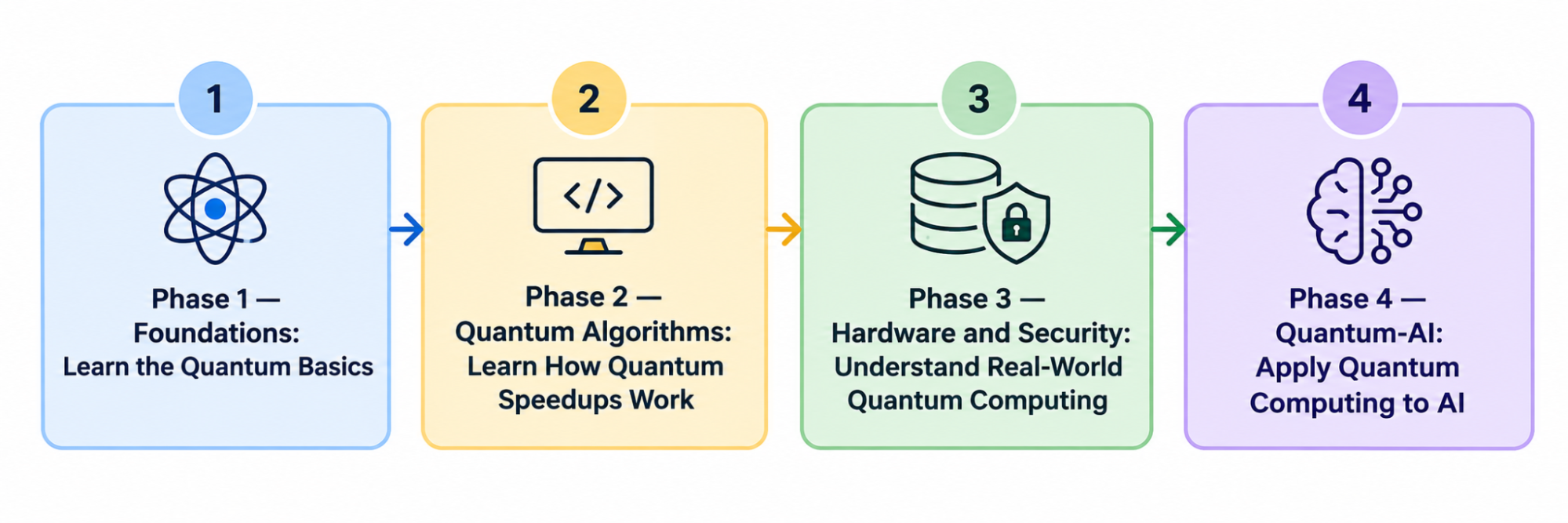
Phase 1 – Foundations: Learn the Quantum Basics
Estimated time: ≈35-40 hours
Start by understanding how quantum computers represent and manipulate information. Focus on:
- Qubits and quantum states.
- Quantum gates and circuits.
- Measurement and measurement probabilities.
- The mathematical foundations of quantum operations.
- Qiskit fundamentals.
Begin with simple circuits and gradually explore how gates change quantum states. Use Qiskit to construct circuits, simulate their behaviour and inspect measurement results.
Beginner project example: Build a Bell-state generator. Create a circuit using a Hadamard gate and a controlled-NOT gate, then examine the correlations between measurement outcomes.
Goal: Understand basic quantum circuits and become comfortable implementing them using a quantum SDK.
Phase 2 – Quantum Algorithms: Learn How Quantum Speedups Work
Estimated time: ≈45-50 hours
Once you understand circuits, explore the quantum computing algorithms that use them to solve specific computational problems. Focus on what each algorithm does, how it works at a high level and where its limitations lie.
Key algorithms include:
- Deutsch–Jozsa and Simon’s algorithm.
- Quantum Fourier Transform (QFT) and Quantum Phase Estimation.
- Shor’s algorithm for factoring.
- Grover’s algorithm for searching unstructured spaces.
- Quantum walks.
- Variational Quantum Eigensolver (VQE) and Quantum Approximate Optimization Algorithm (QAOA).
- Basic quantum computational complexity.
Do not approach this stage as a list of algorithms to memorise. Instead, connect each algorithm to the problem it addresses and understand how its quantum approach differs from a classical one. Also, distinguish theoretical speedups from practical performance on current hardware.
Intermediate project example: Implement Grover’s search or the Quantum Fourier Transform using Qiskit. Explain the circuit, test its output and compare the approach with an appropriate classical baseline.
Goal: Develop the ability to implement quantum computing algorithms and reason about when their computational advantages may matter.
Phase 3 – Hardware and Security: Understand Real-World Quantum Computing
Estimated time: ≈40 hours
Quantum circuits that work in ideal simulations may behave differently on physical quantum processors. This phase introduces the hardware and security considerations that shape real-world quantum computing.
Learn about:
- Noisy Intermediate-Scale Quantum (NISQ) systems.
- Superconducting, trapped-ion and photonic hardware.
- Quantum error correction.
- Quantum cryptography and quantum key distribution (QKD).
- Post-quantum cryptography (PQC).
- Quantum-safe security.
Understand how noise, limited coherence and imperfect operations affect computations. Explore why error correction is important for reliable quantum processing and how quantum computing creates new considerations for existing cryptographic systems.
Also distinguish QKD, which uses quantum communication principles for key distribution, from PQC, which uses cryptographic algorithms designed to resist attacks from quantum computers.
Project example: Build a BB84 quantum key distribution simulation or experiment with a simple quantum error-correction circuit.
Goal: Understand the gap between ideal quantum algorithms and real hardware, while developing an introductory understanding of quantum security.
Phase 4 – Quantum-AI: Apply Quantum Computing to AI
Estimated time: ≈25-30 hours
The final phase explores the intersection of quantum computing and machine learning. Rather than assuming quantum methods automatically outperform classical models, investigate how quantum circuits can be incorporated into specific learning tasks.
Focus on:
- Quantum machine learning (QML).
- Quantum kernels.
- Quantum Support Vector Machines (QSVM).
- Hybrid quantum-classical models.
- Applied quantum-AI workflows.
Learn how classical data can be encoded into quantum circuits, how quantum measurements can generate features, and how classical optimisers can train parameters in hybrid models.
Advanced project example: Build a quantum-kernel classifier or QSVM for a small classification dataset. Compare its results with a classical machine-learning baseline and discuss accuracy, computational cost and limitations.
Goal: Understand where quantum machine learning may be useful and learn to evaluate proposed applications critically.
The Four-Phase Quantum Computing Learning Roadmap at a Glance
| Phase | Focus | Approx. time | Project outcome |
|---|---|---|---|
| 1. Foundations | Qubits, gates, circuits and Qiskit | ≈35-40 hours | Basic quantum circuits |
| 2. Algorithms | QFT, Shor, Grover, QAOA and VQE | ≈45-50 hours | Quantum algorithm implementation |
| 3. Hardware and Security | NISQ, error correction, QKD and PQC | ≈40 hours | Hardware or quantum-security experiment |
| 4. Quantum-AI | Quantum kernels, QSVM and hybrid QML | ≈25-30 hours | Applied quantum-AI project |
| Total | 4 phases, 16 modules | ≈156 hours | Foundation for a quantum computing portfolio |
These phase durations are approximate learning allocations; actual completion time depends on your prior knowledge and the depth of your projects.
Which Quantum Computing Tools Should Developers Learn?
You do not need to master every quantum programming tool simultaneously. Start with one framework, understand its programming model and expand when your projects require a different approach.
Qiskit
Qiskit is a strong starting point for general quantum programming and circuit development. It supports circuit construction, simulation, transpilation and workflows for executing circuits on IBM quantum hardware. Start here during the foundations and algorithms phases. Explore the official Qiskit documentation.
Cirq
Cirq is a Python framework for constructing and simulating quantum circuits, with tools for working on hardware-oriented experiments. It is worth exploring if you are interested in Google’s quantum-computing ecosystem. Explore Cirq documentation.
PennyLane
PennyLane is particularly useful for quantum machine learning and hybrid quantum-classical workflows. It supports differentiable quantum programming and integrations with machine-learning frameworks. Explore it when you reach the quantum-AI phase. Explore PennyLane.
How Should You Choose?
| Learning goal | Useful starting tool |
|---|---|
| General quantum programming | Qiskit |
| IBM quantum ecosystem | Qiskit |
| Google’s quantum ecosystem | Cirq |
| Quantum machine learning | PennyLane |
| Hybrid quantum-classical experimentation | PennyLane |
The best choice depends on your learning objective. Prioritise transferable quantum concepts rather than trying to learn all three frameworks at once.
What Projects Should You Build While Learning Quantum Computing?
Quantum computing projects help you turn theoretical knowledge into demonstrable skills. Increase their complexity as you move through the roadmap.
Beginner Projects – Foundations
Start with a Bell-state generator, quantum coin-flip simulator, quantum teleportation circuit or measurement-probability visualiser. These projects teach you to construct circuits, run simulations and interpret outcomes.
Intermediate Projects – Algorithms
Implement Grover’s search, a QFT circuit, a QAOA optimisation experiment or a VQE workflow. Focus on connecting a computational problem to an algorithm and explaining the results.
Advanced Projects – Hardware, Security and AI
Build a BB84 simulation, experiment with quantum error correction, or develop a QSVM or quantum-kernel classifier. These projects introduce practical constraints and application-specific questions.
What Should Every Project Include?
Use the same structure for each quantum computing portfolio project:
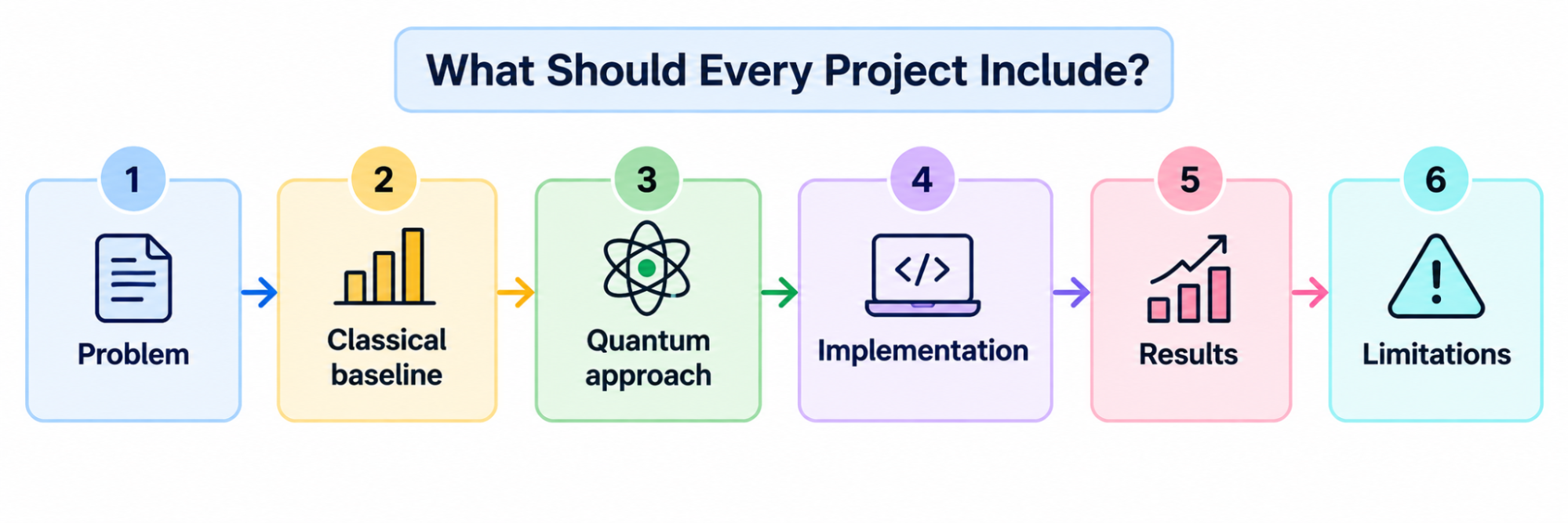
Document your reasoning, code and experimental results. Include a classical comparison wherever appropriate, and explain what your experiment demonstrates rather than claiming a quantum advantage without evidence.
What Careers Can You Pursue After Learning Quantum Computing?
Quantum skills can complement a software-engineering background and support different career directions. However, completing a roadmap alone does not guarantee employment; requirements vary by employer and role.
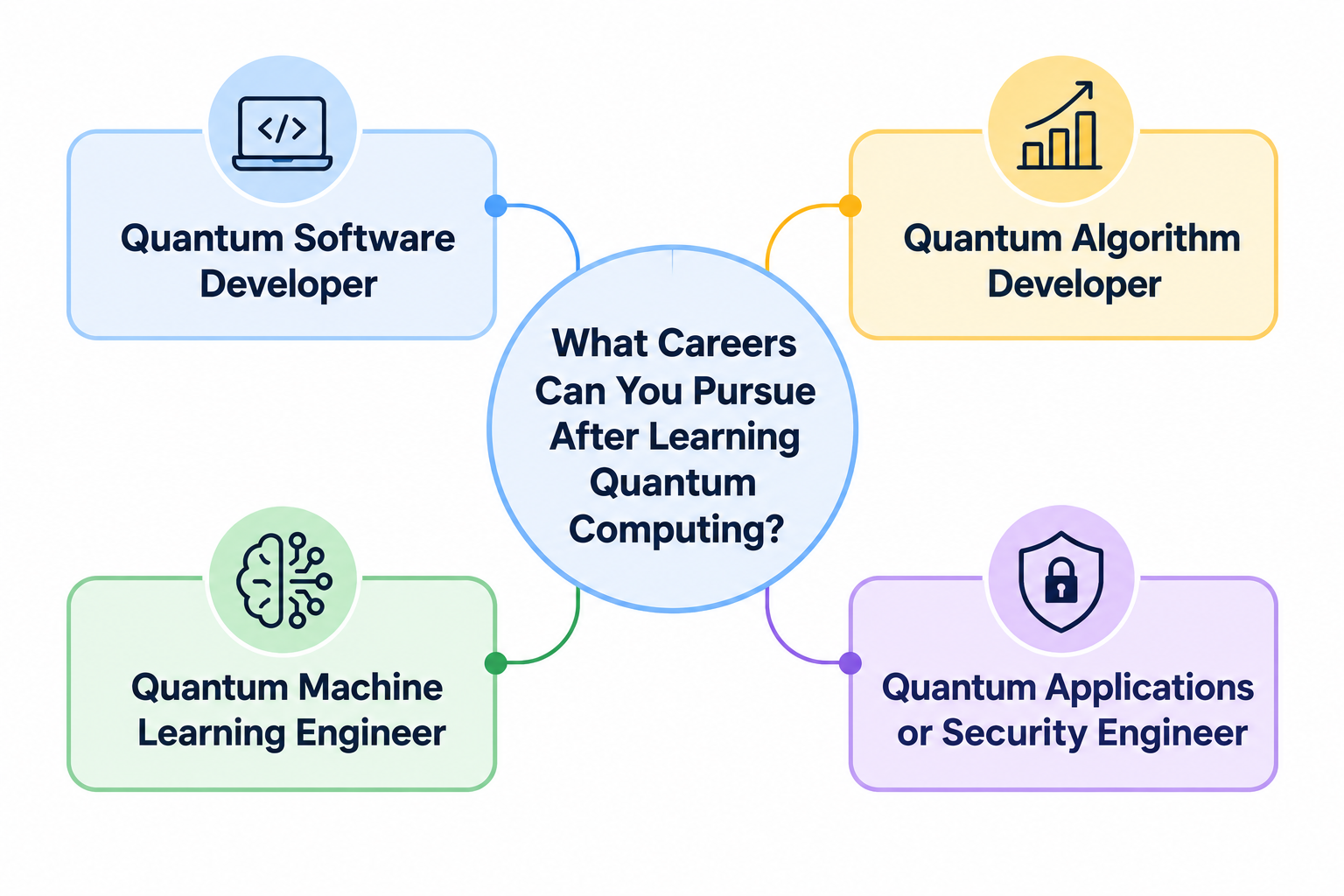
Quantum Software Developer
Focus on quantum SDKs, circuit development, transpilation, simulation and quantum cloud platforms. Strong software-engineering fundamentals and practical coding experience are important.
Quantum Algorithm Developer
This path involves implementing and analysing algorithms, understanding quantum complexity, and exploring optimisation and simulation. Some research-oriented positions may require advanced mathematical knowledge or postgraduate study.
Quantum Machine Learning Engineer
Develop skills in quantum kernels, QSVM, hybrid machine-learning models and optimisation. A solid foundation in classical machine learning is useful for evaluating quantum approaches against established methods.
Quantum Applications or Security Engineer
Possible areas include industry-specific quantum applications, quantum risk assessment, post-quantum cryptography migration and quantum key distribution. The required skills depend on whether the role focuses on application development, security engineering or research.
If you are exploring how to become a quantum developer, begin with your existing strengths and build a portfolio that demonstrates progressively more advanced work.
Where Can You Learn Quantum Computing?
The most effective approach combines structured learning, official documentation, hands-on coding and independent projects.
Structured Learning Platforms
- IBM Quantum Learning offers courses, tutorials and guided learning paths covering quantum information, circuits and algorithms.
- PennyLane Codebook provides interactive material for learning quantum computing and quantum machine learning.
- University courses and open-course materials can help deepen your mathematical and theoretical understanding.
- The IIT Delhi · Applied Quantum Computing & AI programme provides a structured route through quantum foundations, algorithms, hardware and applied quantum-AI.
Official Documentation and Tutorials
Use the Qiskit documentation, Cirq documentation and PennyLane documentation alongside your coursework. Official documentation is especially useful when implementing algorithms or troubleshooting code.
Communities and Practical Learning
Explore open-source repositories, quantum hackathons and developer communities once you are comfortable with basic circuits. Research papers and technical tutorials become more useful when you can reproduce a small experiment and evaluate its assumptions yourself.
Conclusion
A practical quantum computing roadmap helps developers move from mathematical foundations to quantum programming, algorithms, hardware, security and quantum-AI without trying to learn everything at once. Start with the fundamentals, build projects at every stage, and use classical comparisons to evaluate what your quantum implementations actually demonstrate. The goal is to develop both conceptual understanding and the ability to apply it.
Ready to take the next step? Explore the Applied Quantum Computing & AI programme by IIT Delhi, delivered on Varsity by InterviewBit, combines quantum foundations, algorithm design, Qiskit programming, real quantum systems and hands-on projects to help you build practical skills.
Frequently Asked Questions
Can I learn quantum computing without a physics degree?
Yes. You can begin with Python, linear algebra, probability and basic quantum concepts without an advanced physics background. More specialised hardware or research roles may require deeper physics knowledge.
How long does it take to learn quantum computing?
There is no universal timeline. A structured curriculum of approximately 156 hours can provide a foundation across quantum programming, algorithms, hardware, security and quantum-AI. Developing deeper expertise and a strong portfolio will take additional practice.
Should I learn Python before quantum computing?
Yes. Python is a practical starting language because major quantum programming frameworks use it extensively. Familiarity with functions, classes, NumPy and notebooks will make it easier to build and test quantum circuits.
Is Qiskit enough to learn quantum computing?
Qiskit can take you through substantial foundations and algorithm development. However, transferable quantum concepts matter more than mastering one SDK, especially if you later work with other frameworks or hardware platforms.
Should I learn Qiskit, Cirq or PennyLane first?
Start with Qiskit for general quantum programming, Cirq if you want to explore Google’s ecosystem, or PennyLane if your main interest is quantum machine learning and hybrid workflows.
Can I learn quantum computing on a normal laptop?
Yes. Local simulators let you build and test small quantum circuits on a regular computer. Cloud platforms can also provide access to real quantum hardware, subject to their availability and usage limits.
What mathematics is required for quantum computing?
Start with linear algebra, complex numbers, matrix operations and probability. You can learn more advanced mathematics as you progress into quantum algorithms, error correction and quantum machine learning.
Is quantum computing a good career for software developers?
It can be a valuable specialisation for developers interested in emerging computing technologies. Opportunities span quantum software, algorithms, applications, security and quantum-AI, although job availability and entry requirements vary.
What should I put in a quantum computing portfolio?
Include two to four progressively challenging projects. Explain the problem, your quantum approach, implementation, results, classical comparison and limitations. Clear documentation is as important as the code itself.
Can I learn quantum computing while working as a developer?
Yes. A staged roadmap allows you to learn incrementally alongside your job. Set aside consistent study time, begin with the fundamentals and progress toward algorithms, hardware, security and quantum-AI as your confidence grows.