Why Quantum Computing is the Biggest Cybersecurity Threat Yet?

Key Insights
- Quantum computers could eventually undermine widely used public-key cryptography, particularly RSA and elliptic-curve cryptography, which support secure communication, authentication and digital signatures.
- Shor’s algorithm is central to the threat because it could make problems underlying current public-key cryptography efficiently solvable on sufficiently powerful quantum computers.
- “Harvest now, decrypt later” creates a present-day risk: attackers can collect encrypted data today and potentially decrypt it once quantum capabilities become powerful enough.
- There is no confirmed Q-Day, but the uncertainty is not a reason to wait. Cryptographic migration can take years across systems, applications, vendors and infrastructure.
- Post-quantum cryptography (PQC) offers a practical migration path by replacing vulnerable cryptographic algorithms with quantum-resistant alternatives that can run on conventional infrastructure.
- Organisations should begin with a cryptographic inventory, prioritise high-risk systems and data, build crypto agility, and develop a phased PQC migration roadmap rather than waiting for a cryptographically relevant quantum computer.
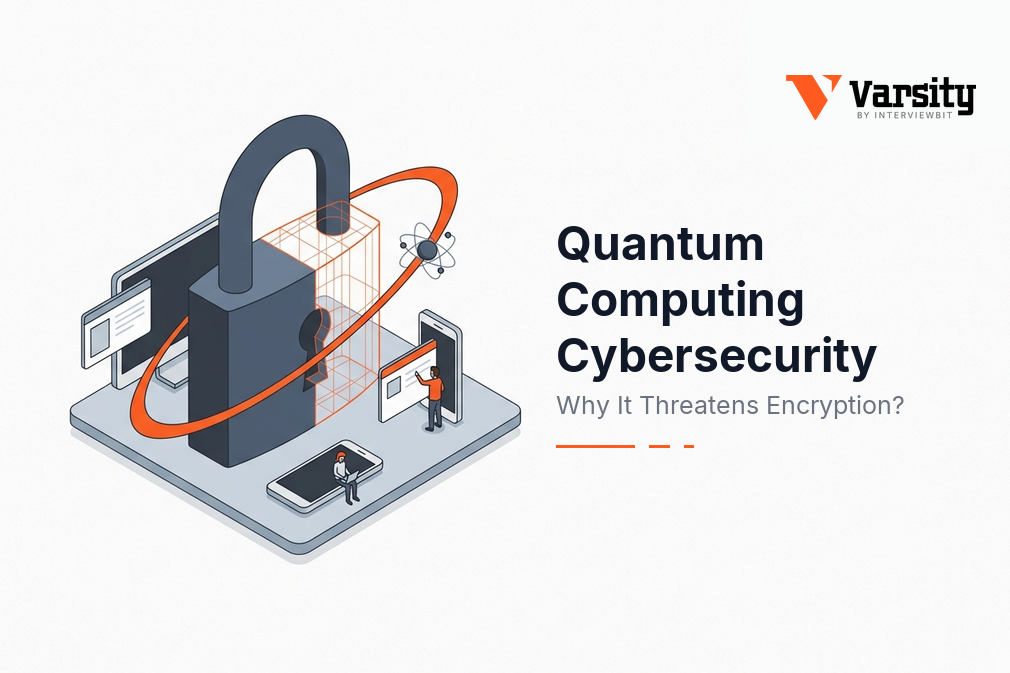
Quantum computing could change how we protect digital information. The biggest concern is that sufficiently powerful quantum computers may eventually break widely used public-key cryptography, putting systems that rely on RSA and elliptic-curve cryptography at risk. This could affect secure communication, authentication, digital signatures and key exchange.
That threat is not here yet, but preparing for it cannot wait until Q-Day. Shor’s algorithm is central to the concern, while “harvest now, decrypt later” means sensitive encrypted data could be collected today and decrypted in the future. But if a cryptographically relevant quantum computer does not exist yet, why act now? The answer is that migration takes years, and NIST has already finalized post-quantum cryptography standards for organisations to begin implementing.
Why Does Quantum Computing Threaten Today’s Encryption?
The quantum threat comes primarily from the possibility that sufficiently powerful quantum computers could solve the mathematical problems underlying widely deployed public-key cryptography. Shor’s algorithm is the key reason RSA and elliptic-curve systems are considered vulnerable.
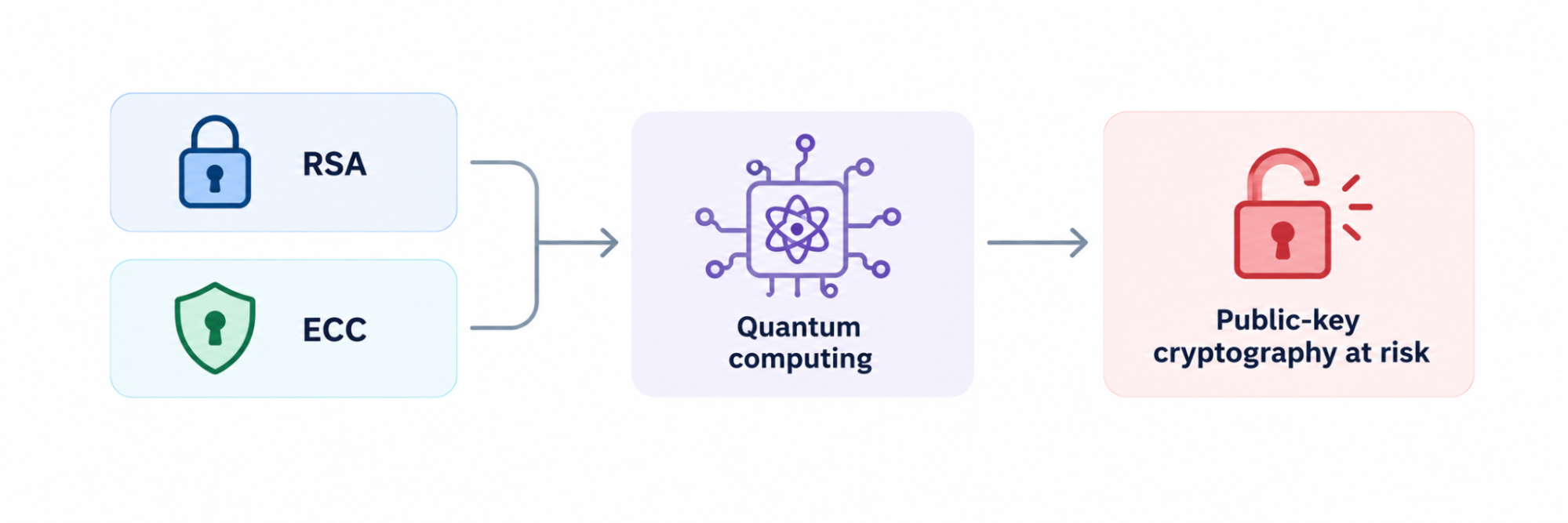
What Shor’s Algorithm Means for RSA and ECC?
RSA depends on the difficulty of factoring large integers, while elliptic-curve cryptography (ECC) depends on discrete-logarithm problems. Classical computers struggle with these problems at appropriate key sizes, but a sufficiently capable quantum computer running Shor’s algorithm could solve them much more efficiently.
This threatens systems used for key establishment and digital signatures rather than every type of encryption equally.
Which Security Systems are Most Exposed?
The most relevant enterprise dependencies include:
- Public-key encryption
- TLS and secure communications
- VPNs
- PKI and digital certificates
- Digital signatures
- Identity and authentication infrastructure
- Long-lived encrypted data
Symmetric cryptography and hash functions face different quantum risks and should not be treated as equivalent to RSA or ECC.
Why This is an Enterprise Problem, Not Just a Future Quantum Problem?
Public-key cryptography is embedded across cloud infrastructure, financial systems, healthcare records, government systems, software signing, device identity and intellectual property.
The important question is therefore not simply when a quantum computer can break encryption. It is whether information stolen today could still be valuable when that capability arrives.
What is “Harvest Now, Decrypt Later”?
“Harvest now, decrypt later” describes an attack strategy in which adversaries collect encrypted information today and retain it until a sufficiently capable quantum computer can decrypt quantum-vulnerable ciphertext.
Why Encrypted Data Can Have a Long Shelf Life?
Some information needs protection for years or decades, including government secrets, healthcare records, financial information, intellectual property and strategic research.
This creates a simple risk relationship:
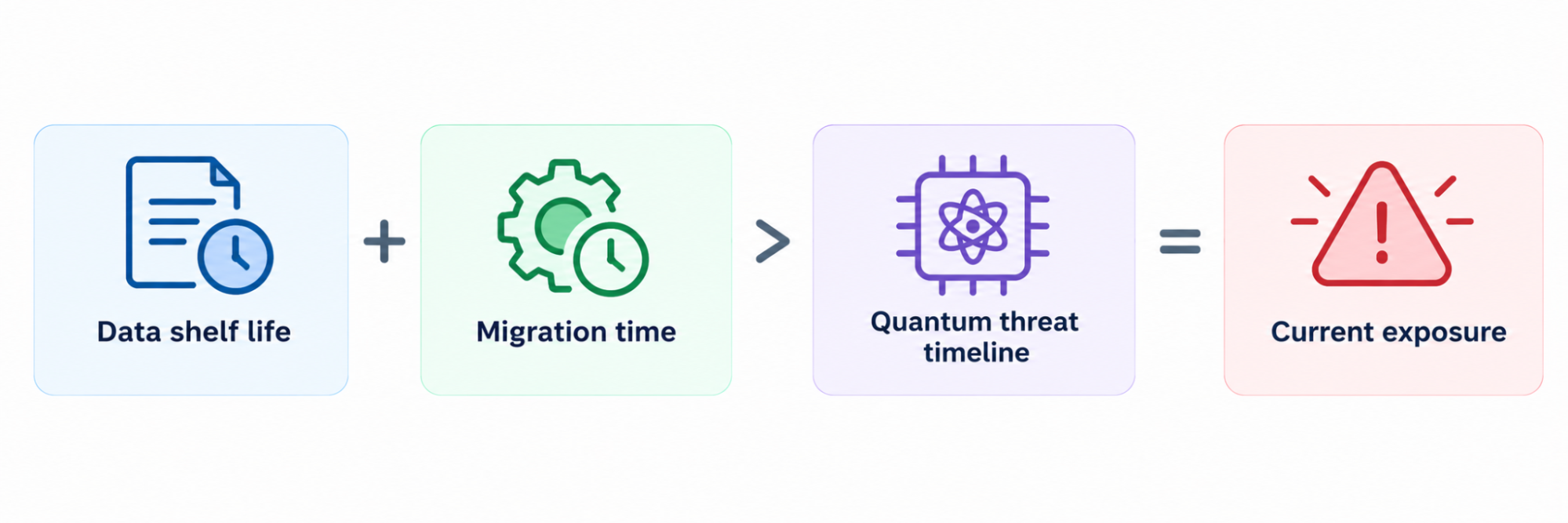
The Global Risk Institute uses these same factors – data shelf life, migration time and the estimated threat timeline – to assess the urgency of quantum-safe migration.
What Attackers Could Collect Today?
Potential targets include encrypted communications, sensitive government information, financial records, healthcare data, trade secrets and proprietary research.
The concern is not that attackers are currently decrypting this information with quantum computers. The concern is that data intercepted today may remain valuable when quantum capabilities improve.
Why “The Quantum Computer Doesn’t Exist Yet” Is Not a Sufficient Defence?
Large organisations often have legacy systems, long certificate lifecycles, third-party dependencies and hardware that cannot be replaced quickly. Cryptographic migration therefore needs to begin before the underlying threat becomes operational.
When Could Quantum Computers Break Current Encryption?
There is no agreed Q-Day date. Estimates depend on progress in hardware, error correction, logical qubits, algorithms and the resources required for cryptanalysis.
The Global Risk Institute’s 2025 expert survey of 26 experts estimated a 28-49% chance of a cryptographically relevant quantum computer within 10 years and 51-70% within 15 years. These are expert estimates, not guaranteed deadlines.
What is Q-Day?
Q-Day refers to the point at which a sufficiently capable quantum computer could threaten widely used cryptography. It is a scenario or milestone, not a scheduled event.
Why Quantum Threat Estimates Vary?
Estimates change with:
- Hardware progress
- Error correction
- Number and quality of logical qubits
- Algorithmic improvements
- Engineering scalability
- Cryptanalysis resource requirements
NIST similarly notes that nobody knows exactly when – or even if – quantum computers will become capable of threatening current encryption.
What Should Security Leaders Do With These Estimates?
The practical response is not to wait for certainty but assess exposure, plan migration and begin deployment. Uncertainty about Q-Day is a reason for risk management, not a reason to ignore the threat.
QKD vs PQC: Which Approach Protects Against Quantum Attacks?
PQC and QKD address quantum security differently. Post-quantum cryptography replaces vulnerable algorithms with quantum-resistant cryptographic algorithms that can run on conventional infrastructure. QKD uses quantum communication to establish cryptographic keys.
What is Post-Quantum Cryptography?
Post-quantum cryptography uses algorithms designed to resist attacks from both classical and quantum computers while operating on conventional systems.
NIST finalized three PQC standards in August 2024: FIPS 203 for ML-KEM, FIPS 204 for ML-DSA and FIPS 205 for SLH-DSA.
What is Quantum Key Distribution?
Quantum key distribution uses quantum states to establish or distribute cryptographic keys and can provide mechanisms for detecting certain interception attempts. However, it requires specialised communication infrastructure and is not a universal replacement for an organisation’s entire cryptographic stack.
PQC vs QKD: Key Differences
| Factor | PQC | QKD |
|---|---|---|
| Basic approach | Mathematical cryptography | Quantum communication |
| Infrastructure | Conventional systems | Specialised infrastructure |
| Primary use | Replace vulnerable cryptography | Secure key distribution |
| Deployment | Software/hardware upgrades | Dedicated communication infrastructure |
| Enterprise scalability | Broad migration | More deployment-specific |
For most organisations, PQC is the central path for transitioning existing cryptographic infrastructure. NIST describes it as a route that can work with existing communications protocols and networks.
What Should Organisations Do Now to Prepare for Quantum Cybersecurity?
Organisations should not wait for Q-Day. The practical starting point is to identify vulnerable cryptography, understand which systems contain long-lived sensitive data, establish crypto-agility and create a phased PQC migration roadmap. NIST recommends beginning migration to its finalized standards now.
Build a Cryptographic Inventory
Identify where RSA and ECC are used across:
- TLS and VPNs
- Certificates and PKI
- Digital signatures
- Applications and APIs
- Cloud services
- Hardware and embedded systems
- Third-party and vendor dependencies
You cannot migrate what you cannot find.
Prioritise Systems by Quantum Risk
Prioritise systems containing long-lived sensitive data, critical infrastructure, national-security information, high-value intellectual property and technology with long replacement cycles. Next, assess customer-facing applications and standard enterprise infrastructure.
Build Crypto-Agility Into the Architecture
Crypto-agility means being able to replace cryptographic algorithms without rebuilding the entire system. Avoid hard-coded cryptographic dependencies where practical and separate applications from cryptographic implementations so future algorithm changes are easier to manage.
NIST’s migration work specifically focuses on discovering where public-key cryptography is used and developing systematic approaches for replacing vulnerable algorithms.
Create a Phased PQC Migration Roadmap
A practical sequence is:
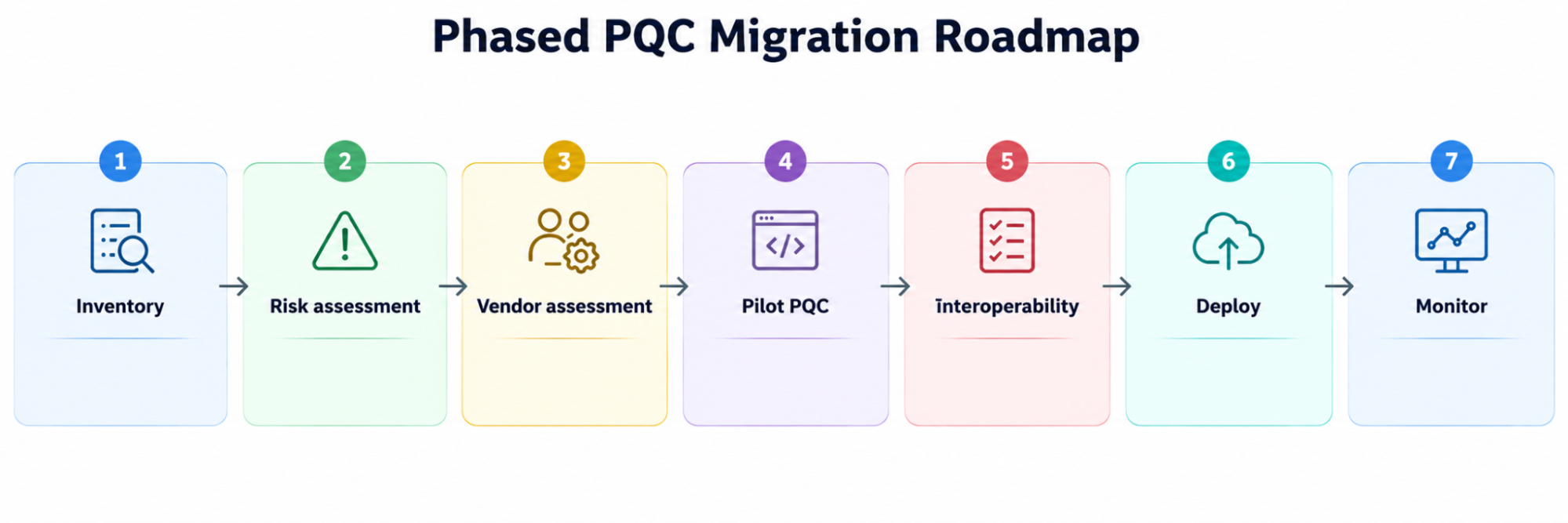
Hybrid approaches may also be appropriate during migration, depending on the system and risk profile.
What are Governments Doing About the Quantum Security Threat?
Governments are increasingly treating quantum-resistant cryptography as a cybersecurity planning issue. NIST has moved from standards development toward implementation and migration guidance.
NIST and the Global Move to Post-Quantum Cryptography
NIST finalized its first three PQC standards in 2024 and now encourages organisations to begin applying them. Its migration work also emphasises cryptographic inventory, interoperability and replacing vulnerable cryptographic dependencies.
India’s Quantum-Safe Security Strategy
India’s Department of Science and Technology, under the National Quantum Mission, has published a Quantum-Safe Ecosystem in India strategy. It sets targets for quantum resiliency across critical information infrastructure by 2029 and enterprise-wide PQC adoption by 2033. The strategy also covers crypto-agile PKI, PQC migration and QKD/PQC hybrid approaches.
Why Policy Timelines Matter to Enterprises?
These targets can influence procurement, compliance, vendor requirements, security architecture, certificate infrastructure and technology-refresh cycles.
They should be treated as policy targets and not as evidence that Q-Day will occur by a particular year.
Conclusion
Quantum security is ultimately a preparedness challenge. Organisations that understand their cryptographic exposure, plan for long-lived data and build the flexibility to adopt new security standards will be better positioned as quantum computing advances. The goal is not to predict exactly when the threat arrives, but to ensure that security infrastructure is ready when it does.
Ready to understand the technology behind this shift? The Applied Quantum Computing & AI programme by IIT Delhi, delivered on Varsity by InterviewBit, takes you beyond quantum computing fundamentals into quantum algorithms, real-world applications and hands-on projects, helping you build the skills needed to navigate the next generation of computing.
Frequently Asked Questions
Can quantum computers break passwords?
Not simply by “guessing every password.” The major concern is their ability to undermine public-key cryptography used by many authentication and secure-communication systems.
Will quantum computing make AES-256 insecure?
Quantum attacks affect symmetric cryptography differently from RSA and ECC. AES-256 is not considered to have the same level of quantum vulnerability as RSA-2048 or comparable public-key systems.
What is the difference between quantum security and post-quantum security?
Quantum security is the broader field of protecting systems in the quantum era. Post-quantum cryptography specifically refers to cryptographic methods designed to resist attacks from quantum computers.
Does HTTPS need to be replaced because of quantum computing?
No. The underlying cryptographic mechanisms used by HTTPS/TLS may need to be upgraded, particularly quantum-vulnerable public-key components.
Can blockchain survive a quantum computer attack?
It depends on the cryptographic schemes used by the blockchain, particularly its digital signatures and hashing assumptions. There is no universal answer for every blockchain.
What industries are most vulnerable to quantum cyberattacks?
Industries with valuable long-lived data and complex legacy infrastructure are particularly exposed, including finance, government, defence, healthcare, telecommunications, energy and critical infrastructure.
Is post-quantum cryptography available today?
Yes. NIST finalized FIPS 203, 204 and 205 in August 2024, and its current guidance encourages organisations to begin migration.
How long does post-quantum migration take?
There is no universal timeline. It depends on an organisation’s cryptographic inventory, legacy systems, vendor dependencies, data shelf life and testing requirements.
Should companies use QKD instead of post-quantum cryptography?
Not necessarily. QKD and PQC solve the problem differently. PQC is designed for broad migration across conventional infrastructure, while QKD requires specialised quantum communication systems.
What is the first step in preparing for a quantum cyberattack?
Start with a cryptographic inventory. Identify where vulnerable algorithms are used, prioritise systems by data sensitivity and migration difficulty, and then build a phased PQC migration plan.