Quantum Decoherence Explained: Why Qubits Fail, and How Long They Survive

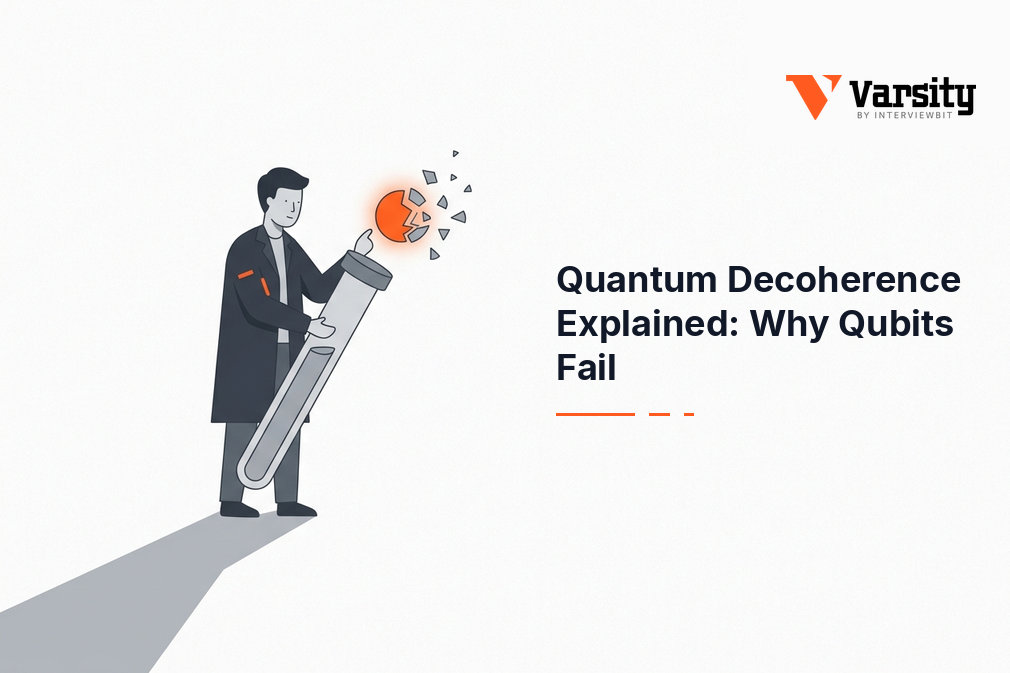
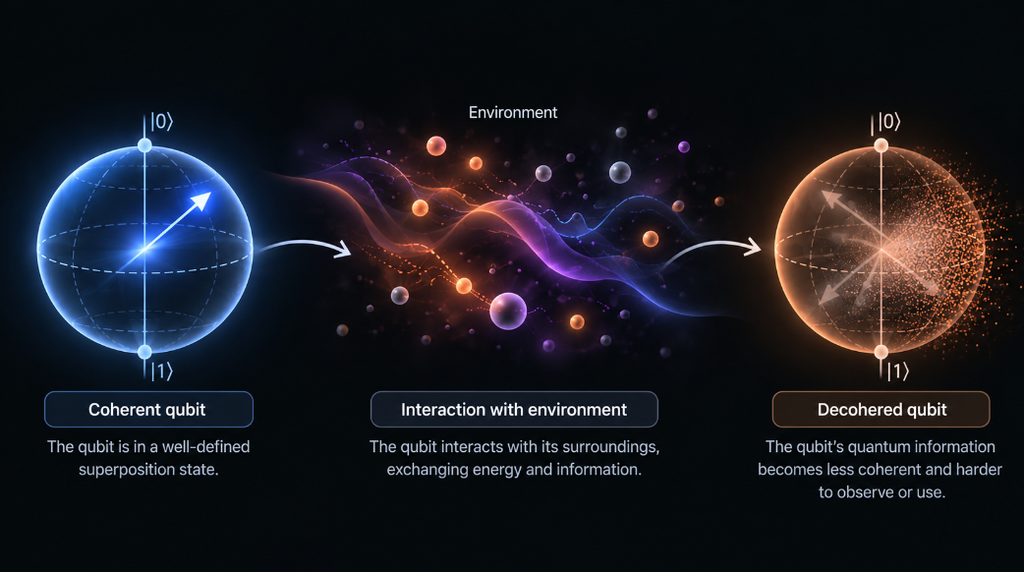
Quantum decoherence is the process by which a qubit loses its usable quantum coherence when it interacts with its environment. These interactions can disrupt the phase and energy of a qubit, limiting how long quantum information can be preserved.
In short:
- T₁ measures how quickly a qubit loses energy.
- T₂ measures how quickly it loses phase coherence.
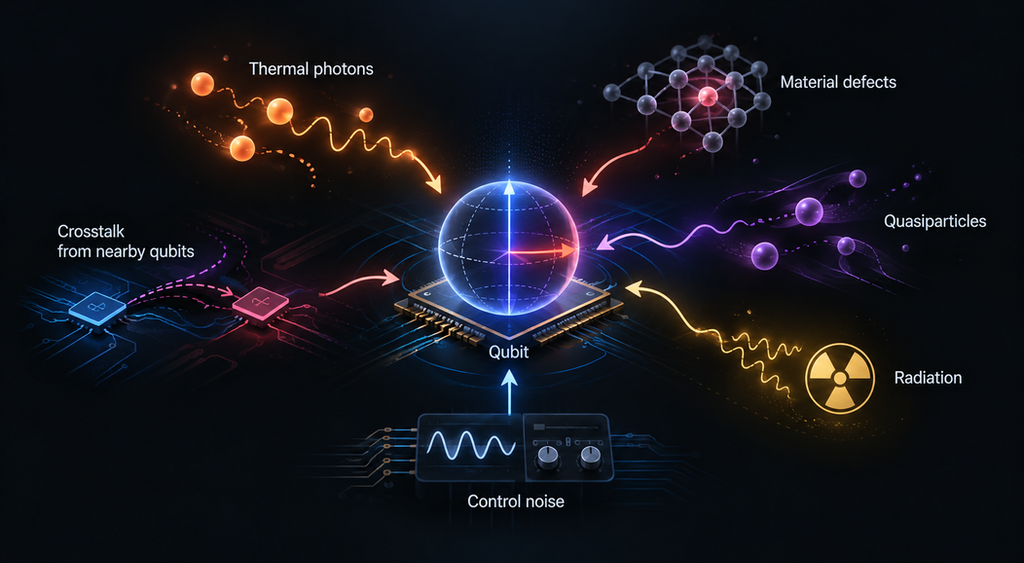
- Thermal photons, material defects, radiation, noise and crosstalk can cause decoherence.
- Coherence times vary significantly across quantum hardware.
- T₁, T₂ and T₂* are measured experimentally to determine how long a qubit remains usable.
In this guide, we’ll look at what causes qubits to lose coherence, how T₁ and T₂ differ, how long different types of qubits can remain coherent, how these times are measured, and what decoherence does and does not explain about quantum mechanics.
The Two Clocks: T₁ and T₂
T₁ measures energy relaxation, while T₂ measures the loss of phase coherence. They describe different ways a qubit can lose useful quantum information, and together they provide the most important measures of its coherence.
| Measure | What happens | Why it matters |
| T₁ | The qubit loses energy and falls toward its lower-energy state. | The qubit can end up in the wrong state. |
| T₂ | Noise disrupts the relationship between the qubit’s states. | Quantum interference becomes harder to maintain. |
| T₂* | Slow changes in the environment make that relationship drift. | It shows how strongly slow noise affects the qubit. |
T₁: Energy Relaxation
T₁ is the characteristic time over which a qubit in its excited state relaxes toward its ground state.
For a superconducting qubit, energy can escape into the surrounding electromagnetic environment. A qubit prepared in |1⟩ can therefore end up in |0⟩ without a gate intentionally causing the transition.
T₁ is commonly associated with energy relaxation or amplitude damping.
A longer T₁ means the qubit can retain its energy for longer.
T₂: Dephasing
T₂ measures how long the qubit retains the phase relationship between its quantum states.
A qubit does not need to lose energy to lose coherence. Environmental fluctuations can change the relative phase between |0⟩ and |1⟩ while leaving their populations largely intact.
That matters because quantum algorithms rely on phase to produce interference.
A qubit can therefore have a reasonably long T₁ while still suffering from a much shorter T₂.
Why T₂ Cannot Exceed 2T₁
The relationship between the two timescales is:
1/T₂ = 1/(2T₁) + 1/Tφ
where Tφ represents pure dephasing.
Therefore:
T₂ ≤ 2T₁
This is an upper bound, not a formula for estimating T₂ from T₁.
Even if pure dephasing disappeared completely, energy relaxation would still contribute to the loss of phase coherence. That places a fundamental limit on T₂ relative to T₁.
T₂* is different again. It captures additional dephasing from slowly varying or quasi-static fluctuations. A Ramsey experiment measures T₂*, while a Hahn-echo sequence can refocus some of that slow noise and produce a longer T₂.
What Causes Qubits to Lose Coherence?
Qubit decoherence comes from several physical mechanisms, and the dominant cause depends on the hardware platform. In superconducting systems, thermal photons, material defects, quasiparticles, radiation, control noise and crosstalk are important sources.
| Cause | What happens | Main effect |
| Thermal photons | Unwanted energy reaches the qubit. | T₁ / T₂ |
| Material defects | Tiny defects interact with the qubit. | Mainly T₁ |
| Quasiparticles and radiation | Unwanted excitations disturb the circuit. | T₁ / T₂ |
| Control noise | Changes in electrical or magnetic signals disturb the qubit. | Mainly T₂ |
| Crosstalk | A nearby qubit operation affects another qubit. | T₁ / T₂ |
Thermal Photons and Stray Energy
Superconducting qubits operate inside dilution refrigerators at temperatures close to absolute zero.
The reason is not simply to make the hardware cold. Their energy scales are small enough that unwanted thermal photons can disturb the system.
A stray thermal photon at a relevant frequency can excite a qubit or contribute to unwanted energy exchange. Cooling and filtering therefore help reduce thermal contributions to decoherence.
Two-Level-System Defects
Two-level-system (TLS) defects are microscopic defects in materials or at interfaces that can behave as their own quantum systems.
A superconducting qubit interacting with a defect can lose energy to it, particularly when the defect and qubit become strongly coupled.
TLS defects are one reason two physically similar qubits can exhibit different coherence times. Fabrication, interfaces and microscopic material imperfections all matter.
Quasiparticles and Radiation
Superconducting circuits can be affected by quasiparticles, excitations associated with broken Cooper pairs.
Ionising radiation can generate these excitations. Vepsäläinen et al. reported in a 2020 Nature study that naturally occurring ionising radiation can limit superconducting-qubit coherence and that radiation shielding can reduce its impact.
Cosmic rays can also produce bursts that affect several qubits.
McEwen et al. reported in Nature Physics in 2021 that cosmic-ray events can produce catastrophic error bursts across large superconducting-qubit arrays.
This matters because correlated errors are more difficult for error-correction systems to handle than isolated errors.
Control Noise and Crosstalk
Not every failure begins with radiation or a material defect.
Quantum processors depend on carefully controlled electromagnetic signals. Fluctuations in magnetic flux, charge or other control parameters can shift a qubit’s frequency and disturb its phase.
Crosstalk occurs when an operation intended for one qubit unintentionally affects another.
This is also where the distinction between decoherence and gate error becomes less clean in practical hardware. An imperfect control pulse is a gate error, while environmental fluctuations can cause decoherence. Real devices can experience both at the same time.
Different Hardware Has Different Failure Modes
The mechanisms above are not universal across quantum platforms.
Superconducting qubits are particularly affected by material defects, quasiparticles and electromagnetic environments.
Trapped-ion systems have different dominant challenges, including magnetic-field fluctuations, laser noise and heating of the ions’ motion.
The hardware determines what the environment looks like and therefore what engineers need to control.
How Long Does a Qubit Survive?
There is no universal qubit lifetime. Coherence varies by hardware platform, device design, fabrication, environment and whether the measurement is T₁, T₂ or T₂*. Current systems span very different timescales, from microseconds in some implementations to seconds or longer in others.
| Hardware | Published coherence example | What it shows |
| Superconducting qubits | T₂ up to 245 μs in a 2024 study | Coherence can reach hundreds of microseconds, but varies across devices. (Nature) |
| Trapped-ion qubits | Coherence of about 5,500 s reported for a single ion qubit | Carefully isolated ion qubits can maintain coherence for very long periods. (Nature) |
| Neutral-atom qubits | T₂ of 12.6 s demonstrated in a 2025 tweezer array | Atomic qubits can maintain coherence for seconds under controlled conditions. (Nature) |
| Silicon spin qubits | Hahn-echo T₂ up to 1.9 ms in a 2025 study | Silicon spin qubits can reach millisecond-scale phase coherence, with performance varying by design. (Nature) |
These figures should not be treated as a simple ranking because the studies use different hardware, operating conditions and measurement methods.
A trapped-ion qubit can retain coherence much longer than a superconducting qubit, but its operations are also generally slower. A superconducting processor may compensate for shorter coherence with much faster gates.
That makes the more useful engineering question:
How many useful operations can be performed before decoherence becomes a serious limitation?
Coherence Time vs Gate Time
Suppose a processor has a coherence time measured in hundreds of microseconds. That number means little without knowing how quickly its gates operate.
If individual gates take only a small fraction of that time, many operations can fit within the coherence window.
This is why coherence time-to-gate time ratio is more informative for circuit execution than coherence time alone.
A longer coherence time is valuable, but it has to be considered alongside gate speed, gate fidelity, connectivity and measurement performance.
How Are T₁ and T₂ Measured?
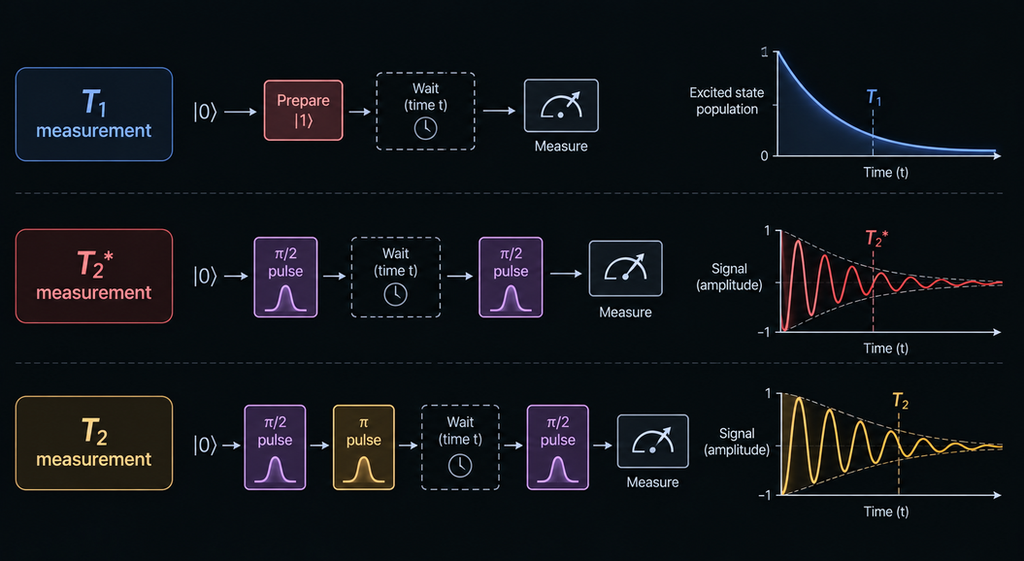
Coherence times are measured experimentally by preparing a qubit, allowing it to evolve for controlled intervals, and observing how its state changes. T₁ uses population decay, while T₂ and T₂* use interference and phase-sensitive experiments.
Alt text: Diagram showing the experimental steps used to measure T₁, T₂, and T₂* in a qubit
Measuring T₁
The basic experiment is:
- Prepare the qubit in |1⟩.
- Wait for a chosen amount of time.
- Measure the qubit.
- Repeat the experiment many times.
- Fit the decay of the excited-state population.
The resulting exponential decay gives the characteristic T₁ time.
The experiment is simple in principle. The difficult part is ensuring that the measured decay reflects the physical mechanism being studied rather than an experimental artefact.
Measuring T₂: Ramsey and Hahn Echo
T₂ involves phase rather than simply population.
A Ramsey experiment typically applies a π/2 pulse, waits for a controlled period, applies another π/2 pulse and measures the result.
The resulting oscillations decay as phase coherence is lost.
A Ramsey measurement gives T₂* because it is sensitive to slow frequency fluctuations and other inhomogeneous effects.
A Hahn-echo experiment adds a π pulse halfway through the waiting period.
That pulse refocuses certain slow fluctuations, allowing some accumulated phase errors to cancel. The resulting coherence time is generally longer than T₂*.
The idea also leads directly to dynamical decoupling, where carefully timed control pulses are used to suppress selected environmental noise during computation.
What Can Be Done About Decoherence?
Decoherence cannot be eliminated completely, so engineers reduce its sources and make quantum computations less vulnerable to them. The main approaches involve improving materials, controlling the environment, using pulse sequences and mitigating the effects of noise.
| Approach | Purpose |
| Better materials and fabrication | Reduce microscopic defects and unwanted losses |
| Cooling and shielding | Suppress thermal excitations and radiation-related effects |
| Dynamical decoupling | Refocus selected forms of environmental noise |
| Error mitigation | Reduce the impact of noise on computational results through techniques such as zero-noise extrapolation |
These approaches are mitigation, not error correction.
Mitigation attempts to obtain a more useful result from a noisy computation.
Error correction uses additional physical resources to detect and correct errors affecting encoded quantum information.
Where Does Error Correction Pick Up?
Error correction deals with the errors that remain after physical improvements and mitigation. Instead of requiring every physical qubit to remain perfectly coherent, quantum error correction distributes information across multiple physical qubits and uses redundancy to detect and correct certain errors.
A central idea is the threshold. Below a sufficiently low physical error rate, increasing the amount of error-correction overhead can make the resulting logical qubit more reliable.
The physical origin of errors still matters.
For example, cosmic-ray events can affect several qubits simultaneously. These correlated errors are more challenging than independent errors because many error-correction schemes are designed around assumptions about the statistical structure of noise.
The details of syndrome measurements, stabilisers, surface codes and decoders belong to quantum error correction itself. They are outside the scope of this page.
Does Decoherence Explain the Measurement Problem?
Not by itself. Decoherence explains why quantum interference becomes inaccessible and why certain classical-looking states are more stable, but it does not select one measurement outcome.
This distinction is important.
When a quantum system interacts with its environment, some states become more robust against that interaction than others. Wojciech Zurek described this process as environment-induced superselection, or einselection.
The relatively stable states are called pointer states.
This helps explain why macroscopic objects do not normally display easily observable interference between radically different states. The environment continually interacts with them, rapidly suppressing observable coherence between alternatives.
But decoherence does not simply announce:
“This is the outcome.”
Instead, it turns a coherent quantum description into something that, for an observer without access to the environment, behaves like a classical mixture.
The question of why one particular outcome is experienced remains interpretational.
This is why decoherence is not wavefunction collapse and should not be described as a complete solution to the measurement problem.
For quantum computing, the connection is useful because the same environmental interaction appears at two scales: it limits the coherence of a qubit in a processor, while at macroscopic scales it helps explain why the classical world does not visibly behave like a giant quantum superposition.
Conclusion: The Real Challenge Is Controlling Coherence
Quantum decoherence is ultimately a problem of control. A qubit cannot be perfectly separated from its surroundings because the same hardware that protects quantum information must also control, connect and measure it.
That makes coherence time more than a number on a specification sheet. T₁ and T₂ reveal how a physical qubit interacts with its environment, while the causes of decoherence show engineers where those unwanted interactions come from. The practical question is then not simply how long a qubit survives, but how much reliable computation can be performed before that coherence is lost.
This is also why there is no single solution to decoherence. Better materials, colder environments, shielding, pulse sequences and error-correction techniques address different parts of the problem. The path toward useful quantum computing is therefore less about creating a perfectly isolated qubit and more about learning how to keep quantum information under control while the computation is taking place.
If you want to study quantum computing beyond individual concepts, the Certification in Applied Quantum Computing and AI from IIT Delhi offers a longer-form learning path through the field.
Frequently Asked Questions
Does decoherence happen while a qubit is idle?
Yes. A qubit can lose coherence even when no gate is being applied. Environmental interactions continue during idle periods, which can gradually affect the quantum state.
Can decoherence be reversed?
Some effects can be partially reversed. Techniques such as spin echo and dynamical decoupling can refocus certain types of phase noise, particularly slower fluctuations. Once information has become strongly entangled with an uncontrolled environment, however, full recovery is generally difficult.
Is decoherence the same as noise?
Not exactly. Noise is a broad term for unwanted disturbances in a quantum system. Decoherence specifically refers to the loss of quantum coherence caused by interactions with the environment. Some errors in a quantum processor, such as imperfect control pulses, are not necessarily decoherence.
Is decoherence the same as dissipation?
No. Dissipation involves the transfer of energy from the quantum system to its surroundings. Decoherence is broader and refers to the loss of phase relationships that make quantum interference possible. A system can experience dephasing without significant energy loss.
Does cooling completely prevent decoherence?
No. Cooling reduces thermal excitations, but it does not eliminate every source of unwanted interaction. Quantum processors can still be affected by material defects, electromagnetic fluctuations, radiation, control signals and other sources of noise.
Why do quantum computers need to be isolated from the environment?
Isolation reduces unwanted interactions that can carry information about a qubit into its surroundings. In practice, however, complete isolation is impossible because the processor must still be controlled, coupled to other qubits and measured.
Where does the information go during decoherence?
It becomes correlated with the environment. The quantum information is not necessarily destroyed at the level of the complete system, but it becomes spread across the qubit and its surroundings, making the original coherence inaccessible when the environment is not controlled.
Why does decoherence make the quantum world look classical?
Environmental interactions suppress observable interference between certain quantum states. As those interference effects become inaccessible, the system can behave like a classical statistical mixture to an observer who does not control the environment.
Can large objects experience quantum decoherence?
Yes. Decoherence is not limited to qubits. Larger systems interact with vastly more environmental degrees of freedom, so their observable quantum coherence can disappear extremely quickly. This is one reason everyday objects appear classical even though their underlying physics is quantum mechanical.
Can decoherence affect multiple qubits at the same time?
Yes. Some environmental events can affect several qubits together. Radiation events, for example, can produce correlated disturbances across a quantum processor rather than affecting only one qubit independently. This matters because correlated errors can violate assumptions used by some error-correction schemes.
Why can two identical-looking quantum processors have different decoherence rates?
Small differences in fabrication, materials, interfaces, shielding, control electronics and local environmental conditions can change how strongly qubits interact with unwanted noise. As a result, nominally similar devices can show different measured coherence.
Does decoherence affect quantum algorithms directly?
Yes. Quantum algorithms depend on controlled interference and phase relationships. When environmental interactions reduce that coherence, the interference patterns the algorithm relies on become less reliable, which can reduce the quality of the final result.
Is decoherence only a problem in quantum computing?
No. It is also important in quantum sensing, quantum communication and foundational studies of how classical behaviour emerges from quantum systems. In each case, the central issue is how interactions with the environment affect quantum coherence.
Does decoherence prove that wavefunction collapse is real?
No. Decoherence explains the suppression of observable interference and the emergence of stable, classical-looking states, but it does not by itself explain why a particular measurement outcome occurs. The distinction remains important in interpretations of quantum mechanics.