Quantum Key Distribution: Securing the AI Era When Classical Encryption Falls

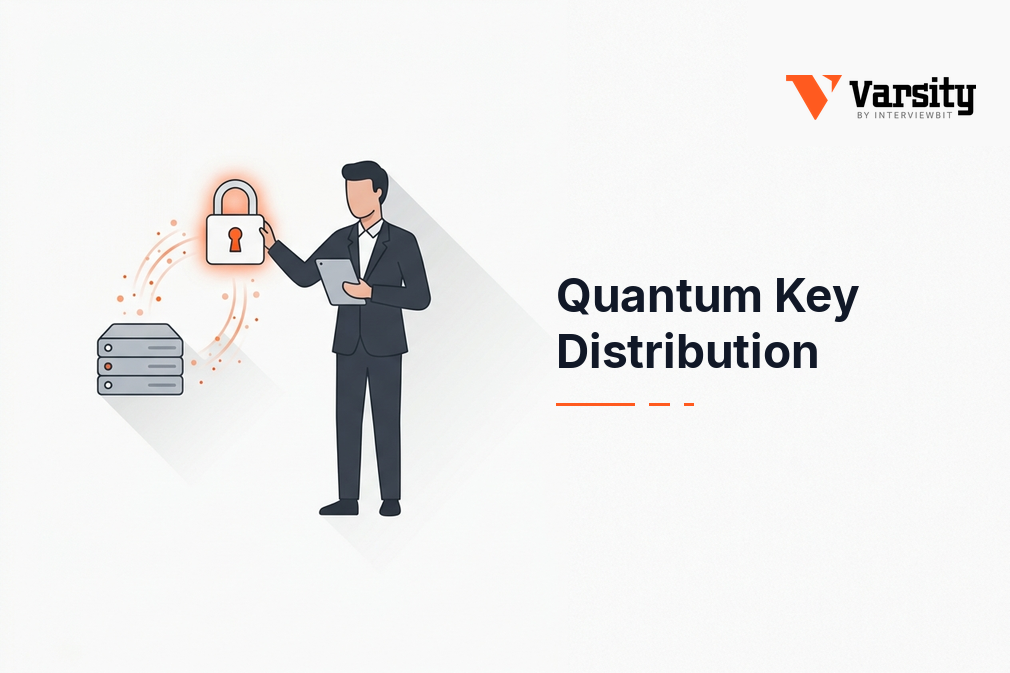
Quantum key distribution (QKD) is a method of sharing a secret encryption key between two parties using individual particles of light, where the laws of physics, not the difficulty of a maths problem make an undetected eavesdropper impossible. Intercepting the key measurably disturbs it, revealing the eavesdropper.
One thing trips up almost everyone at first: QKD distributes the key, it doesn’t encrypt your message. The data is still encrypted with ordinary symmetric encryption, using the key QKD delivered.
Why encryption needs rethinking at all
Most encryption protecting the internet today – RSA, ECC, TLS relies on maths problems hard for classical computers to solve. A capable quantum computer would change that see [Internal link: Quantum Computing Basics] for what today’s machines can do.
What a quantum computer would do to RSA and ECC
RSA and ECC rely on maths problems factoring large numbers (RSA), certain elliptic-curve problems (ECC) that take classical computers an impractical amount of time. Shor’s algorithm, a quantum algorithm, solves both efficiently on a large enough quantum computer, so the maths keeping your banking and messaging apps secure stops being hard once such a machine exists.
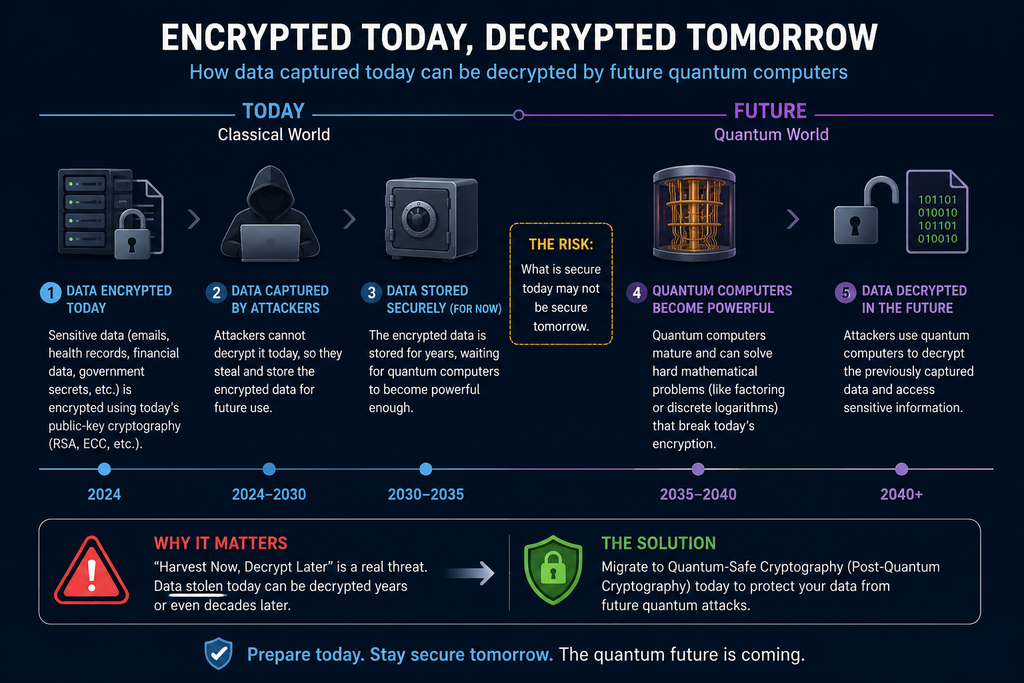
“Harvest now, decrypt later”
This is why any of this matters today, not in some distant future. An attacker can capture encrypted traffic now and store it, waiting rather than breaking it immediately if a large-scale quantum computer arrives years later, that stored traffic becomes readable retroactively.
This matters most for information that has to stay secret for years medical records, state and diplomatic communications, legal and financial archives, long-lived trade secrets. If any of that is encrypted with RSA or ECC and captured today, it’s already exposed to a future decryption event, even though nothing has been “broken” yet.
How close is the threat, honestly?
Be wary of anyone giving a precise year. Estimates of when a quantum computer capable of breaking RSA-2048 will exist vary widely, and no machine near that scale exists today.
How quantum key distribution works: BB84 step by step
BB84, published by Charles Bennett and Gilles Brassard in 1984, is the original and still most widely explained QKD protocol. Here’s how it works, with no equations.
The idea in one line
Measuring a quantum state changes it. If someone measures the photons carrying your key in transit, that act leaves detectable fingerprints.
Sending the photons
The sender (“Alice”) encodes each bit onto a single photon’s polarisation the orientation of its oscillation randomly choosing one of two “bases” for each photon. Picture a basis as two orientations of a polarising filter, like sunglasses lenses rotated relative to each other; a simplification, but enough to follow the rest.
The receiver (“Bob”) doesn’t know which basis Alice used, so he also picks one at random for each photon he measures guessing right sometimes, wrong other times.
Comparing notes (sifting)
Once all photons are sent and measured, Alice and Bob talk over an ordinary public channel, comparing which basis each used never revealing the actual bit values, only the basis. Matching bases keep the bit; mismatches are discarded. In this simplified BB84, roughly half the transmitted bits survive the sifted key.
Catching the eavesdropper
Alice and Bob compare a small, random sample of the surviving bits out loud. If nobody was listening, these should match almost perfectly. An eavesdropper’s measurement disturbs some photons, showing up as an unexpectedly high error rate. Low error → the key is likely uncompromised, and they keep the remaining, unrevealed bits as their shared secret. High error → they assume interception, discard the batch, and start over.
Why you can’t just copy a photon
Why can’t an eavesdropper just copy the photon and pass the original along undisturbed? The no-cloning theorem rules this out a law of quantum mechanics stating it’s impossible to copy an unknown quantum state without disturbing the original. Unlike a digital file, which copies endlessly, a quantum state can’t be duplicated which is what makes eavesdropping detectable instead of silent.
What “information-theoretic security” actually promises
You’ll see QKD described as “information-theoretically secure” narrower than it sounds.
What it does mean: the security of the key exchange rests on the laws of physics, not a maths problem that’s merely hard to solve. Unlike RSA or ECC, more computing power quantum or classical doesn’t help an attacker break a properly implemented QKD exchange.
implemented QKD exchange.
What it does not mean: QKD doesn’t secure your servers, software, employees, endpoints, or key management. It secures one thing agreeing a key between two points and nothing else in your system.
Real QKD hardware isn’t automatically flawless, either researchers have published genuine side-channel attacks against commercial devices, exploiting imperfections in detectors and lasers rather than the underlying theory. “Unhackable” is marketing language, not fact treat any claim using that word with suspicion.
QKD vs post-quantum cryptography : which one will you actually use?
QKD and post-quantum cryptography (PQC) both respond to the quantum threat, but aren’t interchangeable and vendor pages calling them simply “complementary” often dodge the question readers actually want answered.
| Factor | QKD | Post-Quantum Cryptography |
| What it is | A physical method for exchanging a key using quantum states | A set of classical algorithms designed to resist quantum attacks |
| Security basis | Laws of physics (no-cloning, measurement disturbance) | Mathematical problems believed hard for both classical and quantum computers |
| Hardware required | Specialised photon sources, detectors, dedicated fibre or line-of-sight | Runs on existing computers; software update only |
| Distance limitations | Hard limits from signal loss over fibre or air | None , works over any network that supports normal internet traffic |
| Existing internet compatibility | No , needs dedicated infrastructure, doesn’t route over the standard internet | Yes , designed to slot into existing protocols like TLS |
| Cost | High – specialised optical hardware and point-to-point links | Low – largely a software and protocol migration |
| Standardisation | No single global standard yet; ETSI has an active QKD working group | NIST finalised its first standards (FIPS 203, 204, 205) in August 2024 |
| Realistic adopters | Governments, defence, select finance/critical-infrastructure links | Almost every organisation with digital infrastructure |
For the overwhelming majority of organisations, the realistic answer is post-quantum cryptography. It’s primarily a software transition. NIST has already finalised ML-KEM (FIPS 203), ML-DSA (FIPS 204), and SLH-DSA (FIPS 205) as production-ready standards, and PQC works over connections you already have. QKD, by contrast, needs dedicated fibre or a satellite link, has hard distance limits, and doesn’t replace the cryptography securing ordinary web traffic.
This isn’t purely a commercial opinion: the UK’s National Cyber Security Centre states plainly it doesn’t support QKD for government or military use and considers PQC the primary mitigation, while continuing to fund QKD research a position QKD vendors dispute, a genuine live disagreement rather than settled fact.
None of this makes QKD pointless. It may suit specific high-security, point-to-point links two government data centres a known, fixed distance apart, say where dedicated infrastructure is justified by the traffic’s sensitivity. That’s a narrow use case, not a replacement for wider internet security.
Where QKD is actually deployed today
Fibre networks and the distance problem
Quantum signals can’t be amplified the way classical ones can. A fibre repeater reads a signal and re-emits a fresh copy but that requires measuring it, and measuring a quantum state disturbs it. So QKD faces a hard ceiling on how far a single link can travel before photon loss makes the exchange unreliable. Treat any specific kilometre figure quoted online with caution unless it’s sourced to a vendor or peer-reviewed paper.
Trusted nodes, and the compromise they involve
One way around the distance limit is chaining shorter QKD links through intermediate “trusted nodes” that decrypt and re-encrypt the key as it passes through. This works, but at a cost: every node must be trusted, since the key briefly exists outside quantum protection there a network is only as secure as its weakest node, undercutting QKD’s promise of physics-based security alone.
Satellite QKD
Satellites sidestep the fibre distance problem by sending photons through open air or near-vacuum, where they lose energy more slowly over long distances. China’s Micius satellite is the best-known large-scale example, and it’s the model India’s own programme is working toward.
Quantum key distribution in India
India doesn’t yet have a commercial QKD network, but its research institutions have run several credible, government-verified demonstrations.
ISRO’s free-space QKD demonstration
ISRO has published its own account of a free-space QKD demonstration at its Space Applications Centre (SAC) in Ahmedabad, between two line-of-sight buildings 300 metres apart. The experiment used an indigenous NavIC receiver for timing synchronisation and gimbal-based optical alignment instead of large telescopes, and included live videoconferencing over quantum-key-encrypted signals , a step ISRO describes toward Satellite Based Quantum Communication (SBQC) between Indian ground stations.
DRDO, DST and the National Quantum Mission
DRDO has run its own demonstrations, separate from ISRO’s: a December 2020 QKD trial between two DRDO labs in Hyderabad (DRDL and RCI) over more than 12 km of fibre, and a February 2022 link with IIT Delhi over commercial-grade fibre between Prayagraj and Vindhyachal, Uttar Pradesh more than 100 km apart, at sifted key rates up to 10 kHz.
The National Quantum Mission (NQM), approved by the Union Cabinet in April 2023 with an outlay of ₹6,003.65 crore through 2030–31, funds quantum communication as one of four thematic areas. DST has set up a Thematic Hub for Quantum Communication at IIT Madras with C-DoT New Delhi, ISRO, and IIT Delhi. NQM’s published deliverables include satellite-based quantum communication between Indian ground stations over ranges up to 2,000 km targets, not completed deployments.
Indian companies and institutes working on QKD
Verifiable QKD work in India sits inside government and academic institutions rather than commercial products ISRO’s SAC, DRDO’s CAIR (Bengaluru) and DYSL-QT (Mumbai) labs, and the DRDO-IIT Delhi Centre of Excellence. NQM has begun supporting quantum-technology startups, though it hasn’t published which work specifically on QKD.
Should you learn quantum cryptography?
There’s a real difference between learning about quantum cryptography and building a career specifically inside QKD.
QKD-specific roles in India are currently limited and mostly research-oriented inside ISRO, DRDO, IITs, IISc, or a handful of specialised groups, typically expecting a physics or EE postgraduate background. That’s a narrow path.
The broader, more transferable skill set is different: cryptography fundamentals, network security, applied maths especially the algebra behind lattice-based PQC and basic quantum information concepts. These are employable today in security engineering regardless of whether QKD ever goes mainstream. [Internal link: Grover’s Algorithm] and its effect on symmetric cryptography will serve far more careers than QKD specifically; for the physics side, [Internal link: Quantum Gates Explained] covers how single qubits are manipulated.
Build the quantum skills that go beyond QKD
If you want to move beyond understanding quantum concepts and build practical skills across quantum computing, AI/ML and quantum-safe cybersecurity, the
IIT Delhi Continuing Education Programme’s Certification in Applied Quantum Computing and AI offers a structured path.
Over 6.5 months and 156 learning hours, the programme combines live and recorded learning with hands-on quantum labs, multiple capstones and a portfolio-grade final project. The curriculum includes quantum algorithms, Qiskit, quantum hardware, QKD, post-quantum cryptography and quantum-AI applications.
Frequently asked questions
What is quantum key distribution in simple terms?
It’s a way of sharing a secret encryption key using single photons of light, where any attempt to eavesdrop disturbs the photons and leaves a detectable trace. QKD only distributes the key , the actual message is still encrypted separately, using ordinary symmetric encryption once the key is agreed.
Is QKD the same as post-quantum cryptography?
No. QKD is a hardware-based method of exchanging keys using quantum physics; PQC is a set of classical algorithms resisting quantum attacks, run entirely in software. For almost every organisation, PQC is the one you’ll deploy, since it works over existing internet infrastructure.
Is quantum key distribution unbreakable?
The key exchange itself is provably secure under the theory, based on physical laws rather than computational difficulty. Real QKD hardware, however, has had genuine side-channel attacks published against it, exploiting equipment imperfections rather than the underlying theory. “Unhackable” overstates what’s actually been demonstrated.
What is the BB84 protocol?
BB84 is the original QKD protocol, published in 1984. The sender encodes bits on photons using randomly chosen orientations; the receiver measures each photon with a randomly chosen orientation of their own; both publicly compare which orientations they used (not the bit values) and discard mismatches; then they check a sample of the rest for signs of eavesdropping.
Why can’t a quantum key be copied?
The no-cloning theorem, a fundamental rule of quantum mechanics, states that an arbitrary unknown quantum state cannot be perfectly copied. Unlike a digital file, a photon’s quantum state can’t be duplicated without disturbing the original, which is exactly what makes eavesdropping on QKD detectable rather than silent.
How far can QKD signals travel?
Distance is limited by signal loss in fibre or air, since quantum signals can’t be amplified the way ordinary optical signals can. Trusted nodes extend a network’s reach by chaining links, but each node then has to be trusted, a real security trade-off, not a free extension.
Is QKD used in India?
Yes, in verified demonstrations rather than commercial deployment. ISRO has demonstrated free-space QKD over 300 metres in Ahmedabad, and DRDO has demonstrated QKD over fibre, including a link spanning more than 100 km between two Uttar Pradesh cities in 2022. India’s National Quantum Mission funds further work in this area.
Do I need quantum physics to work in cryptography?
For most security and cryptography engineering roles, no, cryptography fundamentals, network security, and applied mathematics are the more directly useful skills, and PQC is implemented entirely in software. Quantum physics knowledge becomes necessary specifically if you want to work on QKD hardware or research.