Quantum Teleportation: What It Actually Is (and Isn’t)

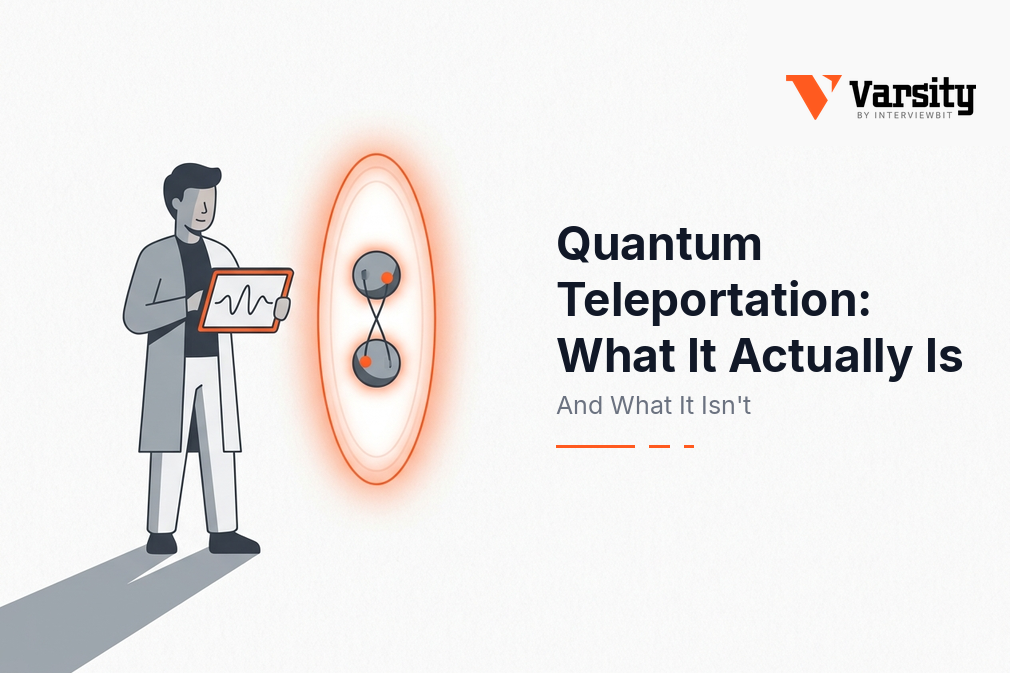
Quantum teleportation is one of the most misunderstood terms in science. It sounds like Star Trek, but it has nothing to do with beaming people or objects anywhere.
Quantum teleportation is a real, experimentally proven technique for transferring quantum information not matter from one particle to another. It’s been demonstrated since 1997, over satellites, and now over ordinary telecom fiber. Here’s what it actually is, how it works, and where the technology stands today.
What is quantum teleportation, in simple terms?
Quantum teleportation transfers the quantum state of one particle onto another particle, without the original particle physically moving anywhere.
Think of a qubit (a quantum bit) as holding a fragile, unmeasurable piece of information like a spinning coin that shows a different result depending on how you look at it. Quantum teleportation recreates that exact spinning coin somewhere else, using entanglement plus an ordinary message.
Key distinction:
- What’s transferred: the quantum state , the information a particle carries
- What’s not transferred: the particle itself, or any physical matter
A rough analogy: faxing a document. The paper never travels only the pattern of ink gets reconstructed on different paper at the other end. Quantum teleportation is similar, except the copying process is far stranger and more limited than a fax (more on that below).
How does quantum teleportation actually work?
This is the core mechanism, and it only takes four steps. Two people are traditionally used to describe it: Alice, who has the unknown quantum state, and Bob, who ends up with it.
Alice and Bob share an entangled pair
Before anything else, Alice and Bob each hold one particle from an entangled pair. Entangled particles are correlated in a special quantum way measuring one instantly tells you something about the other, regardless of distance.
This pair is created and distributed in advance. It’s the shared resource teleportation depends on later.
Alice measures her qubit with the unknown state
Alice has a third particle the one whose unknown state she wants to send to Bob. She performs a joint measurement, called a Bell-state measurement, on this particle together with her half of the entangled pair.
The measurement is destructive: it scrambles Alice’s original qubit and her half of the pair, but the result reveals how the two states are related.
The measurement produces 2 classical bits, sent to Bob
Alice’s measurement has four possible outcomes, written as ordinary 2 classical bits (00, 01, 10, or 11). She sends this small message to Bob over email, fiber, radio, anything.
This step is non-negotiable. Without these 2 bits, Bob’s particle is just noise. It’s the step people usually forget, and the reason teleportation can’t be instant.
Bob applies a fix his qubit becomes the original state
When Bob receives the bits, he applies one of four simple corrections to his half of the entangled pair.
Once applied, Bob’s particle carries the exact quantum state Alice’s original particle had. The state moved. The particle never did.
The four-step flow, visually:
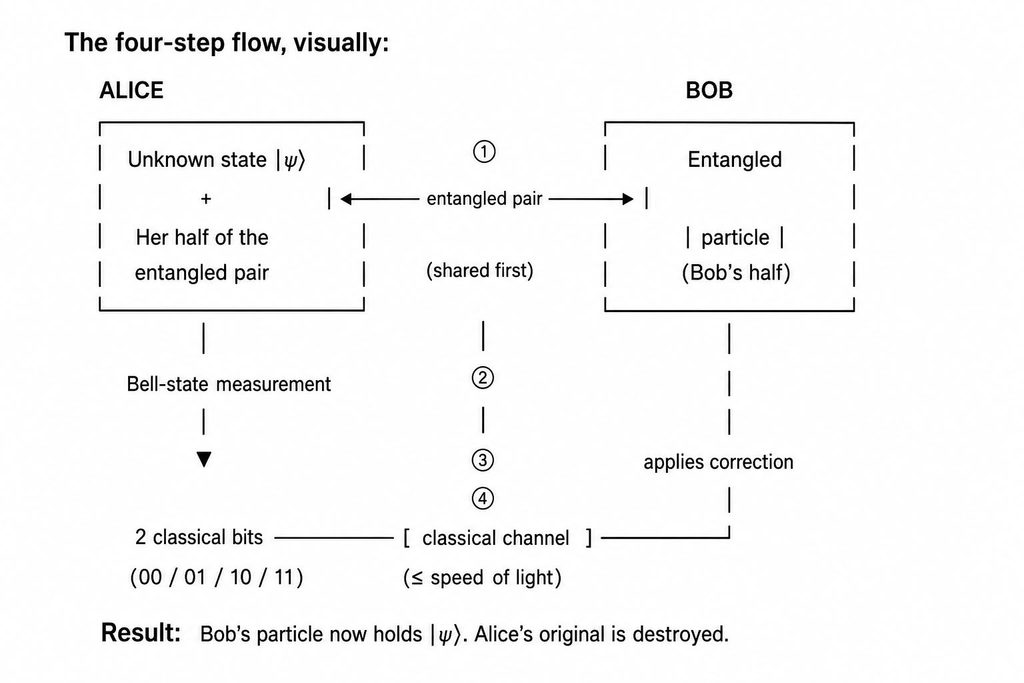
Two separate channels do two separate jobs here: the entangled pair (quantum channel) and the 2-bit message (classical channel). Neither works alone , that’s the point of the next section.
Why does quantum teleportation need entanglement?
Entanglement is necessary, but it’s not magic, and not a communication channel by itself. This is worth being blunt about, since it’s the most common myth in pop-science coverage of this topic.
- Entanglement creates correlations between two particles’ measurement outcomes.
- Entanglement alone transmits zero usable information. If Bob only looks at his particle without Alice’s classical bits, he sees pure randomness nothing decodable.
- The classical 2-bit message is mandatory. Only by combining his particle with Alice’s message can Bob reconstruct the state.
- The classical channel is limited by the speed of light. That message has to physically travel, so teleportation is bound by the same speed limit as any other signal.
Entangled particles do not “talk instantly” to each other in any way that carries a message. That phrase misrepresents the physics.
Does quantum teleportation move matter?
No. Not the particle, not any atoms, not any physical stuff.
- What moves: the quantum state the information describing the particle’s properties.
- What doesn’t move: the particle itself. Bob’s particle was already in his lab before the protocol started; only its state changes.
Alice’s original particle isn’t sent anywhere — it’s altered by her own measurement. Nothing physical crosses the distance except the entangled photons (sent earlier) and the classical bits.
Is quantum teleportation faster than light?
Quantum teleportation cannot transmit information faster than light, full stop. Bob can’t do anything useful with his particle until he receives Alice’s 2 classical bits, and that message travels through an ordinary channel, capped at the speed of light.
Entanglement itself doesn’t carry a signal, so there’s no shortcut. The classical channel is the bottleneck. Any headline claiming otherwise is describing the entanglement correlation, not an actual usable message.
What happens to the original state and what’s the no-cloning theorem?
When Alice performs her Bell-state measurement, her original qubit’s state is destroyed measurement collapses it. It isn’t preserved and copied to Bob; it’s consumed in extracting the classical bits.
This matters because of the no-cloning theorem, a foundational rule of quantum mechanics:
No-cloning theorem: It is impossible to create an independent, identical copy of an arbitrary unknown quantum state.
That’s very different from classical information, where you can copy a file endlessly without touching the original.
Does teleportation break this rule? No. At no point do two identical copies of the state exist simultaneously. Alice’s version disappears the instant Bob’s version is created. Teleportation moves the state; it doesn’t clone it.
Quantum teleportation vs. science-fiction teleportation
| Feature | Quantum Teleportation | Science-Fiction Teleportation |
| What it does | Transfers the quantum state or information of a particle | Imagines transporting an entire object or person from one location to another |
| How it works | Uses pre-shared quantum entanglement between two parties | Usually does not specify a scientifically established physical mechanism |
| Communication | Requires a classical communication channel to transmit measurement results | Often depicted as instantaneous, without requiring a communication channel |
| What actually moves | Quantum information; matter itself does not travel between locations | The fictional concept involves matter being transported, disassembled, or reconstructed |
| Scientific evidence | Experimentally demonstrated at the quantum scale | Has never been experimentally demonstrated and is not supported by known physics |
| Speed | Cannot be used to transmit information faster than light | Often portrayed as instantaneous or faster than light |
| Primary purpose | Quantum communication, quantum networking, and transferring quantum states | Instant travel or transportation of people and objects |
The key difference: Quantum teleportation does not teleport physical matter. It transfers information about a quantum state, while science-fiction teleportation imagines moving the actual object or person.
Quantum Networks – future Quantum Internet in Quantum Computing
A quantum internet would let distant quantum devices share quantum states directly, enabling inherently eavesdropper-detectable communication and distributed quantum sensing. Teleportation is the basic operation such a network would run on, since it moves quantum states between nodes without shipping particles the whole distance.
Linking separate quantum computers
Large-scale quantum computing may eventually require connecting many smaller processors into one bigger effective machine. Teleportation-based links are among the leading approaches being studied to move quantum information between separate quantum computing modules.
What’s real today vs. still research in quantum teleportation:
| Real Today | Still Research / Future |
| Lab demonstrations of quantum teleportation across various platforms, including photons, ions, and atoms | A large-scale, general-purpose quantum internet |
| Quantum-state transfer over controlled experimental links, including live fiber | Seamless networking of many large-scale quantum computers |
| Active research into quantum networking protocols | Practical long-distance, fault-tolerant quantum teleportation at scale |
| Experimental point-to-point quantum communication links, including satellite and metro-fiber trials | Commercial, always-on quantum network services |
Important: These achievements represent experimental demonstrations and field trials, not deployed infrastructure. A global, fault-tolerant quantum network and commercial quantum-network services remain areas of active research.
Has Quantum Teleportation Actually Been Demonstrated?
Yes , repeatedly, across very different physical systems, for nearly three decades.
| Year | Milestone |
| 1997 | First experimental demonstration, by Anton Zeilinger’s group in Innsbruck (plus a related Rome-based demonstration), teleporting a photon’s polarization state over a lab bench. |
| 2004 | NIST (Colorado) and the University of Innsbruck independently teleported states between trapped ions, moving teleportation from photons to matter-based qubits. |
| 2012 | Teleportation across 143 km of open air between the Canary Islands of La Palma and Tenerife , a distance matching a realistic ground-to-satellite link. |
| 2017 | China’s Micius satellite achieved ground-to-satellite teleportation of single-photon qubits at distances up to roughly 1,400 km , the first teleportation from Earth to orbit. |
| 2026 | Northwestern researchers, building on a 2024 lab demo of teleportation coexisting with live internet traffic, distributed entangled photons over a 24.4 km commercial telecom link (Evanston–Chicago) at over 94% fidelity, alongside heavy classical data traffic. Full teleportation over that same live network is their stated next step, not yet completed. NIST has separately developed control protocols for entanglement distribution over fiber links exceeding 100 km. |
Worth being precise here: the headline 2026 result was entanglement surviving on a busy, real-world commercial fiber line not a new teleportation record. Full teleportation over that kind of live metro fiber was demonstrated separately in a controlled 2024 lab setup, and running it end-to-end over an actual live city network is the researchers’ stated next step, not a completed result as of this writing.
Current limitations
- Requires pre-shared entanglement : the pair must be generated and distributed before teleportation can happen.
- Entanglement is fragile : it degrades quickly through decoherence, especially over long distances.
- A classical channel is always required : no way around sending the 2 bits, which caps speed and adds infrastructure needs.
- Measurement and hardware are imperfect : real Bell-state measurements and detectors introduce errors and loss.
- Fidelity drops over longer chains : stringing together multiple links compounds errors.
- Scaling remains genuinely hard : going from single-qubit demos to many-qubit, always-on networks is an unsolved engineering problem.
FAQs
What is quantum teleportation in simple terms?
It’s a method for transferring a particle’s quantum state onto another particle at a different location, without moving the original particle. It requires a pre-shared entangled pair plus an ordinary message carrying 2 classical bits. Nothing physical actually travels between the two points.
Does it move matter like sci-fi teleportation?
No. Only information about a quantum state moves; the particle receiving that state was already at the destination beforehand. Sci-fi teleportation imagines disassembling and rebuilding physical matter instantly, which has no basis in how quantum teleportation works or in known physics.
What’s the no-cloning theorem?
It states an arbitrary unknown quantum state can’t be perfectly copied while the original still exists. Teleportation doesn’t break this: Alice’s original state is destroyed by her measurement before Bob’s particle takes on that state, so only one copy ever exists.
Has quantum teleportation been demonstrated, or is it still theoretical?
Demonstrated repeatedly since 1997: first with photons in Innsbruck, then trapped ions in 2004, 143 km between the Canary Islands in 2012, a satellite over roughly 1,400 km in 2017, and live commercial telecom fiber in 2024–2026 experiments. It’s real, replicated, experimental science not a hypothetical.
What’s quantum teleportation used for today?
Almost entirely research: lab demonstrations, quantum-networking experiments, and field trials over fiber and satellites. There is no live, general-purpose quantum internet today. Secure networking and linking separate quantum computers remain research goals, not deployed services.