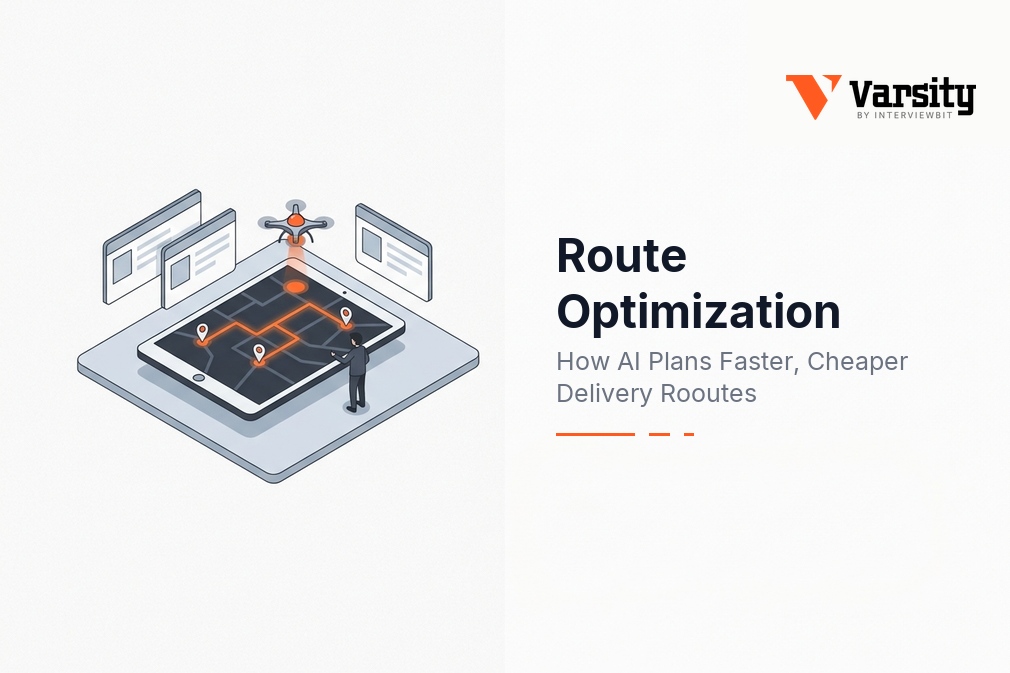
Route Optimization: How AI Plans Faster, Cheaper Delivery Routes

Key Insights
- Route optimization plans the whole fleet, not one trip. It decides which vehicle serves which stops, in what order and by which roads, while balancing distance, travel time, cost, vehicle capacity and delivery windows.
- The shortest route is rarely the best plan. A slightly longer route can win if it avoids congestion, meets a delivery window or saves the cost of dispatching another vehicle.
- The process follows a clear sequence. Systems collect data, define constraints, generate feasible routes, select the best plan, assign vehicles and drivers, then monitor and recalculate routes during delivery.
- AI predicts, and optimization decides. Machine learning forecasts travel times, traffic delays, demand and disruptions. Optimization algorithms then choose the plan within the business’s rules.
- Real-time recalculation keeps plans usable. Heavy traffic, vehicle breakdowns, changed delivery times, new orders and road closures can trigger updates sent straight to drivers.
- Several technologies work together. GPS and telematics, machine learning, optimization algorithms, mapping and traffic data, and cloud systems each supply part of every routing decision.
- Driver rules shape every route. Plans must respect working-hour limits and breaks. In the US, property-carrying drivers must take a 30-minute break after 8 cumulative hours of driving.
- Savings come from removing waste. Fewer miles, less idling, fewer empty miles and fewer vehicles lower costs and emissions. US vehicles burn more than 6 billion gallons of fuel a year while idling.
- Results depend on data quality. Wrong addresses, inaccurate GPS data, outdated traffic information or incorrect vehicle details can produce routes that fail in practice.
- Human oversight stays essential. Dispatchers and drivers handle exceptions the system cannot see, such as site access problems, customer requests or local road knowledge.
- Start small and measure. Pilot in one depot, then compare total distance, cost per delivery, on-time delivery rate, vehicle utilization and fuel consumption against current operations.
Route optimization is the process of finding the most efficient routes for delivery vehicles. It weighs distance, travel time, cost, vehicle capacity and delivery requirements together. The result is a plan that decides which vehicle serves which stops, in what order and by which roads.
- Not just the shortest path: It balances competing constraints, so the best plan is often not the shortest one.
- Fleet-wide: It assigns and sequences stops across every vehicle, not one route at a time.
- Inputs: Addresses, delivery windows, vehicle capacity, driver hours and traffic data.
- Objectives: Fewer miles, less travel time, lower fuel use and fewer vehicles.
This guide explains how route optimization works, how AI plans and adjusts delivery routes, and the technologies behind it. It also covers benefits, practical examples, limitations and implementation.
How AI Plans Faster, Cheaper Delivery Routes
AI route optimization uses machine learning, real-time data and optimization algorithms to recommend delivery routes and adjust them as conditions change. Machine learning forecasts conditions, while optimization algorithms choose the plan.
Static plans are built once and often break when the day changes. The table below shows what AI adds where plans usually fail.
| Planning element | Static route planning | AI route optimization |
|---|---|---|
| Traffic | Assumes average speeds | Uses predicted and live conditions |
| Delivery windows | Checked manually | Built into stop sequencing |
| Vehicle capacity | Left to planner judgment | Enforced as a hard limit |
| New orders | Wait for the next plan | Inserted into active routes |
How does Route Optimization Work?
Route optimization turns orders, vehicles and road data into a delivery plan through a repeatable sequence. Each step narrows a huge set of possible routes to one workable plan.
Collect Data → Define Constraints → Generate Routes → Optimize → Assign Vehicles → Monitor → Recalculate
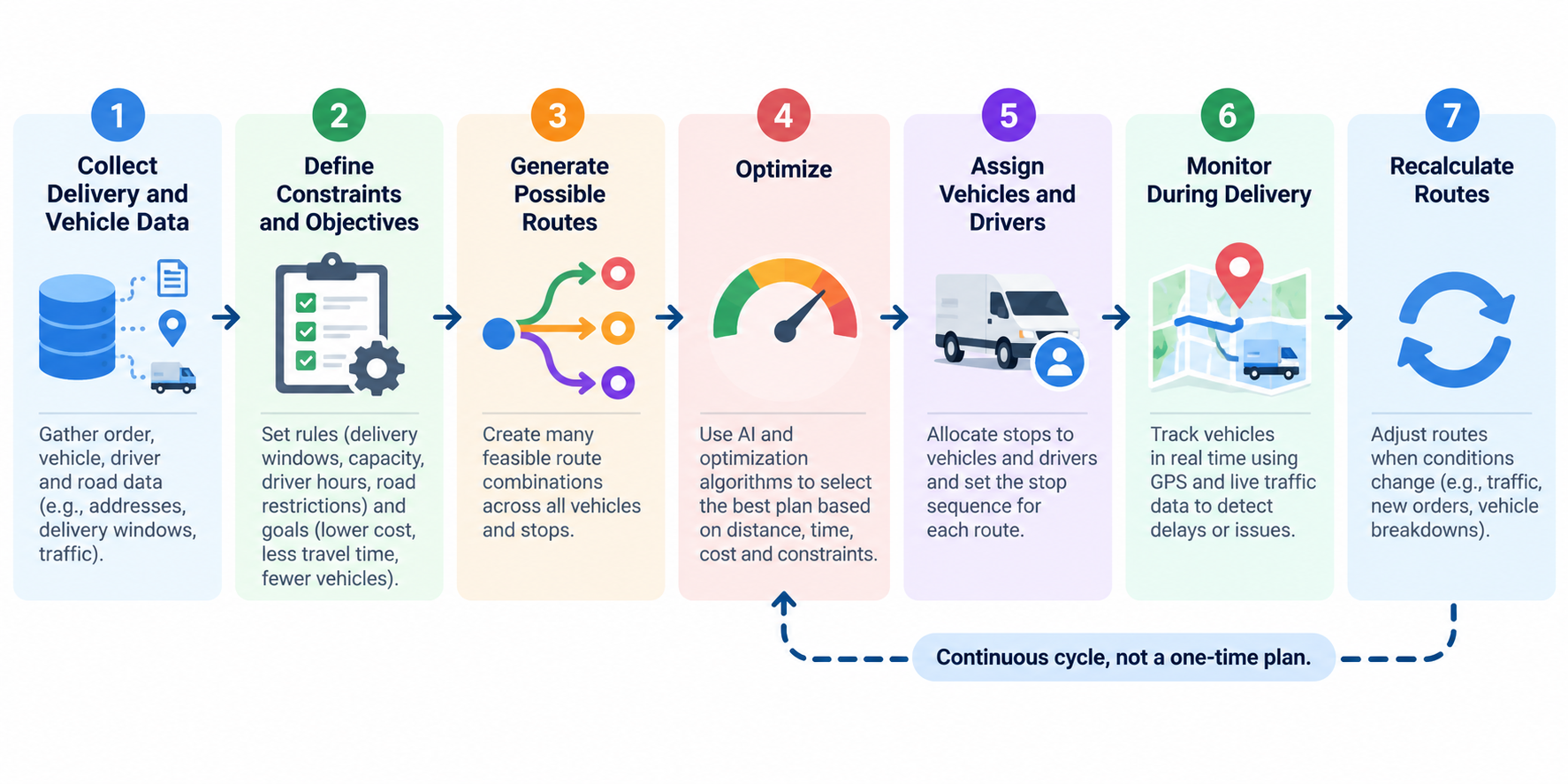
1. Collect Delivery and Vehicle Data
Every routing decision depends on its inputs. Before planning anything, the system gathers order, fleet and road data such as:
- Delivery locations and customer addresses
- Delivery windows
- Vehicle locations and capacity
- Driver availability
- Historical travel times and traffic information
2. Define Routes, Constraints and Objectives
Constraints are rules every route must obey. Objectives define what the system should minimize when several plans satisfy those rules.
- Constraints: Delivery deadlines, vehicle capacity, driver working hours, road restrictions, priority shipments, and pickup and delivery requirements.
- Objectives: Distance, travel time, fuel consumption, transportation cost or number of vehicles.
3. Generate Possible Routes
The system combines vehicles, stops, stop sequences and roads into candidate plans. It keeps only feasible plans that complete every required delivery without breaking a constraint.
The search grows fast: ten stops on one van can already be ordered in more than 3.6 million ways.
4. Select the Best Route Plan
Optimization algorithms score each feasible plan against the defined objectives and constraints. A plan that saves distance but misses a delivery window is rejected, and the best-scoring valid plan is selected.
5. Assign Vehicles and Drivers
The selected plan becomes concrete work for each vehicle and driver. It specifies:
- Which vehicle serves which stops
- The sequence of deliveries
- Driver assignments
- Expected arrival times
6. Monitor and Recalculate During Delivery
A plan starts going stale once vehicles leave the depot. Real-time data lets the system re-plan affected routes when:
- Traffic increases
- A vehicle breaks down
- A customer changes a delivery time
- A new delivery is added
- A road becomes unavailable
Key point: Route optimization is not simply finding the shortest route. It finds the best feasible route plan across multiple vehicles, stops and constraints.
How does AI Optimize Delivery Routes?
AI makes route optimization predictive rather than purely rule-based. Machine learning estimates upcoming conditions, and the optimization engine uses those estimates to select and update routes.
AI Uses Historical and Real-Time Data
AI models learn from past deliveries and combine them with live feeds. The most useful data includes:
- Historical traffic patterns and current traffic conditions
- Delivery history and travel times
- Customer demand
- Vehicle performance
AI Predicts Travel and Delivery Conditions
Predictive models turn that data into forecasts of travel times, traffic delays, delivery demand and potential disruptions. A route through a business district at 5 p.m., for example, gets a longer predicted travel time than the same route at 10 a.m.
AI Evaluates Multiple Route Options
AI-supported optimization compares many route combinations to balance cost, speed, distance, capacity and service levels. Predictions improve the inputs, but the optimization algorithm still makes the final trade-off within the business’s rules.
AI Adjusts Routes in Real Time
When conditions change mid-shift, the system runs a short loop instead of rebuilding the whole day’s plan:
Traffic changes → System detects disruption → AI evaluates alternatives → Route is updated → Driver receives new instructions
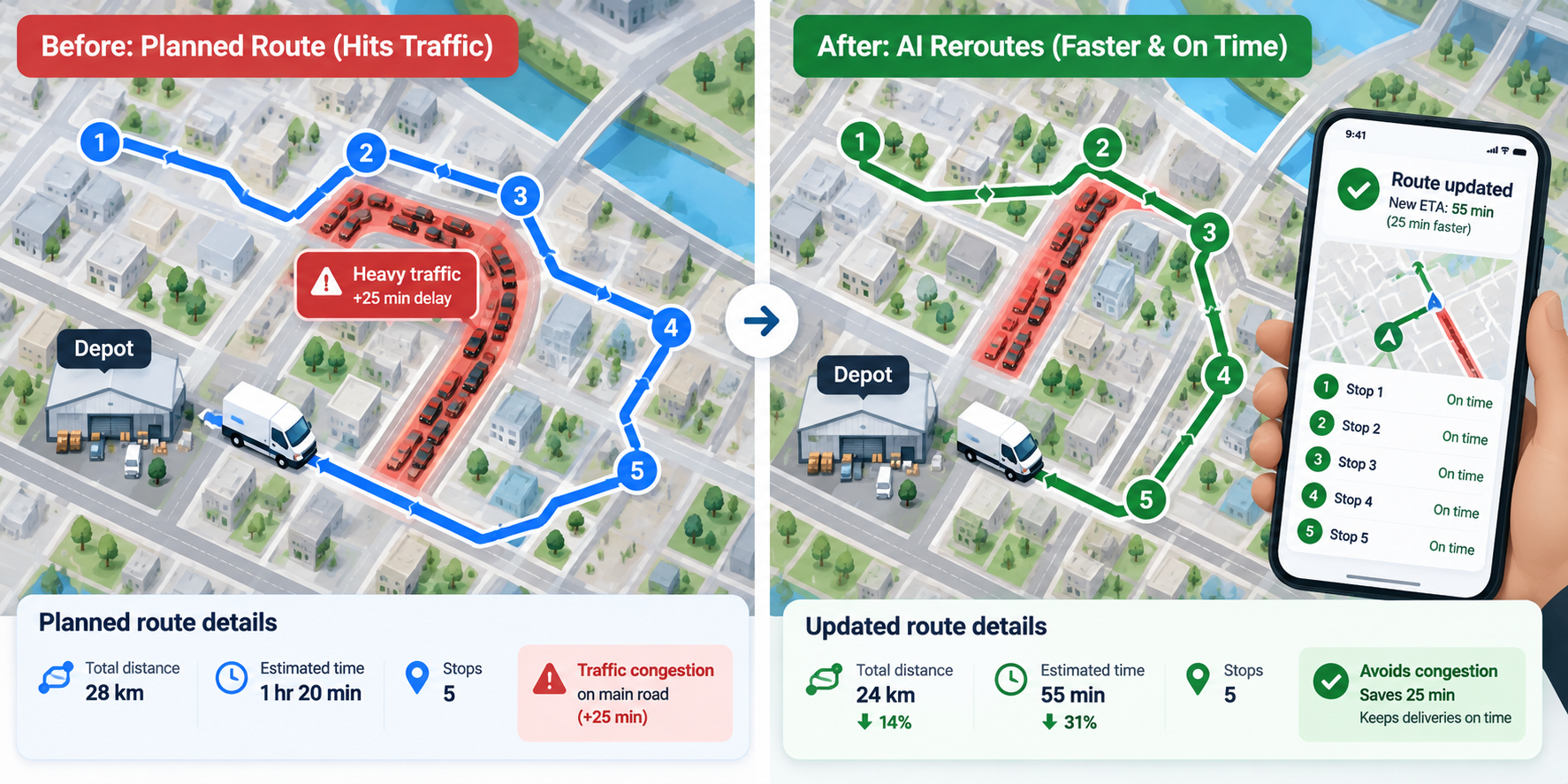
Key point: AI makes route optimization more dynamic by letting routing systems learn from data, predict conditions and adapt to changing circumstances.
What Technologies Are Used in AI Route Optimization?
AI route optimization relies on a connected technology stack rather than one tool. Each layer supplies data, predictions or decisions the routing engine needs.
GPS and Telematics
GPS and telematics devices report what each vehicle is doing on the road. They supply vehicle location, speed, travel history and performance data such as fuel use and engine idling.
AI and Machine Learning
Machine learning identifies patterns in travel times, traffic, delivery performance and demand. For example, it can learn that stops at a large office complex take longer because of security check-in.
Optimization Algorithms
Optimization algorithms produce the actual route plan. The table below summarizes what each approach helps solve, without the underlying math.
| Approach | What it helps solve |
|---|---|
| Vehicle Routing Problem (VRP) optimization | Assigning stops to several vehicles and ordering them at the lowest cost |
| Constraint optimization | Keeping plans within capacity, time windows and driver hours |
| Mathematical optimization | Modeling costs and limits as equations a solver works through systematically |
| Heuristic and metaheuristic approaches | Finding high-quality plans quickly when checking every option is impractical |
Large problems are usually solved within a time limit. Google OR-Tools documentation describes metaheuristics, such as guided local search, that keep improving a plan until that limit is reached.
Mapping and Traffic Data
Mapping platforms and traffic feeds describe the road network that routes run on. They provide road networks, distances, travel times, congestion levels and road restrictions such as height or weight limits.
Cloud and Real-Time Data Systems
Cloud platforms keep everyone working from the same live plan. They connect drivers, vehicles, dispatch teams, customers and routing software, so a route change reaches the driver’s app and updates customer ETAs.
What Factors Does AI Consider When Planning Delivery Routes?
AI route planning is more complex than finding the shortest path because factors interact. Changing one stop can affect capacity, timing and driver hours across a whole route.
Distance and Travel Time
The shortest route is not always the fastest. The system weighs route length against expected travel time, so a slightly longer ring road may beat a congested shortcut.
Traffic and Road Conditions
Road conditions change travel times throughout the day. Planning accounts for congestion, accidents, road closures, construction and weather-related disruptions.
Vehicle Capacity and Restrictions
Every vehicle has physical and legal limits that decide which stops it can serve. Plans consider vehicle capacity, vehicle type, weight restrictions, road restrictions and fuel range.
Delivery Time Windows
Customers often specify when they can receive goods. AI sequences stops so each falls inside its window, even if a nearby stop must wait until later in the route.
Driver Availability and Working Hours
Routes must fit driver schedules, working-hour limits, break requirements and availability. In the US, FMCSA hours-of-service rules require property-carrying drivers to take a 30-minute break after 8 cumulative hours of driving.
Priority and Special Deliveries
Not every stop carries equal weight. Urgent, high-value, temperature-sensitive or time-critical deliveries can receive earlier slots, higher priority or dedicated vehicles.
Key point: The fastest route for one vehicle may not be the cheapest or most efficient solution for the entire fleet. Adding a stop to a nearby van can cost less than dispatching another vehicle.
What are the Benefits of AI Route Optimization?
The benefits of AI route optimization come from specific operational changes. Each one below is tied to a mechanism businesses can measure.
Faster Deliveries
Optimized routes cut backtracking and unnecessary travel. Better stop sequencing lets drivers complete more deliveries in the same shift.
Lower Fuel and Transportation Costs
Transportation costs fall when vehicles do less unproductive driving. Route optimization targets four sources of waste:
- Distance: fewer total miles driven
- Idling: less time stuck in predictable congestion
- Empty miles: fewer trips without a load
- Unnecessary vehicle usage: fewer vehicles for the same volume
Idling adds up at scale: the US Department of Energy reports that US vehicles burn more than 6 billion gallons of fuel a year without moving.
Better Fleet Utilization
Optimization helps businesses get more from existing vehicles. It balances capacity, workload, routes and delivery volumes, so some vans aren’t overloaded while others run half-empty.
Improved On-Time Delivery
Plans built on realistic travel times are easier to keep. Accounting for traffic and delivery windows during planning makes arrival estimates more reliable for customers.
Lower Environmental Impact
Less unnecessary travel means less fuel burned and fewer associated emissions. Transportation is one of the largest sources of US greenhouse gas emissions, according to the EPA.
Key point: AI route optimization aims to improve the overall delivery plan, not simply make individual routes shorter.
What are Some Examples of AI Route Optimization?
Route optimization adapts to what is being delivered and how quickly. These four use cases show the same principles applied to different operations.
E-Commerce Last-Mile Delivery
High order volumes and dense stop lists make last-mile delivery a strong fit. A typical daily flow looks like this:
Customer orders → Delivery locations grouped → Vehicles assigned → Routes optimized → Drivers receive routes → Routes updated during delivery
With hundreds of stops per depot, small sequencing gains add up quickly.
Grocery and Food Delivery
Grocery and food delivery run on tight timing. Route optimization must handle short delivery windows, multiple stops per trip, vehicle capacity including chilled space, and time-sensitive products.
Fleet and Logistics Operations
Logistics companies plan across many vehicles and customers at once. Optimization balances multi-stop routes, mixed loads, and pickups alongside deliveries across the whole network.
Emergency and Time-Critical Deliveries
For medical supplies or urgent spare parts, speed outweighs cost. Routing systems can assign these jobs to the nearest suitable vehicle based on current travel conditions, then re-sequence other stops around them.
What are the Challenges and Limitations of AI Route Optimization?
AI route optimization is only as reliable as its data, rules and integrations. Understanding these limits helps teams set realistic expectations.
Data Quality and Accuracy
Poor inputs produce poor routes, however advanced the algorithm. Common data problems include:
- Incorrect addresses: drivers sent to the wrong building or entrance
- Inaccurate GPS data: vehicles or stops placed in the wrong spot
- Outdated traffic information: travel times underestimated
- Wrong vehicle details: loads assigned to vehicles that cannot carry them
Changing Real-World Conditions
Even a strong morning plan meets surprises. Unexpected traffic, weather, road closures, vehicle breakdowns or unavailable customers can force route changes during the day.
Complex Constraints
Real delivery networks combine time windows, capacity, driver hours and vehicle restrictions at once. Each added rule enlarges the search, making large problems computationally difficult to solve perfectly.
Integration With Existing Systems
Route optimization must exchange data with other platforms, which can take significant integration work. Key connections include:
- Transportation management systems (TMS)
- Enterprise resource planning (ERP) software
- Fleet management systems
- GPS and telematics platforms
- Order management systems
Human Oversight
Routing systems cannot capture everything. Dispatchers and drivers may need to override recommendations because of site access issues, customer requests or local road knowledge.
Key point: AI can recommend highly optimized routes, but real-world operations still require human judgment and exception handling.
How can Businesses Implement AI Route Optimization?
Successful implementation starts with a defined problem and careful measurement. These five steps move from goal-setting to daily dispatch.
Start With a Clear Routing Problem
A clear goal tells the system which objectives to prioritize. Decide whether the main aim is to reduce delivery time, fuel costs, fleet size, late deliveries or empty miles.
Connect Relevant Data Sources
The optimizer needs complete, current inputs to produce usable routes. Integrate orders, customer locations, vehicle data, traffic data and driver information before testing.
Define Business Constraints
Rules must reflect how the operation really runs. Set clear rules for capacity, delivery windows, driver availability, vehicle restrictions and priority shipments.
Test and Measure Route Recommendations
Pilot optimized routes in one depot or region and compare them with current operations. Use the same metrics before and after so the comparison is fair:
| Metric | What it shows |
|---|---|
| Total distance | Route efficiency |
| Cost per delivery | Financial impact per stop |
| On-time delivery rate | Service reliability |
| Vehicle utilization | How fully the fleet is used |
| Fuel consumption | Fuel and emissions impact |
Keep Human Oversight in the Workflow
Dispatchers should review, adjust and approve routes when real-world conditions need exceptions. Their overrides also reveal where data or constraints need fixing.
Optimize Operations. Make Smarter Decisions with AI.
Discover how AI can streamline workflows, optimize resource allocation, and improve operational efficiency with the Certificate Programme in AI-Powered Operations & Process Transformation by IIM Tiruchirappalli.
Frequently Asked Questions About Route Optimization
How do businesses choose the right route optimization software?
Start with your constraints, not the feature list. Confirm the software handles your time windows, vehicle types, depots and integrations, then test it on your historical routes.
How much does AI route optimization cost for a delivery business?
There is no universal price. Cost depends on fleet size, stop volume, pricing model (per vehicle, driver or stop), required integrations and implementation support.
How can small businesses use route optimization with a limited fleet?
Even two or three vehicles benefit from better stop sequencing and fewer wasted miles. A simple tool that imports orders and sends routes to drivers’ phones is often enough to start.
How can companies measure the ROI of route optimization?
Record baseline distance, fuel cost, driver hours and late deliveries before rollout. Compare them afterwards, then weigh the savings against software and implementation costs.
How often should delivery routes be recalculated?
Most operations plan daily and recalculate when an event affects a route, such as heavy traffic, a breakdown or a new order. Thresholds prevent constant changes that confuse drivers.
How does route optimization handle failed or missed deliveries?
Failed stops can be re-inserted into a later route that day or moved to the next day’s plan. Recording the failure reason helps fix recurring address or availability issues.
Can route optimization work with multiple delivery depots or warehouses?
Yes. Multi-depot routing assigns each order to the most suitable depot and vehicle based on stock, distance and capacity, instead of planning each site separately.
How can businesses optimize routes for mixed vehicle fleets?
Record each vehicle’s capacity, dimensions, range and restrictions, such as refrigeration or weight limits. The optimizer then matches stops to vehicles that can serve them at the lowest cost.
How does route optimization handle new orders added during delivery?
The system checks which active routes can absorb the order within capacity, time-window and driver-hour limits. It inserts the stop where it adds the least cost, or holds it for a later route.
What is the difference between route optimization and fleet optimization?
Route optimization decides how vehicles travel and which stops they serve. Fleet optimization is broader, covering fleet size, vehicle mix, maintenance and replacement over time.
How can businesses improve route optimization when address or GPS data is inaccurate?
Validate addresses at order entry and geocode them to precise coordinates. Let drivers flag wrong locations so corrections are saved, and check telematics devices regularly.
What metrics should companies track to measure route optimization performance?
Track total distance, cost per delivery, on-time delivery rate, vehicle utilization and fuel consumption. Planned-versus-actual route time also shows how realistic your plans are.
Sources
Idle Reduction, Alternative Fuels Data Center, U.S. Department of Energy
Hours of Service (HOS), Federal Motor Carrier Safety AdministrationFast Facts on
Transportation Greenhouse Gas Emissions, U.S. Environmental Protection Agency