SLM vs LLM: Why Small Language Models Are the Skill Nobody Saw Coming

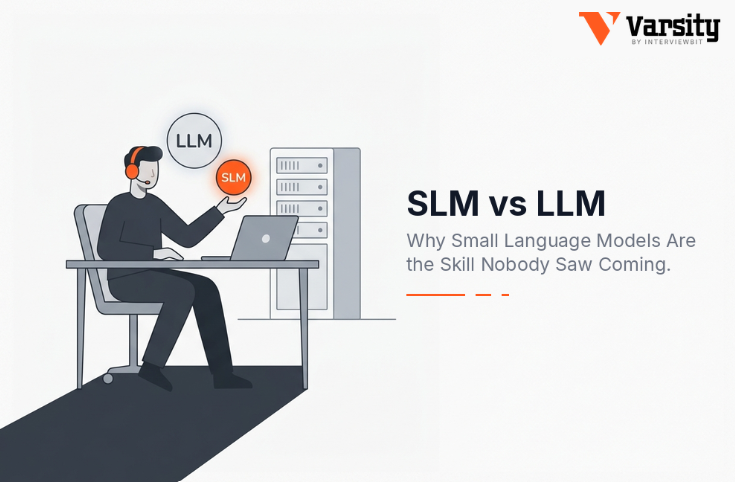
In the SLM vs LLM comparison, a small language model is any model small enough to run on a single consumer device, which in practice means under roughly 10 billion parameters, while a large language model needs cloud infrastructure. SLMs win on latency, cost, privacy and format reliability for narrow repetitive tasks. LLMs win on open-ended reasoning, broad world knowledge and long context. The 2026 production pattern is not choosing one: it is routing most traffic to a small model and escalating the hard minority to a large one.
Every engineer added “prompt engineering” to their profile in the last two years. Almost nobody added “model sizing,” which is the decision that actually shows up in an infrastructure bill. That asymmetry is the opportunity.
Key Takeaways
- The SLM vs LLM question is a routing problem, not a loyalty test. Production systems in 2026 run both.
- Below roughly 10 billion parameters is the working definition of “small,” per NVIDIA’s research team.
- Small models are often better, not just cheaper, at strict format compliance and tool calling, which is most of what an agent actually does.
- Temperature matters far more on a small model, because it has less headroom before output structure breaks.
- The differentiated skill is measuring whether the small model is good enough for your specific task, not knowing which model is “best.”
What Is a Small Language Model?
A small language model is a language model compact enough to run on ordinary hardware while still responding fast enough to serve a real user in real time. That is a deployment definition rather than a parameter count, and it is deliberate.
NVIDIA’s position paper Small Language Models are the Future of Agentic AI puts it plainly: as of 2025 the authors are “comfortable with considering most models below 10bn parameters in size to be SLMs.” Their second definition is refreshingly blunt: an LLM is a language model that is not an SLM.
The line moves every year, which is the point. A 7 billion parameter model was research infrastructure in 2022 and runs on a mid-range laptop now. What stays constant is the question underneath: can this model run where I need it to run, at the speed I need, without a network round trip?
SLM vs LLM: The Comparison That Actually Decides Things
| Dimension | Small language model | Large language model |
| Parameters | Roughly 100M to 10B | Roughly 30B to 1T+ |
| Runs on | Laptop, phone, single consumer GPU, on-premise box | Multi-GPU server or cloud API |
| Works offline | Yes, this is the defining use case | Rarely |
| Latency | Low, local, no network hop | Higher, network plus compute |
| Cost shape | Mostly fixed, near-zero marginal per call | Metered per token, scales with usage |
| Data residency | Data never leaves your boundary | Data goes to a provider by default |
| Broad world knowledge | Narrow | Broad |
| Open-ended reasoning | Limited outside its domain | Strong |
| Failure mode | Fails visibly when pushed out of domain | Fails fluently and plausibly, harder to catch |
| Fine-tuning | Hours on one GPU | Expensive and infrastructure-heavy |
| Best fit | High-volume, well-defined, repetitive tasks | Novel, ambiguous, multi-domain tasks |
Read the failure-mode row twice. It is the one people skip and the one that decides real architectures. A small model that goes outside its competence usually produces something obviously wrong. A frontier model produces something confident, well-written and subtly incorrect.
For a task where a human reviews every output, fluent failure is tolerable. For an automated pipeline, visible failure is safer, because you can detect and route around it.
Why This Stopped Being a Fringe Argument
The debate changed when the economics stopped being theoretical.
The NVIDIA paper makes three claims: small models are sufficiently powerful for many agent tasks, inherently more suitable for agent architectures, and necessarily more economical. The third claim is the one with a hard number attached, and it is worth quoting precisely because it is so often misquoted. The paper states that serving a 7 billion parameter model is 10 to 30 times cheaper in latency, energy consumption and FLOPs than serving a 70 to 175 billion parameter model.
Notice what that sentence does not say. It does not say your API bill drops 30x. Latency, energy and FLOPs are the physical costs. What that translates to in rupees depends on your hardware, your batching, and whether you keep a GPU saturated. Most articles quietly convert this into a pricing claim. It is not one.
The more interesting evidence is the case study appendix. The authors walked through three real open-source agent systems and estimated how much of each one’s model traffic a specialised small model could absorb:
| Agent system | Share of LLM calls replaceable by SLMs |
| MetaGPT | ~60% |
| Open Operator | ~40% |
| Cradle | ~70% |
Between 40% and 70%. Not all of it, and the paper is explicit about why: architectural reasoning, adaptive planning, unstructured error resolution and dynamic GUI adaptation still want a large model. But the majority of what an agent does all day is intent classification, tool selection, structured extraction and templated generation. Those are not conversations. They are errands.
SLM Examples Worth Knowing in 2026
These are verified against official model cards rather than aggregator tables, several of which currently circulate benchmark numbers for models that do not appear to exist.
| Model | Parameters | Context | Licence | Notable for |
| Phi-4-mini-instruct | 3.8B | 128K | MIT | Reasoning-dense training data, permissive licence |
| Gemma 3 4B IT | 4.3B | 128K | Gemma | Multimodal, 140+ languages |
| Qwen3-4B | 4.0B | 32K native | Apache 2.0 | Toggleable thinking mode |
| Llama 3.2 3B Instruct | 3.2B | 128K | Llama 3.2 Community | Wide tooling and runtime support |
| SmolLM3-3B | 3.1B | 64K, 128K via YaRN | Apache 2.0 | Fully open training recipe and data mixture |
Two things to take from this table beyond the specs.
Licence is an engineering constraint, not legal trivia. Apache 2.0 and MIT let you ship commercially without a conversation. The Gemma and Llama community licences carry conditions. If you are building something a company will sell, check this before you benchmark, not after.
Context length claims need reading carefully. Qwen3-4B natively supports 32,768 tokens and reaches further through extrapolation techniques. SmolLM3 was trained on 64K and extends to 128K via YaRN. “Supports 128K” and “was trained at 128K” are different statements, and quality at the far end of an extrapolated window is not the same as quality inside the trained window.
What Is Temperature in an LLM?
Temperature is the single most misunderstood setting in applied AI work, and it matters disproportionately when you move to small models.
The mechanism
When a language model predicts the next token, it produces a raw score for every token in its vocabulary. Those scores get converted into probabilities through a softmax function. Temperature is a divisor applied to the scores before that conversion.
Divide by a number below 1 and the gaps between scores widen. The top candidate becomes overwhelmingly likely and the model becomes near-deterministic. Divide by a number above 1 and the gaps narrow. Unlikely tokens get a real chance of being selected and output becomes more varied and less predictable.
At temperature 0 the model effectively stops sampling and always takes the highest-scoring token, which is greedy decoding.
The critical point: temperature does not make a model smarter, more accurate or more creative in any meaningful sense. It changes nothing about what the model knows. It only changes how adventurously the model samples from a distribution it has already computed.
Practical settings by task
| Task | Temperature | Why |
| Structured extraction, JSON output | 0 | Any variation is a parsing failure waiting to happen |
| Classification, routing, tool selection | 0 | You want the same input to produce the same decision |
| Factual question answering | 0 to 0.3 | Variation adds risk without adding value |
| General assistant chat | 0.6 to 0.8 | Some variation reads as natural rather than robotic |
| Brainstorming, drafting variants | 0.9 to 1.2 | Variation is the actual product |
Model cards often publish recommended values, and they are worth respecting. The SmolLM3-3B card, for instance, recommends temperature 0.6 with top_p 0.95 for its sampling configuration.
Temperature and top_p, and why you should not tune both
Top_p, also called nucleus sampling, restricts selection to the smallest set of tokens whose probabilities sum to p. It is a second, overlapping randomness control. Temperature reshapes the distribution, top_p truncates it.
Turning both dials at once makes the effect of either impossible to reason about. Pick one as your primary control, usually temperature, and leave the other at its documented default. See the Hugging Face generation strategies guide for how these parameters compose in practice.
Why this matters more on a small model
Here is the part that connects back to the SLM vs LLM decision.
A frontier model has enormous headroom. Push it to temperature 1.0 and it will still usually close its JSON brackets, because correct structure is so heavily reinforced that even a flattened distribution rarely escapes it.
A 3 billion parameter model has much less margin. The same temperature increase that makes a large model slightly more conversational can make a small model start dropping required fields, inventing key names, or drifting out of the requested format entirely. Format compliance is exactly the capability you chose the small model for.
So the practical rule when you move a workload down in size is to move temperature down with it. Teams that migrate to a small model, keep their old sampling configuration, watch reliability collapse, and conclude “small models are not ready” have often just failed to change one number.
The Cost Argument, Stated Honestly
Most SLM cost comparisons are marketing. Here is the arithmetic that actually matters, with the assumptions visible so you can substitute your own.
The relevant question is not “which is cheaper per token.” It is “at what volume does fixed cost beat metered cost.” Metered API pricing is close to free at low volume and brutal at high volume. Local hardware is the reverse.
Assume an agent step consumes roughly 2,000 tokens in total, and assume a hosted small-model rate rather than a frontier rate, since comparing a local 3B against GPT-class pricing is not an honest comparison.
| Daily volume | Character of the decision |
| Under 1,000 steps | Use the API. Hardware and ops time will never pay back. |
| 1,000 to 10,000 steps | Genuinely close. Decide on latency and data residency, not cost. |
| Above 10,000 steps | Fixed-cost local serving starts winning clearly, and the gap compounds. |
| Above 100,000 steps | Not running a small model locally is the expensive choice. |
For Indian teams there is a second variable that rarely appears in US-authored comparisons: data residency. If your workload touches financial, health or government data with residency obligations, the SLM vs LLM question may already be settled before cost enters the conversation. A model running on your own hardware means the data never crosses a border, and that is sometimes worth paying more for, not less.
When You Should Not Reach for a Small Model
Being useful here means being specific about the failure cases.
The task needs broad world knowledge. A 3B model has compressed far less of the world into its weights. If your task requires knowing obscure facts without retrieval support, size still wins.
The task is genuinely novel each time. Small models excel at repetition. If every request is structurally different, you are asking for generalisation, which is precisely what parameter count buys.
You need long-context reasoning. Not just a long context window, but actual reasoning across a hundred pages. Small models degrade faster across long inputs.
You do not have evaluation data. This is the one that sinks most migrations. You cannot know whether a small model is good enough without a measured baseline. Without evals, swapping models is guesswork with extra steps.
Your requirements change weekly. Fine-tuning a specialist has a maintenance cost. If the target moves constantly, a general model plus a prompt is more adaptable.
Note that the first three arguments weaken considerably when you add retrieval. Much of what looks like a knowledge gap is really a context problem, and RAG closes it without a larger model. Understanding how large language models are built makes it easier to predict which gaps retrieval can close and which it cannot.
The Skill Nobody Saw Coming
The market spent two years hiring for prompt fluency. That skill commoditised almost immediately, because the barrier to entry was a browser tab.
What did not commoditise is the ability to answer this question with evidence: given this specific task, this latency budget, this compliance constraint and this volume, what is the smallest model that clears the bar, and how do you know?
Answering it requires a genuinely uncommon stack of skills. Quantisation, so you understand what a 4-bit build costs you in quality. Local serving and throughput, so your benchmark reflects reality. Fine-tuning, because a specialised small model is usually the one that closes the gap. Evaluation, because every claim above is unprovable without a harness. And enough architecture judgment to design the routing layer that decides which requests escalate.
That is an engineering specialisation, and it is much harder to fake in an interview than prompt technique. Candidates who can say “we moved 60% of calls to a fine-tuned 3B, held quality within 2% on our eval set, and cut p95 latency by 400 milliseconds” are describing work almost nobody else in the pipeline has done. The AI engineer roadmap sequences the surrounding fundamentals, and AI engineer salary in India covers what the specialisation currently pays.
The fastest way in is smaller than it sounds. Take one task you already solve with a frontier API. Build a fifty-example evaluation set with correct answers. Run a 3B model against it locally. Measure the gap. Fine-tune if the gap is close, and route to the large model if it is not. That single exercise teaches more about production AI than any amount of reading, and it produces a number you can defend.
Conclusion
The SLM vs LLM debate gets framed as a prediction about which model class wins. It is not. Both persist, because they solve different problems, and the interesting work is in the routing layer between them.
What has actually changed is where the engineering difficulty sits. Getting a good answer out of a frontier model is no longer hard. Knowing that a model one twentieth the size would have produced the same answer, on your own hardware, in a fifth the time, and being able to prove it with an eval set, is hard.
Pick one task this week. Build the fifty-example eval set first. Then find out how small you can go.
Frequently Asked Questions
What is the difference between SLM and LLM?
Small language models are compact enough to run on consumer hardware, typically under 10 billion parameters, and are optimised for narrow high-volume tasks. Large language models require cloud infrastructure and are optimised for broad reasoning and general knowledge. The practical difference is that SLMs trade breadth for speed, cost, privacy and predictability.
Can a small language model outperform a large one?
On a narrow, well-defined task with good fine-tuning data, frequently yes. NVIDIA’s analysis found 40% to 70% of model calls across three real agent systems could be handled by specialised small models. Outside its domain, the same model will lose badly to a frontier model.
What are the best slm examples to start with?
Phi-4-mini at 3.8B under an MIT licence, Qwen3-4B under Apache 2.0, Llama 3.2 3B for the widest tooling support, and SmolLM3-3B if you want a fully open training recipe. All five in the table above run on ordinary consumer hardware.
What is temperature in llm settings and what value should I use?
Temperature controls output randomness by scaling token scores before they become probabilities. Use 0 for extraction, classification and tool calling. Use 0.6 to 0.8 for conversational output. Use above 0.9 only when variation is the goal. Keep it lower on small models than you would on frontier models.
Do small language models hallucinate less?
No, and often more within their domain gaps. The useful difference is that small models tend to fail visibly, producing output that is obviously broken, while large models fail fluently, producing output that is confidently wrong. Visible failure is easier to catch automatically.
Do I need a GPU to run a small language model?
Not necessarily. Quantised 3B and 4B models run acceptably on modern laptops with 16GB of RAM, including Apple Silicon machines. A consumer GPU with 8GB of VRAM comfortably handles the 3B to 8B range and makes fine-tuning practical.
Is SLM vs LLM really an either-or decision?
No, and treating it that way is the most common architectural mistake. The dominant 2026 pattern is a router that sends the routine majority to a small model and escalates the difficult minority to a large one. NVIDIA calls these heterogeneous agentic systems and argues they are the natural choice wherever general conversational ability is sometimes needed.