Superposition in Quantum Computing: What it Really Means (with Examples)

Key Insights
- Superposition allows a qubit to exist in a linear combination of the computational basis states |0⟩ and |1⟩.
- The quantum superposition equation is |ψ⟩ = α|0⟩ + β|1⟩, where α and β are probability amplitudes. The measurement probabilities are |α|² and |β|², with |α|² + |β|² = 1.
- Quantum measurement produces a classical outcome, either 0 or 1 for a single qubit. The relative phase between probability amplitudes influences how they interfere during subsequent quantum operations.
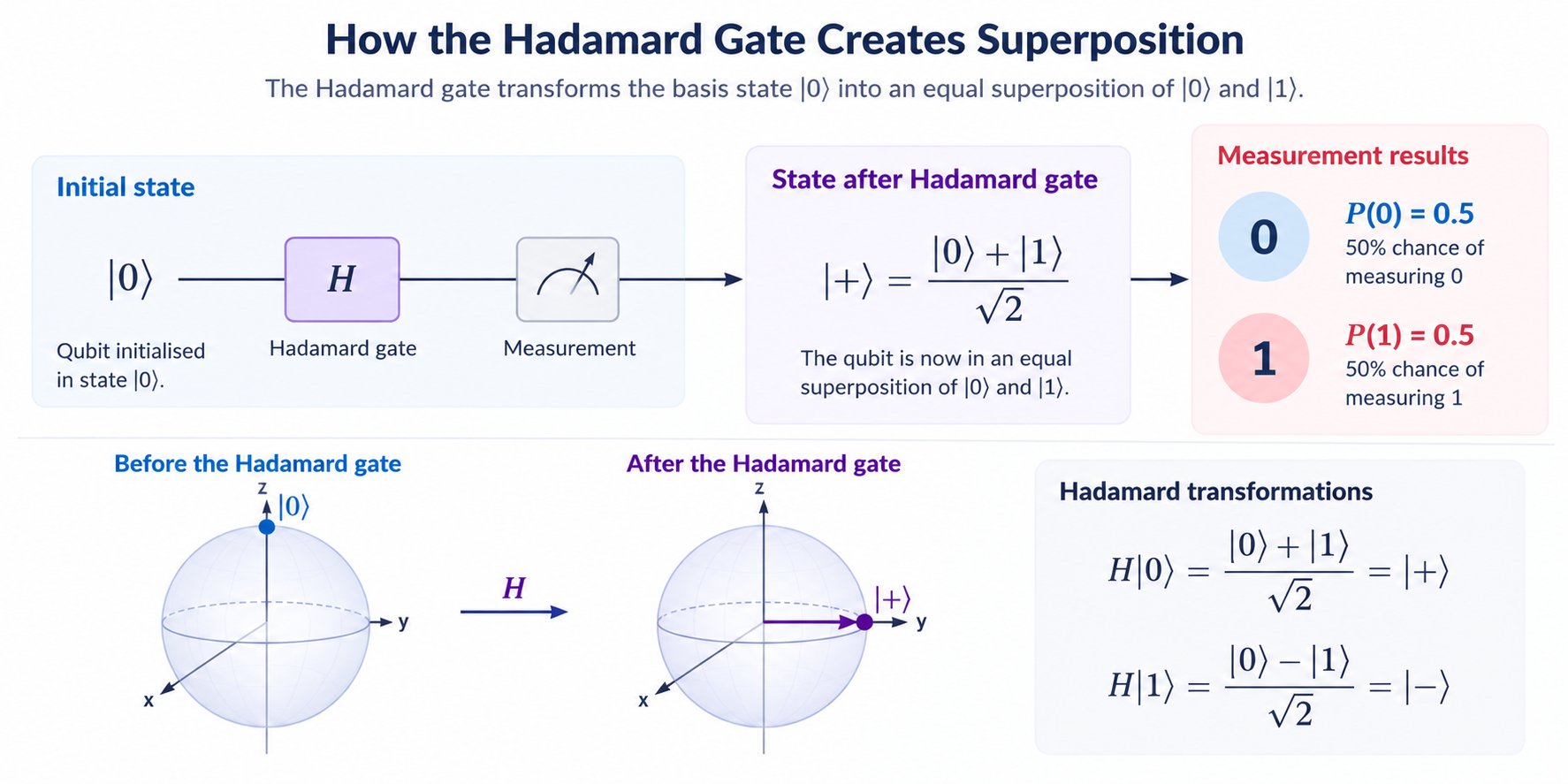
- The Bloch sphere visualises single-qubit states. The Hadamard gate creates an equal superposition when applied to |0⟩: H|0⟩ = (|0⟩ + |1⟩)/√2 = |+⟩.
- Qiskit can demonstrate superposition by applying a Hadamard gate to one qubit and measuring it. Across repeated runs, the results will be approximately evenly split between 0 and 1.
- Superposition does not mean a quantum computer can read every possible answer at once. Quantum algorithms use interference to amplify useful outcomes and suppress others.
- Superposition supports algorithms such as Grover’s search and Shor’s algorithm, while remaining distinct from entanglement.
Superposition in quantum computing allows a quantum bit, or qubit, to exist in a combination of the states 0 and 1, unlike a classical bit, which holds one definite value at a time. This fundamental principle of quantum mechanics enables quantum systems to behave in ways that classical systems cannot.
But what does quantum superposition actually mean, and how does it help quantum computers process information? The answer lies in probability amplitudes, relative phases and quantum measurement. This article explains the superposition equation, how to visualise a qubit using the Bloch sphere, how the Hadamard gate creates superposition, and how to demonstrate it using Qiskit. It also clears up a common misconception: superposition does not mean a quantum computer can simply try every possible answer at once.
What Does Superposition Mean in Quantum Computing?
Superposition occurs when a qubit's quantum state is a linear combination of the computational basis states |0⟩ and |1⟩. The amplitudes associated with these states determine the probabilities of measurement outcomes.
Superposition in Plain Language
A classical bit has a definite value: 0 or 1. A qubit, however, can be prepared in a state that combines |0⟩ and |1⟩. This is known as a qubit superposition.
Consider the state:
|+⟩ = (|0⟩ + |1⟩)/√2
This is an equal superposition of the two basis states. When measured in the computational basis, it produces 0 or 1 with equal probability.
Unlike an ordinary coin that has an unknown but definite face before it lands, a quantum superposition has amplitudes and relative phase. These features allow quantum states to interfere when quantum operations are applied. The distinction is essential to understanding what quantum superposition really means.
The Superposition Equation
The general quantum superposition equation for a single qubit is:
|ψ⟩ = α|0⟩ + β|1⟩
Here:
- |ψ⟩ represents the qubit's quantum state.
- |0⟩ and |1⟩ are computational basis states.
- α and β are complex probability amplitudes.
The amplitudes must satisfy the normalisation condition:
|α|² + |β|² = 1
For example, consider:
|ψ⟩ = √0.7 |0⟩ + √0.3 |1⟩
The probability of measuring 0 is 70%, while the probability of measuring 1 is 30%. This example shows how amplitudes describe the possible measurement outcomes of a qubit in superposition.
How Do Probability Amplitudes and Measurement Work?
Probability amplitudes determine the likelihood of measurement outcomes, but they are not probabilities themselves. Quantum measurement converts the quantum state into a classical result in the chosen measurement basis.
Amplitude vs Probability
For a state α|0⟩ + β|1⟩, the probabilities of computational-basis measurement outcomes are:
P(0) = |α|²
P(1) = |β|²
This relationship is known as the Born rule. Because amplitudes can be complex, their relative phases also matter.
Consider two states:
|+⟩ = (|0⟩ + |1⟩)/√2
|−⟩ = (|0⟩ − |1⟩)/√2
Both produce 0 and 1 with equal probability when measured directly in the computational basis. However, their relative phases differ, so applying further quantum gates can produce different outcomes. This ability to combine or cancel amplitudes is called quantum interference.
What Measurement Does to a Superposition
Measurement produces one classical outcome, either 0 or 1. Repeated measurements of identically prepared states reveal the probability distribution. You cannot directly read every component of a superposition from a single measurement.
How Does the Bloch Sphere Explain Superposition?
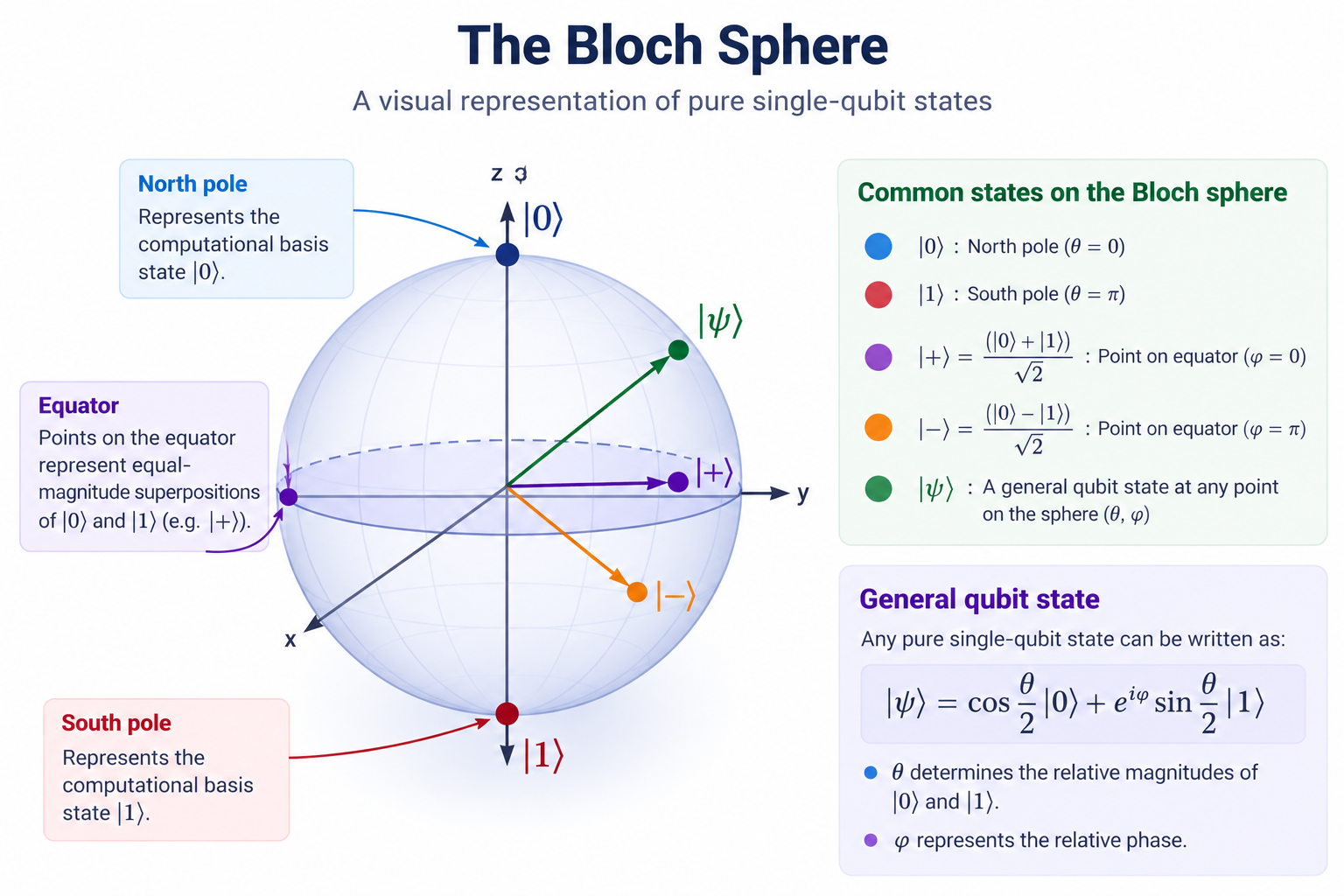
The Bloch sphere is a visual representation of pure single-qubit states. It helps explain how different amplitudes and relative phases correspond to different quantum states.
Reading the Bloch Sphere
The north pole represents |0⟩, while the south pole represents |1⟩. Points along the equator represent equal-magnitude superpositions, although their relative phases can differ.
A general pure qubit state can be written as:
|ψ⟩ = cos(θ/2)|0⟩ + e^(iφ) sin(θ/2)|1⟩
The angle θ determines the relative magnitudes of the two components, while φ represents their relative phase. Together, these angles describe the qubit's position on the Bloch sphere.
Superposition as a State You Can Rotate
Quantum gates transform a qubit's state and can be visualised as rotations on the Bloch sphere. The X gate exchanges the computational basis states, the Z gate changes the phase of the |1⟩ component, and the Hadamard gate transforms |0⟩ into an equal superposition.
These transformations allow quantum circuits to prepare and manipulate states before measurement. The Bloch sphere offers an intuitive picture of these changes, while the Hadamard gate provides a practical way to create superposition.
How Does the Hadamard Gate Create Superposition?
The Hadamard gate is a fundamental quantum gate that creates an equal superposition when applied to a qubit initialised in |0⟩.
The Hadamard Transformation
The transformation is:
H|0⟩ = (|0⟩ + |1⟩)/√2
When applied to |1⟩, it produces:
H|1⟩ = (|0⟩ − |1⟩)/√2
The minus sign represents a relative phase difference, not a negative probability. This makes the Hadamard gate useful for preparing states whose amplitudes can later interfere.
Superposition in Qiskit
You can create a simple quantum circuit superposition using Qiskit:
from qiskit import QuantumCircuit
qc = QuantumCircuit(1)
qc.h(0)
qc.measure_all()
print(qc)
The code creates a circuit with one qubit, applies the Hadamard gate and measures the qubit. When executed repeatedly on a suitable simulator, the outcomes should be approximately evenly split between 0 and 1.
The Hadamard operation itself is deterministic. The randomness appears in the measurement outcomes. Actual hardware results may deviate from an exact 50/50 split because of finite sampling and device noise.
Is Superposition the Same as Trying All Answers at Once?
No. Superposition allows a quantum state to contain amplitudes associated with multiple computational basis states, but measurement does not return every answer simultaneously.
Why “Quantum Computers Try Everything at Once” Is Misleading
An (n)-qubit register has (2^n) computational basis states. Its quantum state can contain amplitudes for these states, but this does not mean a quantum computer performs (2^n) independent classical calculations and then reveals all their results.
Measurement provides limited classical information. Quantum algorithms must manipulate amplitudes through carefully designed operations to make useful information more likely to appear in the final measurement.
Superposition + Interference = Algorithmic Power
A simplified view of many quantum algorithms is:
Prepare a superposition → apply quantum operations → create interference → measure.
Interference can reinforce some outcomes and suppress others. Grover's algorithm, for example, uses amplitude amplification to increase the probability of finding a desired item. Superposition is an important resource, but it does not by itself guarantee a quantum speedup.
Why Is Superposition Important in Quantum Algorithms?
Quantum superposition algorithms use quantum states that can be transformed through gates and interference. These techniques underpin several important quantum algorithms.
Superposition in Grover's Algorithm
Grover's algorithm begins by preparing a superposition of candidate states. An oracle marks the desired state, and repeated Grover operations amplify its probability. Measurement then produces a candidate answer. For unstructured search, the algorithm offers a quadratic query improvement over classical search.
Superposition in QFT and Shor's Algorithm
The Quantum Fourier Transform (QFT) changes the amplitudes and phases of a quantum state, helping reveal periodic structure in certain computations. Shor's algorithm uses quantum phase estimation and the QFT as part of its period-finding procedure for integer factorisation. Superposition provides a starting resource; the algorithm's structure and interference make it useful.
Superposition and Entanglement
Superposition and entanglement are related but distinct. Superposition describes a quantum state as a combination of basis states, while entanglement describes correlations between quantum systems that cannot be represented as independent states. Multi-qubit algorithms may use both.
Conclusion
Understanding superposition is an important step towards understanding how quantum computers process information differently from classical computers. Its real significance lies not in storing every possible answer, but in how quantum algorithms manipulate probability amplitudes and interference to make useful outcomes more likely. With this foundation, learners can move on to quantum gates, circuits and algorithms to understand how these principles translate into practical quantum computing applications.
To build on these fundamentals, explore the Applied Quantum Computing & AI programme by IIT Delhi, delivered on Varsity by InterviewBit,. The programme offers a structured pathway to deepen your understanding of quantum computing concepts and explore their applications in AI and emerging technologies.
Frequently Asked Questions
Can a qubit be in more than two states at the same time?
A qubit has two computational basis states, (|0\rangle) and (|1\rangle), but its state can be a continuous superposition of them, with different amplitudes and relative phases.
Does superposition mean a qubit contains infinite information?
No. A qubit's state can be described using continuous parameters, but a single measurement does not reveal those parameters in full. Repeated preparations and measurements are needed to estimate properties of the state.
What is the simplest real-world analogy for quantum superposition?
A spinning coin can offer an initial visual analogy, but it is not an exact model. A quantum state has probability amplitudes and relative phase, which allow interference in ways an ordinary coin does not.
Does observing a qubit always destroy its superposition?
A measurement in the computational basis projects the qubit into (|0\rangle) or (|1\rangle). Measurements in other bases have different outcomes, so the effect depends on what is measured and how.
Can superposition exist at room temperature?
Superposition is a property of quantum states, not a temperature setting. Maintaining coherent quantum states in hardware is an engineering challenge, and the practical conditions depend on the physical technology used.
How many qubits can be in superposition?
An (n)-qubit register can have amplitudes associated with (2^n) computational basis states. However, this does not mean all those states can be read out as classical values in one measurement.
What is the difference between superposition and quantum uncertainty?
A classical probability distribution represents uncertainty about possible outcomes. A quantum superposition also includes relative phases, which can create interference and affect the results of later operations.
Can a classical computer simulate quantum superposition?
Yes. Classical computers can simulate quantum states mathematically, but the resources needed can grow rapidly as the number of qubits increases, making large simulations difficult.
Does every quantum algorithm use superposition?
Many important quantum algorithms use superposition, but algorithms differ in the quantum effects and structures they exploit. Superposition alone does not establish that an algorithm will outperform a classical method.
What should I learn after superposition in quantum computing?
A useful next step is to study quantum measurement, single-qubit gates, entanglement and quantum circuits. These foundations make it easier to understand introductory algorithms such as Grover's search and the Quantum Fourier Transform.
Resources
- Superposition with Qiskit — IBM Quantum Learning
- Quantum bits, gates, and circuits — IBM Quantum Learning
- QuantumCircuit API — IBM Qiskit Documentation
- Measure Qubits — IBM Qiskit Documentation
- Grover's Algorithm — IBM Quantum Learning
- Quantum Fourier Transform — IBM Quantum Learning
- Shor's Algorithm — IBM Quantum Learning
- Superposition — Microsoft Quantum