
Takt Time: Formula, Examples & Takt Time vs Cycle Time


Key Insights
- Takt time is the pace at which one unit must be completed to meet customer demand. It is calculated from demand, not measured with a stopwatch.
- The takt time formula is Available Production Time ÷ Customer Demand. Both inputs must cover the same period, such as one shift or one day.
- Available production time excludes breaks, planned downtime and other non-production periods. Unplanned breakdowns are not deducted.
- Worked example: 7 hours of available time (420 minutes) and demand of 420 units gives a takt time of 1 minute per unit.
- Takt time vs cycle time: takt time is the required pace; cycle time is how long the process actually takes. Comparing them shows whether capacity is sufficient.
- Lead time is the total time a customer waits from order to delivery. It answers a different question from takt time and cycle time.
- Cycle time above takt points to delays, growing work-in-process, bottlenecks and overtime. Cycle time below takt shows spare capacity, not automatic efficiency.
- In Lean manufacturing, takt time guides line balancing, capacity planning, staffing and continuous improvement.
- Takt time works beyond the factory, including service operations, wherever demand and working time can be expressed over a comparable period.
- Takt time is dynamic. Recalculate it whenever customer demand, available production time or shift patterns change.
Takt time is the rate at which a product needs to be completed to meet customer demand. It aligns production output with the pace at which customers buy, so teams know how often one finished unit must leave the line.
The basic takt time formula is:
Takt Time = Available Production Time ÷ Customer Demand
Takt time is often confused with cycle time, but the two measure different things. Takt time is the required production pace, while cycle time is how long the process actually takes to produce a unit.
This guide explains the takt time formula, calculation examples, how takt time is used in Lean manufacturing, and the difference between takt time vs cycle time.
What is the Takt Time Formula and How Is It Calculated?
The takt time formula divides the time available for production by the number of units customers need in that same period. The result is a target interval that shows how often one unit must be finished to keep pace with demand.
Takt Time = Available Production Time ÷ Customer Demand
What does Available Production Time Mean?
Available production time is the time the operation can actually spend producing during the period being planned. It is usually shorter than the full shift, because some scheduled time is never used for production. To calculate it, account for:
- Shift duration: the starting point, such as an 8-hour shift
- Breaks: meal and rest breaks
- Planned downtime: scheduled maintenance and cleaning
- Other non-production periods: meetings, start-up and shutdown routines
Unplanned breakdowns are not deducted, because removing them would hide a reliability problem inside the target.
What does Customer Demand Mean?
Customer demand is the number of units customers require during the same period used for available production time. If production time is calculated per shift, demand must also be stated per shift. Mixing periods, such as dividing one shift’s minutes by weekly demand, produces a misleading takt time.
How to Calculate Takt Time Step by Step
Calculating takt time follows four steps, each building on the one before. The final unit should match how the line is managed, so fast assembly lines often use seconds while complex builds may use minutes or hours.
1. Calculate available production time → 2. Determine customer demand → 3. Divide production time by demand → 4. Express the result in seconds, minutes or hours per unit
Takt Time Calculation Example
A factory has 7 hours of available production time in a shift and needs to produce 420 units. Converting hours to minutes gives 7 × 60 = 420 minutes, which is then divided by customer demand.
Takt Time = 420 minutes ÷ 420 units = 1 minute per unit
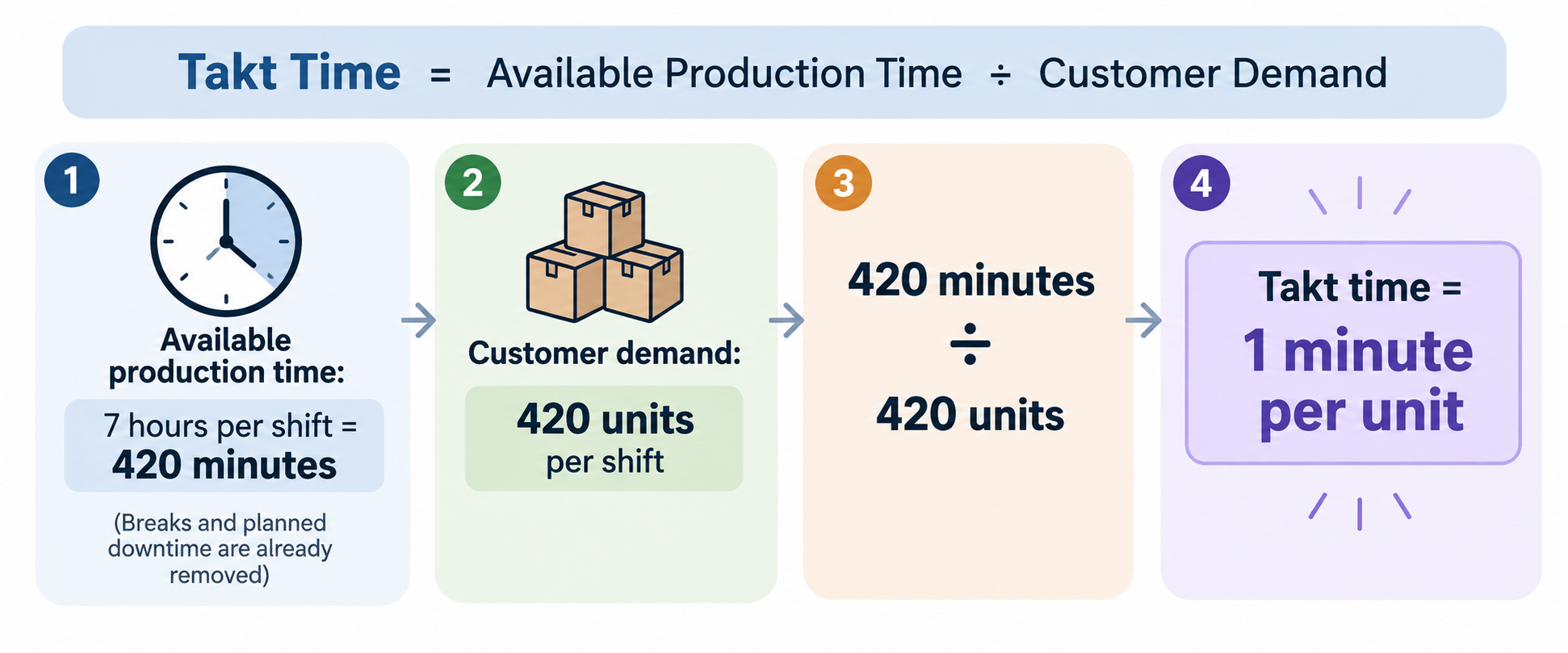
Operationally, the production system needs to complete approximately one unit every minute to meet demand. Takt time is a demand-driven target pace, not a measurement of how quickly a machine or worker actually performs a task. As the Lean dictionary LeanSpeak puts it, takt time is a calculated number, not a reflection of capability.
How is Takt Time Used in Lean Manufacturing?
In Lean manufacturing, takt time turns a demand figure into a working pace the whole line can plan around. Toyota calls it the heartbeat of production, synchronizing work with demand to avoid under- and overproduction (Toyota Material Handling Europe). It guides line balancing, capacity planning and continuous improvement.
Aligning Production With Customer Demand
Without a demand-based pace, lines tend to run at whatever speed the equipment allows. That either builds inventory customers have not ordered or falls short when orders rise. Takt time ties output to actual demand, so drifts above or below the required pace show up quickly.
Balancing Work Across Production Stations
Line balancing compares each station’s process time with takt time. When every station’s work fits close to, but within, the takt interval, units flow without long waits or pile-ups. This comparison helps teams spot:
- Bottlenecks: stations slower than takt that limit the whole line
- Uneven workloads: some operators overloaded while others wait
- Underutilized stations: work content well below takt, leaving idle time
- Processes that cannot meet demand: steps that fall behind even when fully staffed
Identifying Capacity Gaps
If a process consistently takes longer than takt time, it cannot deliver the required output in the time available. The difference between the two figures shows how much capacity is missing. Depending on its cause, the operation may need:
- Additional capacity, such as a parallel station or extra shift
- Process improvement to remove non-value-adding steps
- More workers at the constrained step
- Different equipment with higher speed or reliability
- Work redistribution to stations with spare time
Supporting Continuous Improvement
Takt time gives improvement teams a fixed target for evaluating process performance. Steps slower than takt become priority targets, while steps well under it reveal capacity that can be redeployed. Rechecking against takt after each change shows whether an improvement actually closed the gap.
Takt Time vs Cycle Time: What’s the Difference?
Takt time and cycle time are both expressed as time per unit, which is why they are often confused. Takt time tells you how fast you need to produce; cycle time tells you how fast you are producing. The table below shows how they differ.
| Aspect | Takt Time | Cycle Time |
|---|---|---|
| Basis | Based on customer demand | Based on actual process performance |
| What it shows | How frequently a unit needs to be completed | How long it actually takes to complete a unit |
| Type of measure | A required production pace | An observed or measured production time |
| When it changes | When available time or demand changes | When the process or operating conditions change |
| Main use | Used to align production with demand | Used to evaluate process performance |
Takt Time Example vs Cycle Time Example
Suppose a line has a takt time of 60 seconds per unit. Comparing three possible cycle times against that same target shows how clearly the gap between required and actual pace becomes visible:
- Cycle time = 45 seconds: the process can produce faster than the required pace.
- Cycle time = 60 seconds: the process matches the required pace.
- Cycle time = 75 seconds: the process is slower than the required pace and may struggle to meet demand.
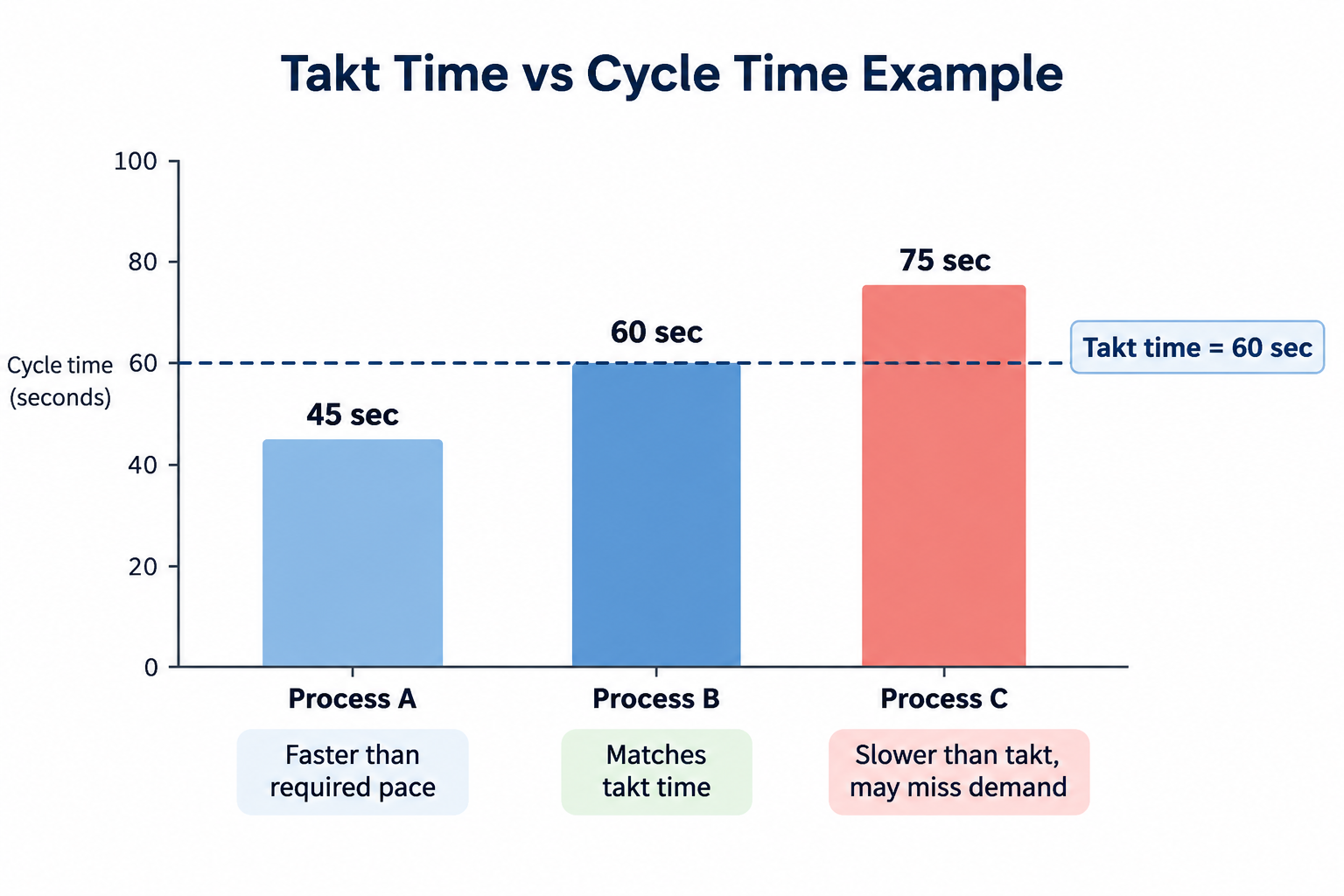
Over a 420-minute shift, the 75-second process completes about 336 units against demand for 420.
Why Takt Time and Cycle Time Should Be Compared
Neither number is useful on its own: takt time shows the target, and cycle time shows actual speed. Comparing them tells teams whether a process has enough capacity to meet demand, where capacity is short, and by how much.
Takt Time vs Lead Time vs Cycle Time: What’s the Difference?
Lead time is a third term often confused with takt time and cycle time. Each answers a different question about the same operation, and only takt time is calculated from demand rather than observed. The table below summarizes the differences.
| Metric | What It Measures | Main Question |
|---|---|---|
| Takt Time | Required production pace | How frequently must we produce to meet demand? |
| Cycle Time | Time required to complete a unit/process | How long does the process actually take? |
| Lead Time | Total elapsed time from request/order to completion or delivery | How long does the customer wait? |
How the Three Metrics Work Together?
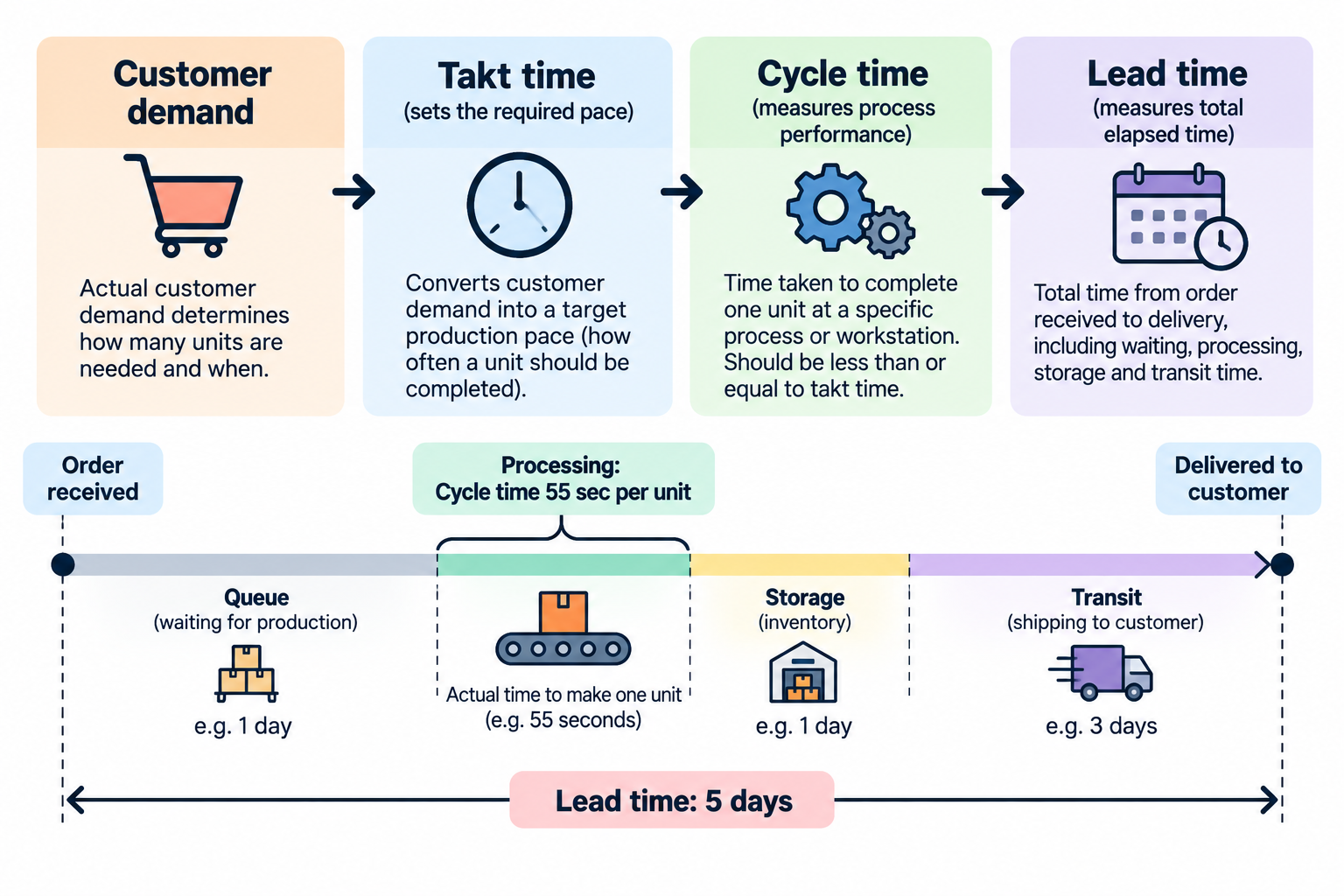
In a manufacturing plant, the three metrics connect in sequence. Demand sets the target, the process is measured against that target, and the customer experiences the total elapsed time from order to delivery.
Customer demand → Takt time sets the required pace → Cycle time measures process performance → Lead time measures the overall elapsed time
For example, a part may have a 60-second takt time and a 55-second cycle time yet take five days to reach the customer, because of time spent in queues, storage and transit.
What happens When Cycle Time Is Higher or Lower Than Takt Time?
The relationship between cycle time and takt time shows whether a process can keep pace with demand. Each of the three possible outcomes calls for a different response, and running faster than takt is not automatically better.
When Cycle Time Is Higher Than Takt Time
When cycle time is higher than takt time, the process may not produce quickly enough to meet customer demand. The shortfall grows with every cycle and affects stations before and after it. Potential consequences include:
- Production delays
- Growing work-in-process inventory
- Missed demand
- Bottlenecks that cap output for the whole line
- Overtime requirements
When Cycle Time Equals Takt Time
When cycle time equals takt time, the process is operating at approximately the required demand pace. Output matches demand without building excess stock, but there is no margin: any minor stoppage or quality issue pushes the process behind takt.
When Cycle Time Is Lower Than Takt Time
When cycle time is lower than takt time, the process can theoretically produce faster than demand requires, leaving spare time in every cycle. Used well, that margin creates opportunities for:
- Capacity flexibility to absorb short demand spikes
- Work redistribution from overloaded stations
- Reduced bottlenecks across the line
Producing faster does not automatically make the entire production system more efficient. A process running ahead of takt either builds excess inventory or waits idle for slower steps. The objective is balanced flow that meets demand without unnecessary overproduction or idle capacity.
What are Some Examples of Takt Time?
The same formula applies wherever demand and available working time can be expressed over a comparable period. The examples below use simple, illustrative figures to show how takt time guides balancing, capacity and staffing in different settings.
Takt Time Example in Automotive Manufacturing
An assembly plant runs two shifts with 450 minutes of available time each, giving 900 minutes per day. The plant must build 450 vehicles per day to meet orders, so its takt time is:
Takt Time = 900 minutes ÷ 450 vehicles = 2 minutes per vehicle
Engineers then divide assembly work so each station’s tasks fit within two minutes. A station with three minutes of work would be split or supported so the line keeps pace.
Takt Time Example in Electronics Manufacturing
A device assembly cell has 400 minutes of available time per shift and must produce 800 circuit boards. Its takt time is 400 ÷ 800 = 0.5 minutes, or 30 seconds per board. If soldering and inspection take 60 seconds per board, one operator cannot keep pace, so the cell needs two parallel workstations or two operators sharing the work.
Takt Time Example in Food Production
A packaged snack line has 450 minutes of available time per shift and an order for 1,800 packs per shift. Its takt time is 450 ÷ 1,800 = 0.25 minutes, or 15 seconds per pack. Filling, sealing and labeling must each finish within 15 seconds, and when orders rise before a holiday, the shorter takt time signals the need for extra staffing or shifts.
Takt Time in Service Operations
Takt time also applies beyond manufacturing, wherever work arrives at a relatively measurable rate, such as claims processing, order handling or customer support. The underlying relationship stays the same as in a factory:
Available service time ÷ customer requests = required service pace
A claims office open 480 minutes a day that receives 96 claims needs to complete one claim every 5 minutes. If each claim takes 20 minutes to handle, about four staff are needed.
How can Teams Improve Performance Against Takt Time?
When actual performance falls short of takt time, teams have several levers. The right one depends on whether the gap comes from one slow step, uneven work, wasted time or a genuine lack of capacity.
Identify Bottlenecks
Start by measuring cycle time at every workstation and comparing it with takt time. Any station above takt cannot keep up and limits output for the whole process. Fixing the slowest station first usually gives the biggest gain.
Balance Work Across Stations
When one station runs above takt while its neighbors sit well below it, the problem is how work is distributed, not total capacity. Moving tasks from overloaded stations to those with spare time brings every station close to, but not above, takt.
Reduce Process Waste
Waste adds time to a cycle without adding value, and removing it can bring a slow process back under takt without new equipment. Toyota counts waiting, motion, processing and rework among these wastes (Toyota Material Handling Europe). Common targets include:
- Waiting: operators idle for parts, approvals or machines
- Unnecessary movement: walking, reaching or searching for tools
- Excess processing: steps the customer does not need
- Rework: time spent correcting defects
- Changeover losses: time lost switching between products
Improve Equipment and Workforce Capacity
Sometimes waste reduction and rebalancing are not enough, because total work content exceeds what the current setup can deliver within takt. At that point, capacity itself has to change, and teams may need:
- Additional operators at constrained steps
- Equipment improvements to raise speed or reliability
- Automation for repetitive, high-volume tasks
- Process redesign when the current method cannot meet takt
Recalculate When Demand Changes
Takt time is not fixed permanently. Because it is calculated from demand and available time, it changes whenever those inputs change, so teams should treat it as a dynamic demand-based target. Recalculate takt time when any of these change:
- Customer demand
- Available production time
- Shift patterns
Frequently Asked Questions About Takt Time
How does demand variability affect takt time?
Because takt time is calculated from demand, any demand change shifts it: rising demand shortens takt time and falling demand lengthens it. When orders fluctuate heavily, teams often level production around average demand and recalculate when the trend changes.
How do you calculate takt time for multiple shifts?
Add the available production time from every shift in the period, then divide by total demand for that period. For example, two 420-minute shifts give 840 minutes; with demand of 560 units, takt time is 1.5 minutes per unit.
How do you calculate takt time when demand changes throughout the day?
Split the day into periods with distinct demand levels and calculate a separate takt time for each. Alternatively, use one takt time based on total daily demand and hold a small buffer for peaks, depending on how quickly staffing can change.
Can takt time be used for low-volume or highly customized production?
Yes, with some adaptation. Teams can calculate takt time for a product family or express it in hours or days per order. It is harder to apply when work content varies widely between jobs, as one takt time may not suit every order.
How does takt time affect workforce planning?
Takt time sets how much work each operator can carry per unit. Dividing total work content by takt time gives the approximate number of operators needed: 10 minutes of work per unit at a 2-minute takt time requires about five operators.
How can takt time help with production line balancing?
Takt time sets the target workload for each station. Teams compare each station’s cycle time with takt time, then move tasks from stations above it to those below it, so units flow evenly without waiting or overload.
What is the difference between takt time and pitch in Lean manufacturing?
Takt time is the demand-based pace for one unit. Pitch is takt time multiplied by the pack-out quantity, giving the time needed to make one container. With a 30-second takt time and 40 units per container, pitch is 20 minutes.
How should takt time be adjusted for planned downtime and maintenance?
Subtract planned downtime, such as scheduled maintenance and cleaning, from available production time before dividing by demand. Do not subtract unplanned breakdowns; they are losses the process must absorb, and excluding them would hide reliability problems.
How can companies use takt time to improve capacity planning?
Comparing takt time with current cycle times shows which processes have enough capacity today. Recalculating takt time for forecast demand shows where future gaps will appear, leaving time to plan equipment, staffing or shift changes.
What should a company do when demand exceeds production capacity?
First, confirm the gap by comparing cycle times with the new, shorter takt time. Close it quickly by removing waste, rebalancing work or adding overtime; if it persists, consider extra shifts, more operators, new equipment or outsourcing some volume.
How does takt time support Just-in-Time manufacturing?
Just-in-Time, one of the two pillars of the Toyota Production System, means making only what is needed, when it is needed. Takt time is one of its three operating elements, alongside pull and continuous flow, keeping output matched to demand.
What are the limitations of using takt time in production planning?
Takt time depends on accurate demand data, so poor forecasts produce misleading targets. It is harder to apply when demand is unstable or work content varies widely, and it shows a shortfall without explaining it, so teams still need root-cause analysis.