The Bloch Sphere Explained: Finally Visualise What a Qubit Actually Is

The Bloch sphere is a geometric picture of a single qubit’s state a sphere where every point on the surface represents a state that qubit could be in. It’s the standard way physicists, quantum computing engineers, and tools like Qiskit visualize what would otherwise be a page of complex numbers.
If you’ve already looked into what a qubit actually is, you know it isn’t simply 0 or 1 the way a classical bit is. The Bloch sphere turns that abstract idea into something you can point at: instead of equations, you get a spot on a sphere.
This guide covers how the sphere works, what each part represents, and why it’s the tool most quantum computing courses and software like IBM’s Qiskit use to teach and debug single-qubit behavior.
What Is the Bloch Sphere, in Simple Terms?
The Bloch sphere is a unit sphere radius 1, centered at the origin used to represent the pure state of a single qubit. Every possible state a qubit can be in corresponds to exactly one point on its surface.
- A classical bit has exactly two possible states: 0 or 1.
- A qubit has infinitely many possible states, and the sphere lets you see where a specific qubit sits among all of them.
Unlike a simplified analogy such as “a spinning coin,” the sphere isn’t a metaphor. It’s a direct, mathematically exact plot of the qubit’s state, drawn in a way a beginner can actually read.
How Does the Bloch Sphere Represent a Qubit?
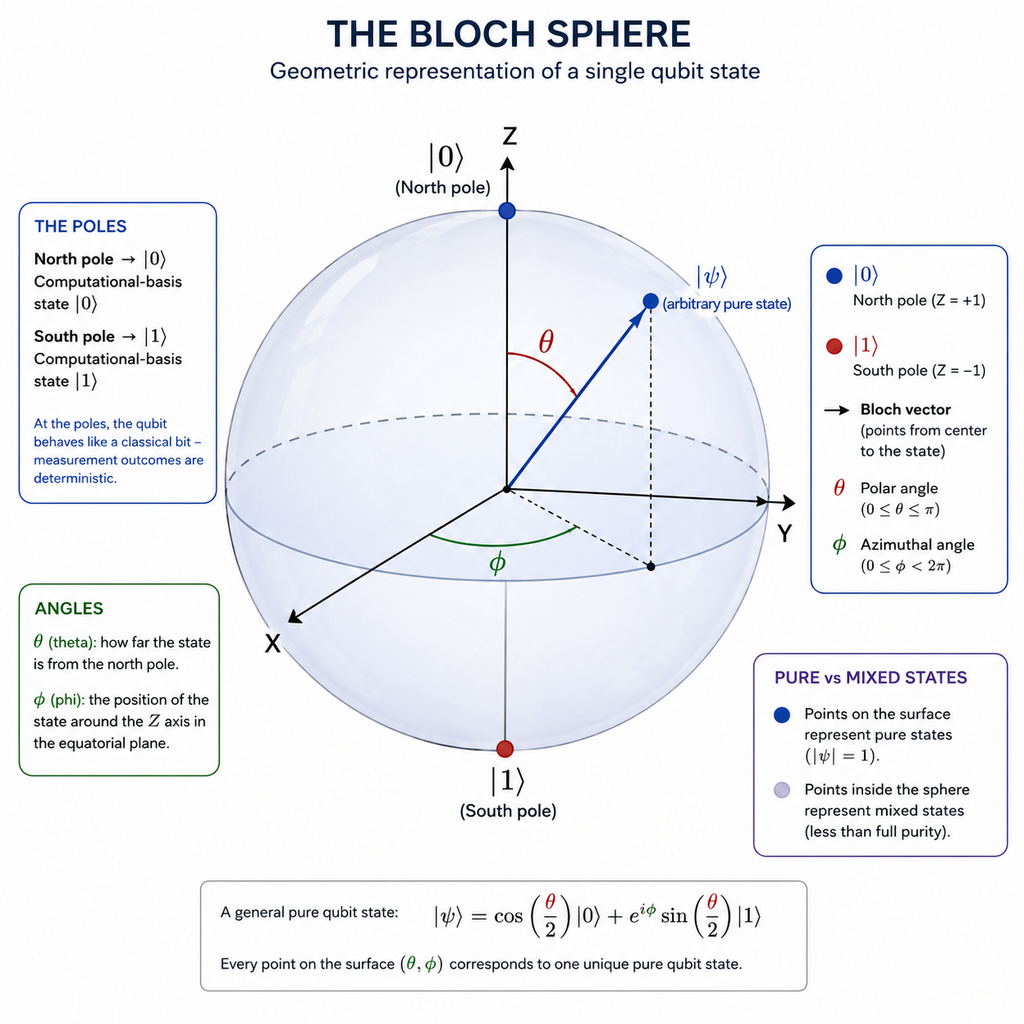
Every point on the sphere’s surface is defined by a vector pointing from the center out to that point. This vector is often called the Bloch vector, and its position tells you everything about the qubit’s current state.
The two poles of the sphere represent the two definite, classical-like states:
- North pole → the state |0⟩
- South pole → the state |1⟩
These are the only two points on the sphere that behave like a classical bit , a qubit sitting exactly at one of the poles will always measure as that value, with no randomness involved.
Superposition: States Between the Poles
Any point that isn’t a pole represents a superposition of |0⟩ and |1⟩ a state that blends both, rather than being definitively one or the other. The closer a point sits to a pole, the more the qubit “leans” toward that value when measured.
This is the same superposition concept covered in more depth in our quantum computing basics guide; here, the useful addition is a literal location on the sphere, somewhere between the two poles.
Want to build toward this kind of quantum intuition systematically, rather than picking it up piece by piece? The Certification in Applied Quantum Computing and AI from CEP, IIT Delhi dedicates an entire module to qubits, gates, and circuit design, then puts it into practice with hands-on Qiskit labs , part of a 156-hour, weekend-friendly programme built for working professionals.
What the X, Y and Z Axes Actually Mean
The three axes aren’t decorative — each one corresponds to a different way of asking “what is this qubit’s value?”
| Axis | Poles represent | Used for |
| Z-axis | |0⟩ and |1⟩ | The standard computational basis — what you get when you measure a qubit normally |
| X-axis | |+⟩ and |−⟩ | Equal superposition states, used heavily in algorithms and the Hadamard gate |
| Y-axis | |+i⟩ and |−i⟩ | Superposition states with a quarter-turn phase difference |
Most beginner explanations focus on the Z-axis (what a measurement reads out) and the X-axis (what the Hadamard gate produces). The Y-axis matters more once you start working with specific gate sequences.
The Angles θ and φ: Where the Qubit Sits on the Sphere
Any point on the sphere can be pinned down with just two angles instead of a full set of coordinates:
- θ (theta) : the polar angle, measured from the north pole. This sets how close the state is to |0⟩ versus |1⟩. θ = 0 means pure |0⟩; θ = 180° means pure |1⟩.
- φ (phi) : the azimuthal angle, measured around the equator. This captures the qubit’s relative phase , a property that has no classical equivalent, and that plain “0 or 1” thinking completely misses.
Put together: θ decides how much |0⟩ versus |1⟩ is in the mix, and φ decides the phase relationship between them. Two qubits can have the exact same 0-versus-1 mix and still be genuinely different states because of φ , a detail the sphere makes easy to see and equations tend to hide.
What Does a Qubit Actually Look Like on the Bloch Sphere?
A few reference points make the sphere much easier to read at a glance.
| State | Position on the sphere | What it means |
| |0⟩ | North pole | Definite 0, no superposition |
| |1⟩ | South pole | Definite 1, no superposition |
| |+⟩ | Equator, pointing along +X | Equal superposition of 0 and 1, phase = 0 |
| |−⟩ | Equator, pointing along −X | Equal superposition of 0 and 1, phase = 180° |
| General superposition | Anywhere else on the surface | A specific weighted blend of 0 and 1, with its own phase |
[VISUAL: Qubit states on the Bloch sphere – |0⟩, |1⟩, |+⟩, |−⟩, and one general superposition state marked as labelled points]
|+⟩ and |−⟩ have the same amount of 0-versus-1 mixing , they sit at the same “height” on the sphere. Only phase separates them, a distinction that’s hard to grasp from notation alone but obvious once it’s two different points on the equator.
How Do Quantum Gates Move a Qubit Around the Bloch Sphere?
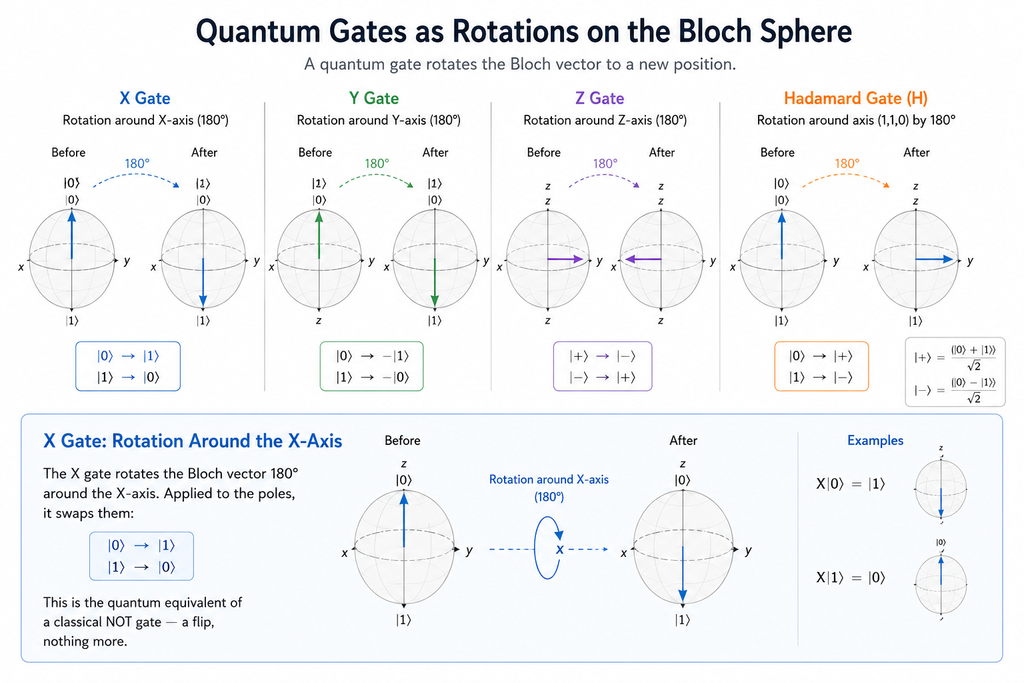
A quantum gate doesn’t “calculate” a new state from scratch , it rotates the Bloch vector to a new position. Instead of memorizing what a gate “does,” you can picture it as a specific spin around a specific axis.
X Gate: Rotation Around the X-Axis
The X gate rotates the Bloch vector 180° around the X-axis. Applied to the poles, it swaps them:
- |0⟩ → |1⟩
- |1⟩ → |0⟩
This is the quantum equivalent of a classical NOT gate — a flip, nothing more.
Y and Z Gates: Changing the Qubit’s Direction and Phase
- Y gate — a 180° rotation around the Y-axis. Like the X gate, it flips |0⟩ and |1⟩, but it also changes the phase, so the result isn’t identical to what the X gate produces.
- Z gate — a 180° rotation around the Z-axis. It leaves |0⟩ and |1⟩ exactly where they are (since they’re already sitting on that axis), but it flips the phase of anything in superposition — for example, turning |+⟩ into |−⟩.
On paper, the Z gate can look like it “does nothing” , visually, it’s obvious that it only leaves the poles untouched and rotates everything else.
Hadamard Gate: Creating Superposition
The Hadamard gate (H) rotates the vector from a pole onto the equator or the reverse. It’s the standard way to create superposition from a definite state:
- |0⟩ → |+⟩
- |1⟩ → |−⟩
| Gate | Rotation | Example |
| X | 180° around the X-axis | |0⟩ → |1⟩ |
| Y | 180° around the Y-axis | |0⟩ → i|1⟩ |
| Z | 180° around the Z-axis | |+⟩ → |−⟩ |
| H | 180° around the diagonal between X and Z | |0⟩ → |+⟩ |
Every single-qubit gate, no matter how complicated it looks in matrix form, boils down to a rotation of the Bloch vector by some angle around some axis.
What Does Measurement Mean on the Bloch Sphere?
Measurement doesn’t mean the point randomly teleports somewhere new. It means the qubit’s current position determines the odds of two specific outcomes and then the vector snaps to whichever outcome occurs.
Specifically:
- The probability of measuring 0 depends on how close the vector is to the north pole.
- The probability of measuring 1 depends on how close it is to the south pole.
- A vector sitting exactly on the equator (like |+⟩ or |−⟩) has a 50/50 split.
Once measured, the vector jumps to whichever pole matches the outcome, and any phase information that existed beforehand is gone. This is why measurement is often described as “collapsing” the state: a continuous position on the sphere is reduced to one of just two points.
Why Is the Bloch Sphere Useful in Quantum Computing?
Beyond teaching, working engineers use it for a few concrete reasons:
- Understanding qubit states visually instead of parsing complex amplitudes
- Seeing gate effects immediately as a rotation you can predict and check by eye
- Grasping superposition and phase, which are easy to state but easier to understand once they’re spatial
- Debugging simple circuits by tracing a qubit’s position through a short gate sequence, often faster than re-deriving the math
Qiskit includes built-in functions (plot_bloch_vector and plot_bloch_multivector) specifically for plotting a qubit’s state on a Bloch sphere, part of why the sphere shows up constantly in quantum computing tutorials and documentation, not just textbooks.
What the Bloch Sphere Cannot Show
This is the sphere’s most important limitation, and it’s worth being direct about it: the Bloch sphere only works for a single qubit.
The moment you have two or more qubits, their combined state lives in a much higher-dimensional space that can’t be drawn as a simple sphere. This matters most for entangled qubits, whose states are correlated in a way that can’t be captured by plotting each one as an independent point on its own sphere — the whole point of entanglement is that the qubits can’t be described separately in the first place.
Bloch Sphere vs. a Classical Bit
| Feature | Classical bit | Qubit (Bloch sphere) |
| Possible states | Two: 0 or 1 | Infinite points on the sphere’s surface |
| Visual representation | On/off switch | Point on a 3D sphere |
| Superposition | Not possible | Any point between the poles |
| Phase | Doesn’t exist | Captured by the angle φ |
| Measurement | Reads the exact value | Probabilistic, then collapses to a pole |
| Operations | Logic gates (AND, OR, NOT) | Rotations of the Bloch vector |
Bloch Sphere vs. Quantum Teleportation and Entanglement
| Concept | What it describes | How many qubits? | Key idea |
|---|---|---|---|
| Bloch Sphere | The state of a single qubit | 1 | Represents a qubit’s state as a point on a sphere. |
| Entanglement | A quantum relationship between qubits | 2 or more | The qubits share a joint state that cannot be described as independent states. |
| Quantum Teleportation | A protocol for transferring an unknown quantum state | 3 qubits + classical communication | Uses a pre-shared entangled pair and a classical message to transfer a quantum state without physically moving the particle. |
In short: The Bloch sphere shows where one qubit is; entanglement describes how multiple qubits are connected; and quantum teleportation describes how a quantum state can be transferred using entanglement and classical communication.
Take the Next Step in Your Quantum Journey
Understanding concepts like quantum teleportation is a great starting point. The next step is learning how to work with quantum systems yourself ,building circuits, running algorithms, exploring quantum-AI applications, and understanding where the technology can actually be applied.
The Certification in Applied Quantum Computing & AI by CEP, IIT Delhi gives you the opportunity to build that practical foundation through hands-on Qiskit labs, industry-focused use cases, multiple capstones, and a portfolio-grade final project across quantum computing, AI/ML, optimisation, hardware, and cybersecurity.
If you’re looking to move from understanding quantum computing to actually building with it, this Quantum Computing Course by IIT Delhi could be your next step.
FAQs
What is the Bloch sphere in quantum computing?
The Bloch sphere is a geometric representation of a single qubit’s state, where every point on the surface of a unit sphere corresponds to a possible state. It turns abstract quantum mechanics into a visual, spatial picture that’s used both for teaching and for practical debugging in tools like Qiskit.
What do the north and south poles of the Bloch sphere represent?
The Bloch sphere is a geometric representation of a single qubit’s state, where every point on the surface of a unit sphere corresponds to a possible state. It turns abstract quantum mechanics into a visual, spatial picture that’s used both for teaching and for practical debugging in tools like Qiskit.
Can the Bloch sphere show superposition?
Yes. Any point on the sphere that isn’t a pole represents a superposition of |0⟩ and |1⟩. The state’s position — how close it sits to each pole, and where it sits around the equator reflects both the mix of 0 and 1 and the qubit’s phase.
What do the X, Y and Z axes represent?
The Z-axis represents the standard |0⟩/|1⟩ measurement basis. The X-axis represents the |+⟩/|−⟩ superposition basis, commonly produced by the Hadamard gate. The Y-axis represents a related superposition basis shifted by a quarter turn in phase.
How do quantum gates affect the Bloch sphere?
Quantum gates rotate the Bloch vector around a specific axis by a specific angle. The X, Y, and Z gates each perform a 180° rotation around their respective axis, while the Hadamard gate rotates a pole onto the equator, converting a definite state into superposition.
Does the Bloch sphere represent entanglement?
No. The Bloch sphere only represents a single qubit. Entanglement is a relationship between two or more qubits whose states can’t be described independently, which means it can’t be captured by plotting each qubit as a separate point on its own sphere.
Is the Bloch sphere only for one qubit?
Yes. It’s specifically a single-qubit visualization. Multi-qubit systems exist in a much higher-dimensional space, so representing more than one qubit requires different tools entirely, not an extended version of the same sphere.
Why is the Bloch sphere useful?
It makes qubit states, gate effects, superposition, and phase visible and intuitive rather than purely mathematical. Engineers and learners use it to predict what a gate will do, debug small circuits, and build intuition that’s difficult to get from equations alone.