Buyer Persona: Template, Examples & How to Build One with GenAI

Key Insights
- A buyer persona should help answer a real marketing, sales or product question.
- Customer interviews, CRM data, reviews, analytics and sales notes can reveal patterns worth building personas around.
- B2B personas need buying roles, business goals and decision criteria, while B2C personas often focus more on needs, motivations and purchase triggers.
- Not every difference between customers deserves a separate persona. Create one only when the difference changes a business decision.
- A useful persona is a living document, not a profile that gets created once and forgotten.
- GenAI can identify patterns and generate hypotheses quickly, but it should not invent customer insights.
Knowing your target audience is useful. Knowing why a particular type of buyer chooses, compares or rejects your product is much more useful. That is where a buyer persona comes in.
This guide explains buyer persona meaning, why personas matter, B2B vs B2C differences, how to research and build one, what a practical template looks like, and how GenAI can help turn customer research into dynamic persona hypotheses.
What is a Buyer Persona?
A buyer persona is a research-based profile representing a specific type of buyer and the factors that influence their purchasing decisions.
It can include:
- Goals
- Needs
- Pain points
- Motivations
- Buying behaviour
- Objections
- Decision criteria
- Information sources
- Purchase triggers
Demographics can be useful, but only when they affect the buying decision. Knowing that someone is 35 matters less than knowing that they are responsible for reducing costs, have a limited implementation window and need approval from a finance team.
Buyer Persona vs Target Audience
A target audience is broad. A buyer persona is more specific and decision-focused.
| Concept | What it describes | Typical use |
|---|---|---|
| Target audience | Broad group a business wants to reach | Campaign targeting |
| Buyer persona | Detailed pattern of a specific type of buyer | Messaging and content |
| Customer segment | Group sharing meaningful characteristics | Marketing strategy |
A target audience might be “mid-career marketing professionals.”
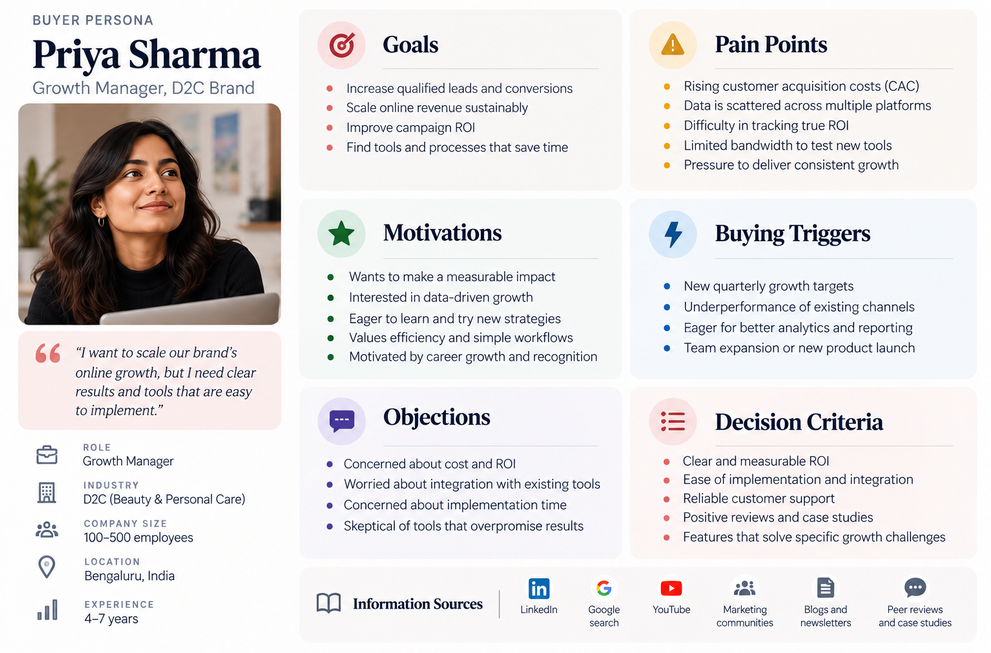
A persona could describe “a growth manager at a mid-size D2C brand who needs to improve lead quality but is worried about adding another complex tool.”
The second gives a marketer something to work with.
Buyer Persona vs Ideal Customer Profile (ICP)
An ICP generally describes the ideal account or company, particularly in B2B. A buyer persona describes the people involved in buying within that account.
For example:
ICP: Mid-size SaaS companies with growing sales teams.
Buyer persona: Revenue Operations Manager responsible for improving CRM processes and reporting.
Why Does a Buyer Persona Matter?
A useful buyer persona improves specific marketing decisions, from messaging to positioning and content.
Improve Marketing Messaging
Personas help marketers use language that reflects real customer concerns.
Instead of saying:
“Our platform improves marketing efficiency.”
A research-backed persona might reveal that buyers actually worry about manual reporting, scattered customer data and proving campaign ROI.
That gives the messaging somewhere concrete to go.
Create More Relevant Content
Persona research can reveal what customers want to know, where they look for information and what questions slow down a purchase.
That can influence:
- Topics
- Content formats
- Search intent
- Distribution channels
- Calls to action
Improve Product Marketing and Positioning
A persona connects product features to customer problems.
The question becomes:
“Which problem matters most to this buyer, and how does our product solve it?”
This makes positioning more useful than simply listing features.
Align Marketing, Sales and Product Teams
A shared persona gives teams a common picture of the buyer.
Marketing can use it for messaging. Sales can use it to understand objections. Product teams can use it to prioritise problems worth solving.
How Are B2B and B2C Buyer Personas Different?
The biggest difference is usually the buying process: B2B purchases often involve multiple stakeholders, while B2C purchases are more often individual or household decisions.
| Factor | B2B buyer persona | B2C buyer persona |
|---|---|---|
| Decision | Often involves multiple stakeholders | Often individual or household |
| Key considerations | ROI, risk, business outcomes, implementation | Need, preference, convenience, emotion |
| Research focus | Role, goals, buying committee, objections | Behaviour, motivations, preferences, triggers |
What to Include in a B2B Persona
Focus on the buyer’s role in the business and role in the purchase.
Useful fields include:
- Job role and seniority
- Business goals
- Pain points
- Decision-making role
- Buying committee
- Evaluation criteria
- Objections
- Information sources
A B2B persona should make it easier to understand who influences the decision and what each person needs to approve it.
What to Include in a B2C Persona
B2C personas usually need more focus on the customer’s individual context.
Useful fields include:
- Needs
- Motivations
- Behaviours
- Purchase triggers
- Preferences
- Barriers
- Information sources
For example, a skincare buyer may care less about a product’s technical formulation than about trust, visible results, reviews and whether the product fits their routine.
How Do You Build a Buyer Persona?
Build a buyer persona from evidence first, then turn recurring patterns into a profile.
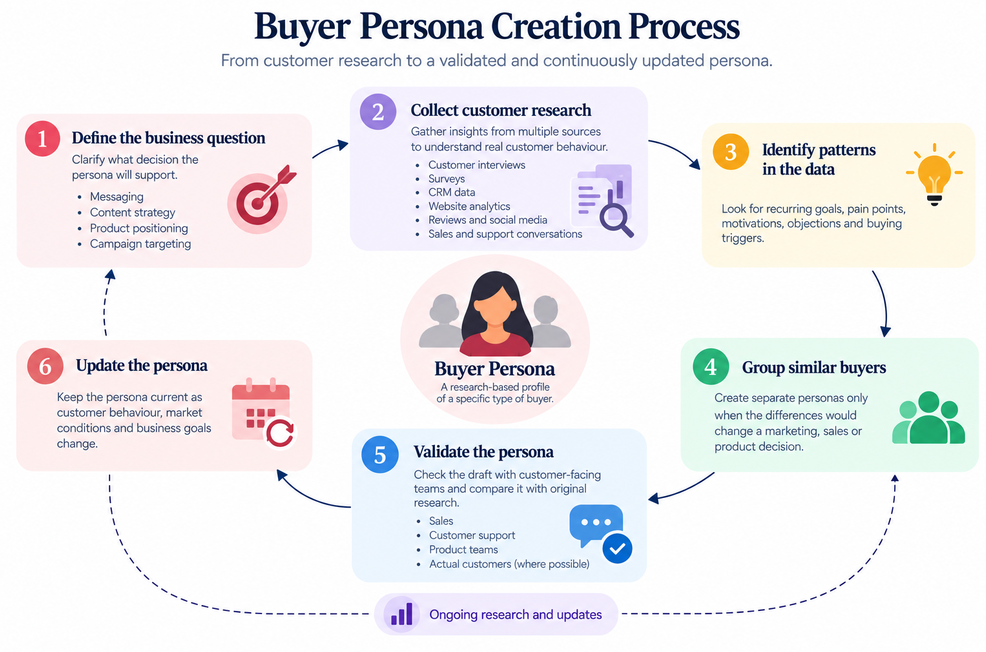
1. Define the Decision the Persona Will Support
Start with a business question.
For example:
- What messaging should we use?
- Why are leads dropping before purchase?
- Which customer problem should our product prioritise?
- Which audience should this campaign target?
This prevents the persona from becoming a collection of interesting but useless facts.
2. Collect Customer Research
Use multiple sources where possible:
- Customer interviews
- Surveys
- CRM data
- Website analytics
- Reviews
- Sales-call notes
- Customer-support conversations
Combining qualitative and quantitative evidence gives a stronger picture than relying on assumptions alone. Current persona guidance also recommends combining customer data with direct conversations and validating the resulting profile with customer-facing teams.
3. Identify Patterns in the Data
Look for recurring:
- Goals
- Pain points
- Motivations
- Buying triggers
- Objections
- Decision criteria
- Customer language
The important word is recurring. One unusual comment should not automatically become a defining persona characteristic.
4. Group Similar Buyers
Create separate personas only when the differences would change a marketing, sales or product decision.
If two customer groups have different ages but the same needs, buying process and objections, they may not need separate personas.
5. Validate the Persona
Take the draft back to people who interact with customers.
Ask sales, customer support and product teams:
“Does this match what you actually hear from customers?”
Then compare it against the original customer evidence.
6. Update the Persona
A buyer persona should evolve as customer behaviour changes.
New products, market conditions, customer expectations, campaign responses and search behaviour can all change what matters to buyers. Treat the persona as a living strategic document rather than a one-time exercise.
Buyer Persona Template: What Should It Include?
A useful buyer persona template captures information that can change a marketing or buying decision, rather than filling space with decorative demographics.
Buyer Persona Template
| Persona field | What to capture | Filled example |
|---|---|---|
| Role & context | Who they are and their buying situation | Growth Manager at a mid-size D2C brand |
| Goals | What outcome they want | Increase qualified leads |
| Pain points | Problems blocking that outcome | Rising CAC and fragmented data |
| Motivations | Why solving it matters | Needs predictable growth |
| Buying triggers | What creates urgency | New quarterly growth target |
| Objections | Why they may hesitate | Cost and integration effort |
| Decision criteria | What they compare | ROI, ease of implementation |
| Information sources | Where they research | LinkedIn, Google, peer communities |
The filled example is more useful than a list of generic characteristics because it connects who the buyer is to what they need to decide.
You can add fields such as budget, preferred content format or competitors when they are relevant to the business question.
What are Some Buyer Persona Examples?
The best persona examples show how customer insight changes a business decision, not just what the customer looks like.
B2B Example: Marketing Operations Manager
- Goal: Improve campaign reporting.
- Pain point: Data is spread across multiple platforms.
- Trigger: Leadership asks for faster performance reporting.
- Objection: Concern about implementation time.
- Decision criteria: Integration, ease of use and measurable ROI.
- Marketing implication: Lead with easier reporting and integration rather than a long feature list.
B2C Example: First-Time Skincare Buyer
- Goal: Find a routine that works.
- Pain point: Too many products and conflicting advice.
- Trigger: A specific skin concern becomes more noticeable.
- Barrier: Fear of wasting money on products that do not work.
- Decision criteria: Reviews, ingredients, trust and visible results.
- Marketing implication: Education, proof and clear product guidance may matter more than discount-led messaging.
Product Marketing Example: SaaS Decision-Maker
- Goal: Reduce manual work.
- Pain point: Existing processes rely heavily on spreadsheets.
- Trigger: Team growth makes the current process difficult to manage.
- Objection: Switching systems could disrupt existing workflows.
- Decision criteria: Ease of adoption, integration and business impact.
- Marketing implication: Position the product around reducing operational friction, not simply adding more features.
Key takeaway: A persona becomes valuable when it changes what you say, what you build or how you sell.
How Can GenAI Help Create Dynamic Buyer Personas?
GenAI can speed up the analysis of customer research and help marketers keep personas current.
Analyse Customer Research With GenAI
GenAI can synthesise appropriately anonymised:
- Interview transcripts
- Survey responses
- CRM notes
- Reviews
- Support conversations
- Sales-call summaries
It can surface recurring themes across large amounts of text much faster than a team reviewing every response manually.
Tools such as HubSpot’s current AI persona workflow also position AI as a way to create a first draft that can then be refined with real customer research.
Generate Persona Hypotheses From Patterns
AI can group recurring goals, pain points, motivations and objections into possible persona clusters.
For example, it might reveal that one group of customers consistently cares about speed, while another repeatedly prioritises cost control and risk reduction.
Those become hypotheses to investigate, not automatic proof that two personas exist.
Update Personas as Customer Behaviour Changes
A persona can be compared against newer signals such as:
- Campaign responses
- Changing search behaviour
- New product usage patterns
- Customer feedback
- Market changes
This makes persona management more dynamic instead of forcing teams to work from an outdated document.
GenAI Prompts for Buyer Persona Creation
Prompt 1: Research synthesis
Analyse these anonymised customer interviews and identify recurring goals, pain points, motivations, objections, buying triggers and information sources. Group only patterns supported by the data. Clearly separate observed evidence from inference.
Prompt 2: Persona generation
Based only on the validated patterns below, create 2–3 buyer persona hypotheses. For each, identify their goals, pain points, decision criteria, objections, buying triggers and preferred information sources. Flag any assumptions that require further research.
Prompt 3: Persona update
Compare this existing buyer persona with the new customer research. Identify what has changed, what remains supported and which attributes should be updated. Do not introduce information that is not present in the research.
What GenAI Should Not Do
AI should not invent customer insights to make a persona look complete.
A generated profile can sound convincing while containing assumptions that were never present in the research. The safest workflow is:
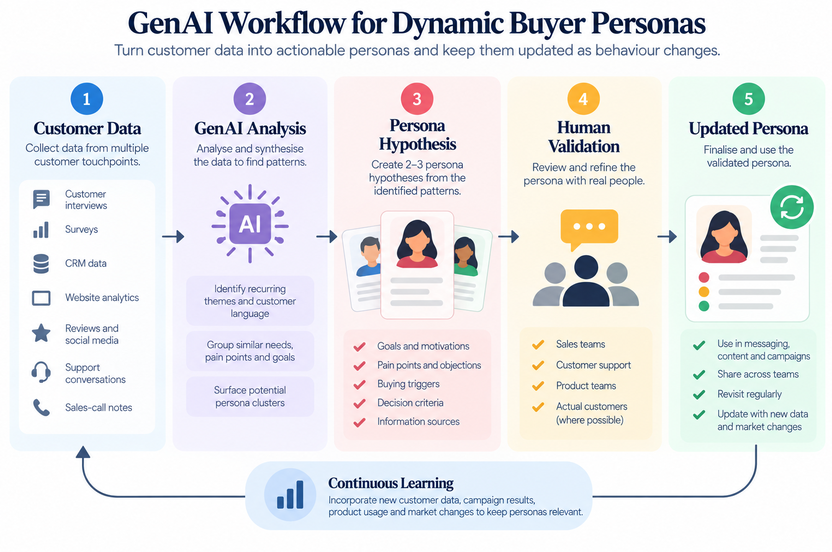
Customer evidence → AI synthesis → Persona hypothesis → Human validation → Updated persona
That keeps AI in the role of an analysis assistant rather than a substitute for customer research.
Conclusion
A buyer persona is useful when it helps a team make a better decision about a real customer. The goal is not to create the most detailed profile possible. It is to understand the goals, problems, triggers and buying behaviour that actually affect the decision.
Start with evidence, turn recurring patterns into a persona hypothesis, validate it with customer-facing teams and update it as behaviour changes. GenAI can make that process faster, but the evidence still has to come first.
Want to build stronger customer-led marketing skills and apply GenAI to modern marketing strategy? Explore the IIM Trichy AI-Powered Marketing & Growth Strategy programme.
Frequently Asked Questions
How many buyer personas should a company have?
There is no fixed number. Start with the smallest number that represents meaningfully different buying patterns. If two groups need the same messaging, product value and sales approach, creating separate personas may add unnecessary complexity.
How much customer research is enough for a buyer persona?
There is no universal sample size. The better test is whether the same goals, pain points and buying patterns keep appearing across multiple sources. If important claims are based on one or two comments, they need more validation.
Should demographics be included in every buyer persona?
No. Include demographics when they help explain buying behaviour. A demographic detail that has no effect on the decision is usually less useful than a specific pain point, trigger or decision criterion.
Can one person belong to more than one buyer persona?
Yes. A buyer can fit different personas in different situations or purchases. Personas are patterns of behaviour, not permanent labels attached to individuals.
How can sales teams help build buyer personas?
Sales teams can provide direct insight into objections, decision criteria, buying triggers and common questions. Their input should be compared with customer evidence rather than treated as the only source of truth.
How do you know when a buyer persona is outdated?
Look for changes in customer behaviour, objections, product usage, buying channels or campaign response. If the persona no longer helps explain current decisions, it needs to be reviewed.
Should a buyer persona have a name and photo?
They can make the profile easier to remember, but they are not the substance of the persona. Goals, behaviour, pain points and buying decisions matter more than the fictional name or stock photograph.
Can buyer personas be used for product development?
Yes. They can help product teams understand which customer problems are most important and why certain features matter. However, product decisions should still be validated through direct user research and behavioural evidence.
What is the biggest mistake when creating a buyer persona?
Confusing assumptions with research. A detailed profile can still be weak if its motivations, preferences and behaviours were simply invented by the marketing team.
How can you test whether a buyer persona actually works?
Use it in a real decision, such as rewriting messaging, prioritising content or changing a campaign. Then compare the outcome with previous performance and continue validating the underlying customer assumptions.
Can GenAI update buyer personas automatically?
It can help analyse new customer data and suggest updates, but fully automatic updates are risky. New patterns should be reviewed by humans before changing a strategic persona.