Value Proposition Canvas: Template, Examples & How to Use It

Key Insights
- Start with customer needs: Understand customer jobs, pains, and gains before mapping your product features.
- Focus on one customer segment: Build the canvas around a specific audience with distinct needs and expectations.
- Prioritise what matters most: Focus on the customer pains and desired gains that influence buying decisions.
- Connect needs to value: Map products and services to relevant pain relievers and gain creators to establish customer-value fit.
- Validate assumptions with evidence: Test whether your proposed value addresses real customer needs instead of relying on internal assumptions.
- Use AI as a support tool: GenAI can organise customer research and identify patterns, but its insights need validation.
- Keep the canvas updated: Refine it as customer feedback, market conditions, and product offerings change.
A product can solve a real problem and still fail if it solves the wrong problem for the wrong customer. The Value Proposition Canvas helps teams avoid that mistake by mapping what customers are trying to achieve, what makes those jobs difficult, and what outcomes they want.
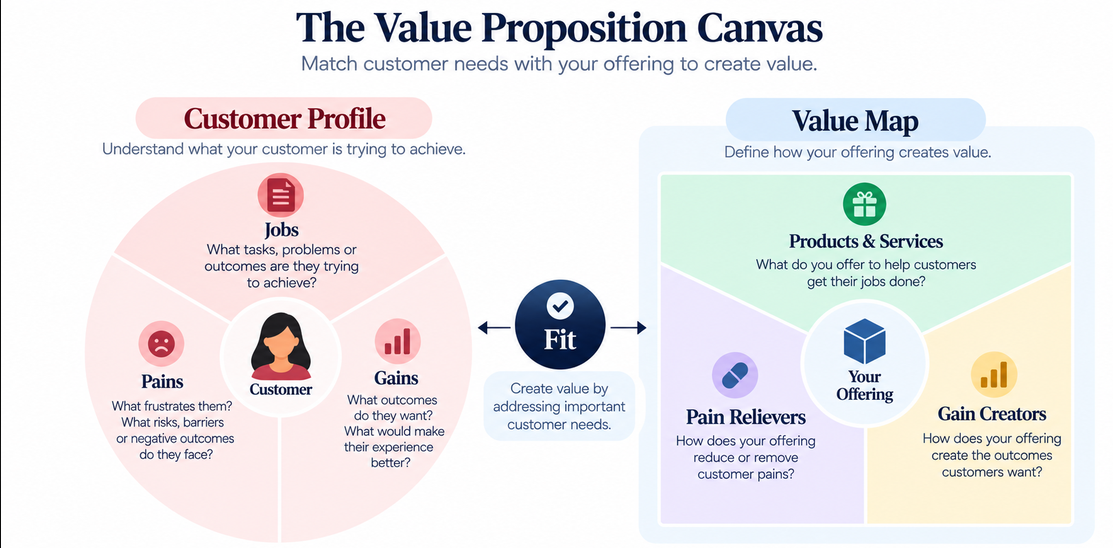
The framework has two sides: the Customer Profile and the Value Map. Together, they cover six areas: Jobs, Pains, Gains, Products & Services, Pain Relievers, and Gain Creators.
The key idea is simple: understand customer needs first, then connect your offering to them. This guide explains the framework, how to fill it out, a practical template, an Indian brand example, and how GenAI can assist the process.
How Does the Value Proposition Canvas Work?
The Value Proposition Canvas works by connecting what customers need with how an offering creates value.
Its two sides are:
| Side | Components | Main focus |
|---|---|---|
| Customer Profile | Jobs, Pains, Gains | What the customer is trying to achieve |
| Value Map | Products & Services, Pain Relievers, Gain Creators | How the business creates value |
| Fit | Matches between the two | Whether important needs are being addressed |
The framework was created as a more detailed complement to the Business Model Canvas. It zooms in on the customer segment and value proposition rather than describing the entire business model.
The basic flow is:
Customer Profile → Value Map → Fit → Test and refine
The important part is the last step. Filling both sides does not automatically mean you have product-market fit. Strategyzer describes fit as something that must be tested against customer evidence.
What are the 6 Components of the Value Proposition Canvas?
The six components are divided into three customer needs and three parts of the offering.
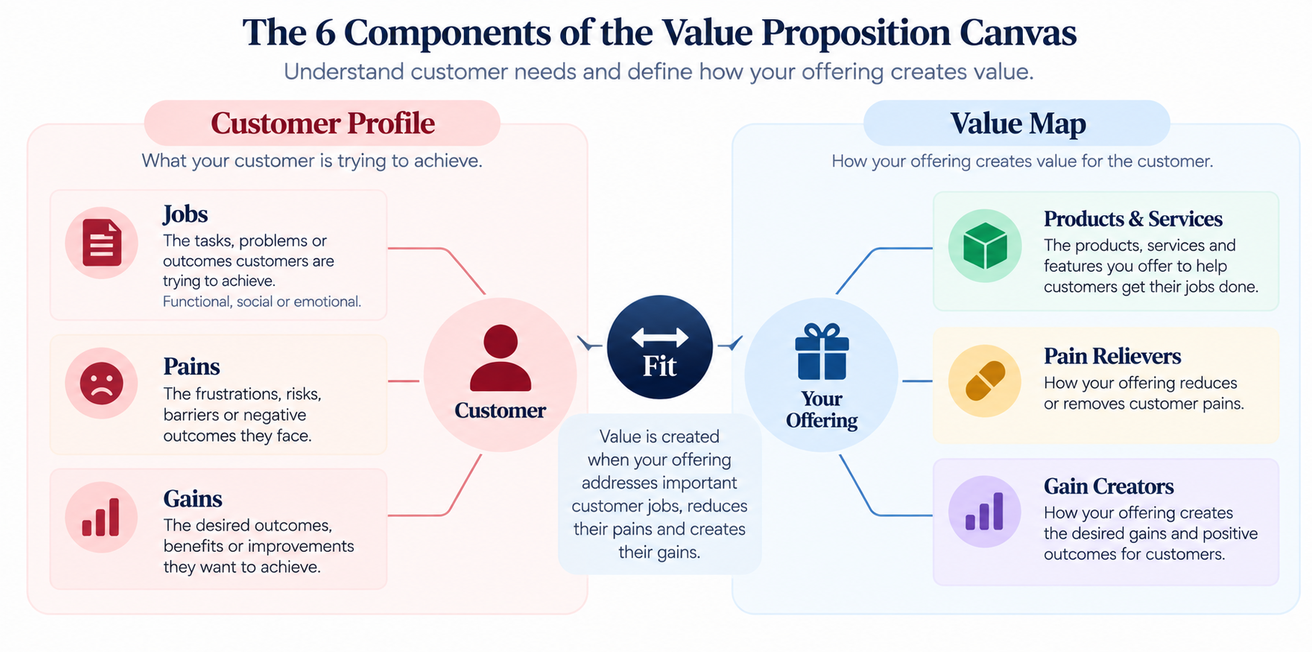
Customer Jobs
Customer jobs are the things customers are trying to get done.
These can be:
- Functional: completing a task or solving a practical problem
- Social: achieving a social outcome or impression
- Emotional: feeling a certain way or reducing emotional difficulty
For example, a customer using a food-delivery platform may want to order dinner quickly, but may also want variety and a convenient experience.
Customer Pains
Pains are the problems customers face while trying to complete their jobs.
They can include:
- Frustrations
- Risks
- Delays
- High costs
- Complexity
- Poor experiences
- Barriers to getting the job done
A pain should describe something that actually matters to the customer, rather than every minor inconvenience.
Customer Gains
Gains are the outcomes customers want to achieve.
These may include:
- Saving time
- Reducing effort
- Better performance
- Greater convenience
- Lower risk
- Better quality
- A more satisfying experience
Gains are not simply the opposite of pains. A gain describes a desired outcome, while a pain describes a problem or negative experience.
Products & Services
This section lists what the business actually offers.
It can include:
- Products
- Services
- Features
- Supporting services
The important distinction is that Products & Services describe the offering, not its value.
Pain Relievers
Pain relievers explain how the offering reduces specific customer pains.
For example, real-time delivery tracking could reduce the uncertainty of not knowing when an order will arrive.
Gain Creators
Gain creators explain how the offering produces desired customer outcomes.
For example, a wide range of restaurants can create greater choice for someone who wants variety.
The 6 Components at a Glance
| Component | What it captures | Key question |
|---|---|---|
| Jobs | What customers are trying to accomplish | What does the customer need to get done? |
| Pains | Problems and frustrations | What makes the job difficult? |
| Gains | Desired outcomes | What would make the experience better? |
| Products & Services | What you offer | What are we providing? |
| Pain Relievers | How you reduce problems | How does our offer address important pains? |
| Gain Creators | How you create benefits | How does our offer create desired gains? |
How Do You Fill Out a Value Proposition Canvas?
Fill the canvas from the customer side first, then map your offering to those needs.
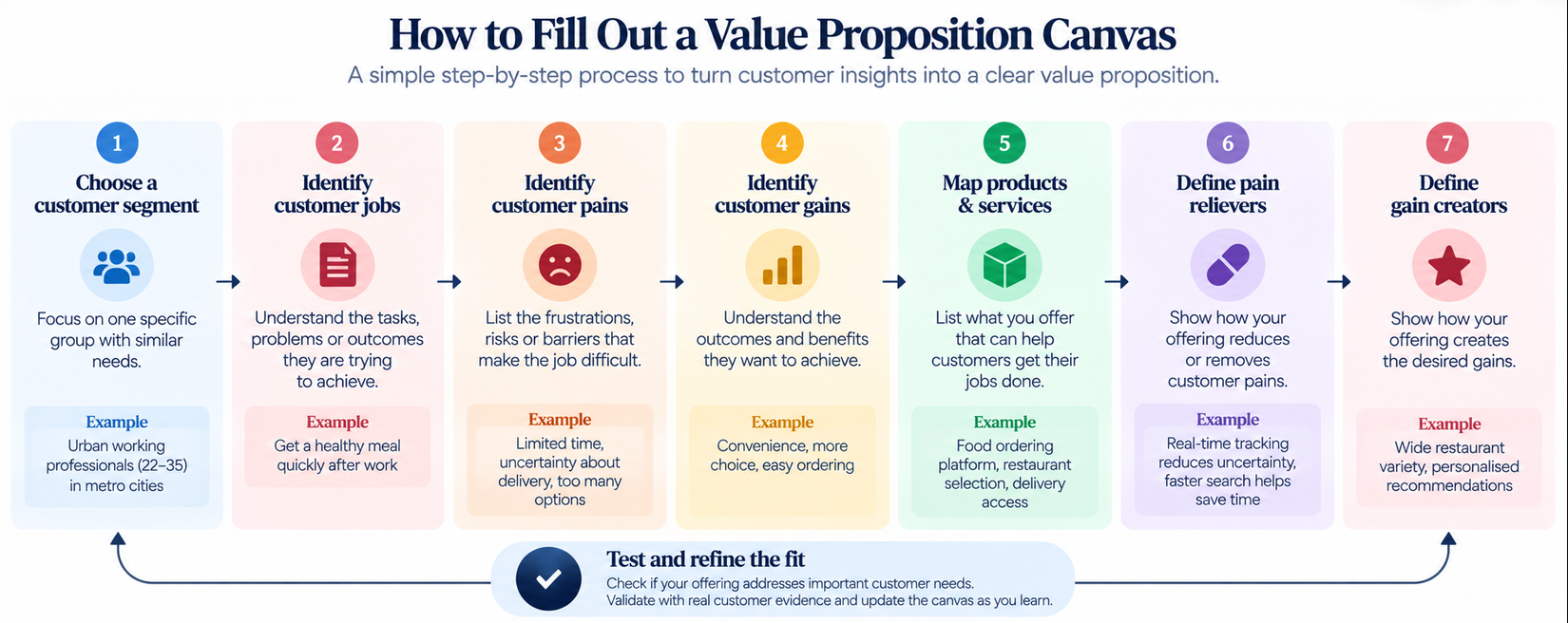
1. Choose One Customer Segment
Do not create a canvas for “everyone.”
Choose a specific customer group with reasonably similar needs, such as first-time skincare buyers or small-business owners managing their own marketing.
2. Identify Customer Jobs
Ask:
- What is this customer trying to accomplish?
- What task are they trying to complete?
- What social or emotional outcome matters to them?
Use interviews, reviews, surveys, search behaviour or other customer evidence where possible.
3. Identify Customer Pains
List the obstacles, frustrations, risks and costs connected to those jobs.
Then prioritise them. A long list of minor complaints is less useful than three important pains that strongly influence buying behaviour.
4. Identify Customer Gains
Ask what customers want beyond simply avoiding problems.
Look for desired outcomes such as speed, convenience, savings, better performance or confidence.
5. Map Products and Services
Now list the parts of your offering that are relevant to this customer segment.
Avoid turning this into a feature dump.
6. Identify Pain Relievers
Connect specific parts of your offering to specific pains.
Pain → Pain Reliever
For example:
Uncertainty about delivery → Real-time order tracking
7. Identify Gain Creators
Connect the offering to desired gains.
Desired gain → Gain Creator
For example:
More food choices → Large restaurant selection
8. Prioritise and Test the Fit
The final step is to identify the strongest matches.
Ask:
- Does the offering address an important pain?
- Does it create a meaningful gain?
- Is this need supported by customer evidence?
- Would solving it affect the customer’s decision?
The canvas should guide testing, not replace it.
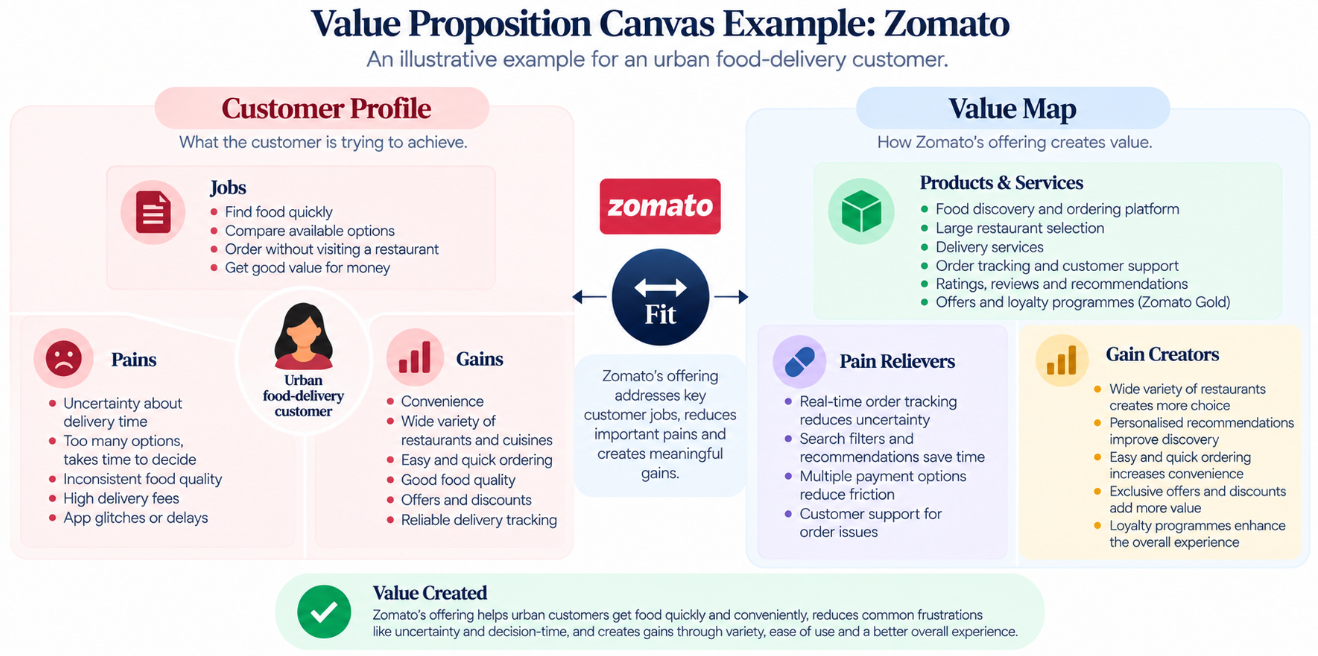
Value Proposition Canvas Example: Zomato and an Urban Food-Delivery Customer
The following is an illustrative application, not a claim about Zomato’s internal strategy.
Imagine an urban customer who wants convenient food ordering after a busy workday.
Customer Profile
Jobs
- Find food quickly
- Compare available options
- Order without visiting a restaurant
Pains
- Uncertainty about delivery
- Difficulty deciding what to order
- Time spent searching
Gains
- Convenience
- More choice
- Easier ordering
Value Map
Products & Services
- Food discovery and ordering
- Restaurant selection
- Delivery access
- Order information
Pain Relievers
- Delivery tracking can reduce uncertainty.
- Search and discovery can reduce time spent finding food.
Gain Creators
- Restaurant variety creates more choice.
- Digital ordering makes the process more convenient.
What Does the Fit Look Like?
| Customer insight | Relevant offering | Value created |
|---|---|---|
| Wants convenient food discovery | Food discovery platform | Easier search |
| Faces uncertainty around delivery | Order tracking and information | Greater visibility |
| Wants variety | Large restaurant selection | More choice |
The important point is not the number of features. It is the connection between a customer need and a specific part of the offering.
Value Proposition Canvas Template
A useful value proposition canvas template should capture the customer need, the proposed response and the evidence behind it.
Blank Value Proposition Canvas Template
| Customer Profile | Value Map | Evidence / Notes |
|---|---|---|
| Jobs: What customers are trying to accomplish | Products & Services: What you offer | Source or evidence |
| Pains: Problems and frustrations | Pain Relievers: How you address them | Source or evidence |
| Gains: Desired outcomes | Gain Creators: How you create them | Source or evidence |
Questions to Ask While Filling the Template
Jobs
- What is the customer trying to get done?
- What outcome are they responsible for?
Pains
- What frustrates them?
- What creates risk, delay or extra effort?
Gains
- What outcome do they want?
- What would make the experience significantly better?
Value Map
- Which offering addresses each important pain?
- Which offering creates each important gain?
- Which claims are supported by actual customer evidence?
Keeping an evidence column is useful because it stops the canvas from becoming a collection of internal assumptions.
Value Proposition Canvas vs Business Model Canvas
The Value Proposition Canvas focuses narrowly on customer-value fit, while the Business Model Canvas looks at the broader business model.
| Aspect | Value Proposition Canvas | Business Model Canvas |
|---|---|---|
| Focus | Customer-value fit | Overall business model |
| Scope | Customer Profile + Value Map | Nine business-model blocks |
| Main question | Does our offering address important customer needs? | How does the business create, deliver and capture value? |
How Do the Two Frameworks Work Together?
Think of the Value Proposition Canvas as a zoomed-in view of two parts of the Business Model Canvas: the customer segment and value proposition. Strategyzer describes the VPC as a complementary tool rather than a replacement for the Business Model Canvas.
A practical sequence is:
Business Model Canvas → Zoom into customer + value proposition → Test the fit → Refine the business model
How Can AI Assist With a Value Proposition Canvas?
GenAI can make research-heavy parts of the canvas faster, but it should support customer research rather than replace it.
Analyse Customer Research With GenAI
AI can help organise appropriately anonymised:
- Customer interviews
- Survey responses
- Reviews
- Support conversations
- Search and feedback data
It can group repeated themes and surface patterns that would take longer to organise manually.
Generate Jobs, Pains and Gains Hypotheses
AI can turn recurring patterns into candidate Jobs, Pains and Gains.
For example, instead of manually reviewing hundreds of reviews, a marketer could ask AI to identify recurring complaints and desired outcomes.
These are hypotheses until validated.
Map Needs to Pain Relievers and Gain Creators
Once customer needs are established, AI can suggest possible matches between:
Customer pain → Pain reliever
and
Customer gain → Gain creator
This order matters. Starting with product features and asking AI to find customers for them can reinforce internal assumptions.
Compare Alternative Value Propositions
GenAI can also help create several value proposition options for the same customer segment.
Teams can then compare:
- Which pain each option addresses
- Which gain it creates
- What evidence supports it
- What still needs testing
Validate AI-Generated Insights
AI should not invent customer needs or declare product-market fit.
Strategyzer’s current approach also emphasises using AI to structure customer profiles while moving toward verified, evidence-backed insights.
Example GenAI Prompt
Analyse these anonymised customer research notes. Identify recurring customer jobs, pains and gains. Separate directly observed evidence from inferred patterns. Then suggest potential pain relievers and gain creators using only insights supported by the research.
Conclusion
The Value Proposition Canvas gives teams a simple way to connect customer needs with business offerings. Its six components help separate what customers are trying to achieve from the ways a product or service can create value.
The strongest canvas is not the one with the most ideas. It is the one where the most important customer needs are supported by evidence and connected to a clear offering. Use the canvas as a starting point, test its assumptions, and refine it as you learn more.
Want to build practical AI-powered marketing skills alongside frameworks like the Value Proposition Canvas? Explore the IIM Trichy AI-Powered Marketing & Growth Strategy programme.
Frequently Asked Questions
When should a business use a Value Proposition Canvas?
Use it when you need to understand a specific customer segment better, improve an existing offer, or test whether an idea addresses a meaningful customer need.
Can a business create more than one Value Proposition Canvas?
Yes. Different customer segments may have different Jobs, Pains and Gains, so separate canvases can make sense when their needs or buying decisions differ significantly.
Should features be included in a Value Proposition Canvas?
Yes, but mainly under Products & Services. Features should then be connected to specific Pain Relievers or Gain Creators instead of being presented as value on their own.
How many Jobs, Pains and Gains should a canvas have?
There is no fixed number. Start broad enough to capture the important patterns, then prioritise the needs that have the greatest impact on the customer’s decision.
Is the Value Proposition Canvas only for new products?
No. It can also be used to improve existing products, reposition an offer, enter a new market or understand why customers are choosing competitors.
Can the Value Proposition Canvas help with marketing messaging?
Yes. The customer language, pains, desired gains and decision factors can help marketers create more relevant messaging and content.
How is the Value Proposition Canvas different from a buyer persona?
A buyer persona describes a type of buyer more broadly, while the Value Proposition Canvas focuses specifically on that customer’s Jobs, Pains and Gains and how an offering responds to them.
Does the Value Proposition Canvas prove product-market fit?
No. It helps teams create and organise hypotheses about customer value. Those hypotheses still need to be tested with real customer evidence.
Can startups use the Value Proposition Canvas?
Yes. It is particularly useful for early-stage teams because it helps them examine customer needs before investing heavily in a product or proposition.
Can AI create a Value Proposition Canvas automatically?
AI can help draft and organise a canvas from customer research, but the output should be treated as a hypothesis. Human review and customer validation are still necessary.
What is the biggest mistake when using the Value Proposition Canvas?
Starting with the product instead of the customer. A team may list its favourite features and then try to find pains they supposedly solve. The stronger approach is to understand customer needs first and build the Value Map around them.
How often should a Value Proposition Canvas be updated?
Update it when new customer research, product changes, market shifts or buying behaviour reveal that the existing assumptions no longer hold.