AI Lead Generation: Tools & Tactics That Actually Work

Key Insights
- AI improves lead quality, not just volume: Better targeting and qualification matter more than generating a large number of contacts.
- The strongest tactics solve specific problems: Predictive scoring prioritises leads, intent data highlights potential buying interest, and AI chat supports lead capture.
- Tools are not interchangeable: Apollo supports prospecting, Clay supports enrichment workflows, HubSpot supports CRM and lead management, while platforms such as 6sense focus on account intelligence.
- Free tools have limits: Credits, integrations, automation and AI usage may be restricted by plan.
- Agentic AI connects multiple tasks: An AI SDR workflow can research accounts, prepare outreach, interpret responses and route qualified prospects to sales.
- Human oversight remains necessary: Verify prospect data, review important messages and set clear limits on automated actions.
- Measure commercial outcomes: Track qualified opportunities, conversion rates, pipeline and customer acquisition cost instead of relying on lead counts alone.
AI lead generation helps marketing and sales teams find suitable prospects, identify buying signals and focus on leads most likely to convert. Instead of simply increasing lead volume, the goal is to generate qualified opportunities that can turn into customers.
AI can support prospect research, lead scoring, personalised outreach, lead capture and sales follow-ups. Its effectiveness depends on reliable data, clear qualification criteria and regular performance reviews.
How Does AI Lead Generation Work?
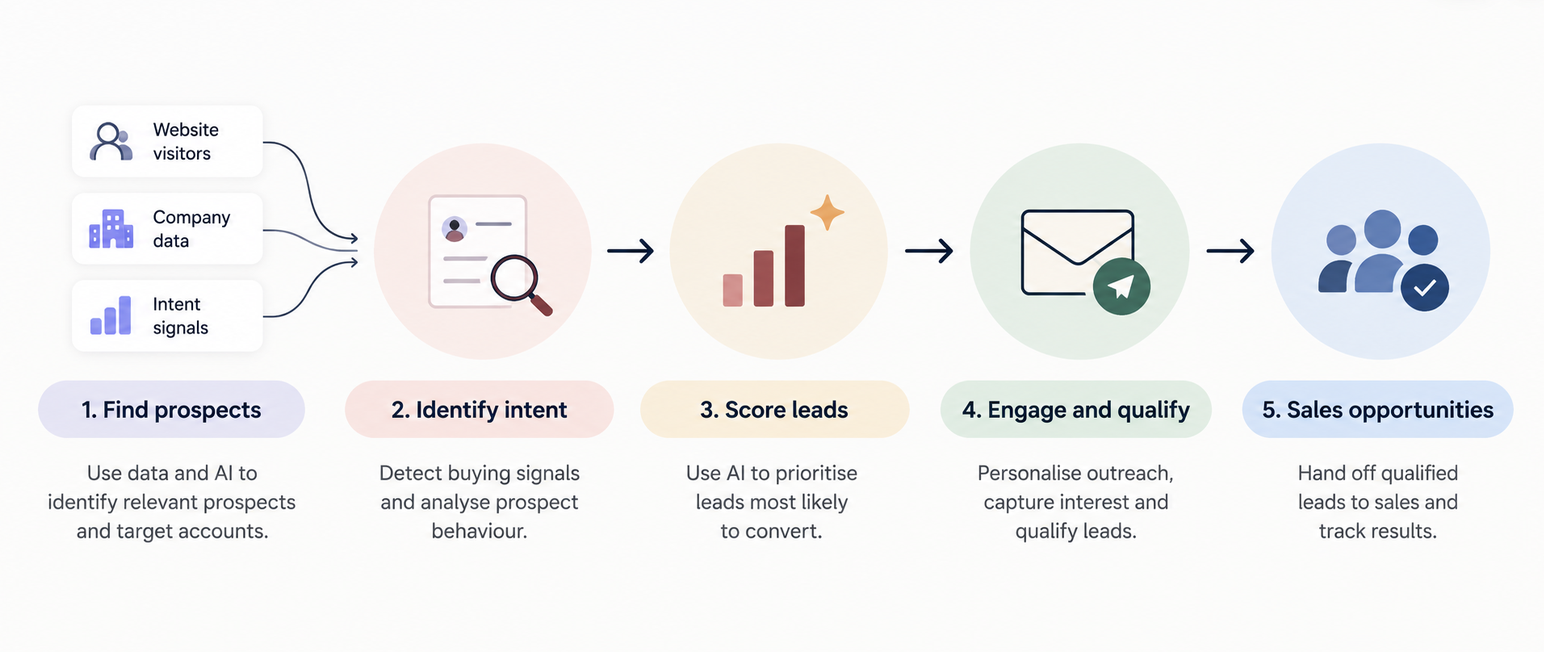
AI lead generation helps teams move from finding prospects to identifying, qualifying and engaging potential customers.
Traditional vs AI-assisted lead generation
| Traditional approach | AI-assisted approach |
|---|---|
| Research prospects manually | Enrich prospect data and automate research |
| Apply fixed qualification rules | Use scoring models alongside defined criteria |
| Send broad outreach messages | Draft messages using verified prospect context |
| Sort and assign leads manually | Route leads using predefined rules and relevant signals |
AI can support prospect research, data enrichment, lead scoring, intent detection, personalised outreach, chat-based qualification and lead routing. The level of automation depends on the tools, data available and workflow design.
AI does not remove the need for a clear ideal customer profile (ICP). Teams still need to define which prospects they want, verify the information used and review whether the leads generated are turning into opportunities.
AI vs Automation vs Agentic AI
These terms describe different capabilities:
- Automation: Follows predefined rules. For example, a form submission can trigger a CRM update and assign the lead to a salesperson.
- AI: Analyses data, identifies patterns, makes predictions or generates content. For example, a model can estimate which leads are more likely to convert.
- Agentic AI: Coordinates multiple tasks towards a defined goal. For example, an agentic workflow might research an account, prepare outreach, interpret a response and route a qualified prospect to sales.
These capabilities can work together. Automation handles predictable tasks, AI supports analysis and content generation, and agentic workflows connect tasks across a process. Human review remains important where accuracy, privacy or business risk is involved.
Which AI Lead Generation Tactics Actually Work?
The most useful tactics address a specific bottleneck. Before adding another tool, identify whether the problem lies in prospect quality, buying-intent visibility, lead qualification, outreach relevance or sales follow-up.
Predictive Lead Scoring
Predictive lead scoring uses historical customer and conversion data to estimate which prospects are more likely to become customers.
Depending on the available data, a model may consider:
- Behaviour: Pages visited, resources downloaded or product features explored.
- Firmographic or demographic data: Company size, industry, role, location or other relevant characteristics.
- Engagement: Responses to campaigns, event participation and meaningful interactions.
- Previous conversions: Patterns among leads that became customers.
- Product activity: Trial usage, repeat visits or other relevant product signals.
Marketing use: Prioritise sales attention instead of treating every lead equally.
For example, a B2B software company might prioritise a prospect whose company fits its ICP, whose role is relevant and whose recent activity suggests a specific business need.
Scoring is only as reliable as the data and outcomes used to develop it. Teams should review whether high-scoring leads actually convert and update the model when customer behaviour changes.
Intent Data
Intent data helps teams identify signals that a prospect or organisation may be researching a product, service or business problem.
Useful signals can include:
- Relevant website visits and repeat engagement
- Consumption of product-related content
- Searches or research activity captured by legitimate data providers
- Increased engagement across a buying group
- Relevant company events, such as expansion, hiring or funding
Marketing use: Focus campaigns and sales research on accounts showing potentially relevant interest.
For example, a cybersecurity vendor might prioritise an account that has recently engaged with content about compliance and threat detection, provided those topics match the vendor’s offering.
Intent is a signal, not proof of readiness to buy. A prospect may be researching for academic purposes, comparing alternatives or gathering information well before making a purchase. Combine intent with fit, engagement and direct qualification.
AI Chat for Lead Capture and Qualification
Website visitors often leave without completing a form because the process feels lengthy or their question remains unanswered. AI-powered chat can help capture relevant information while guiding visitors towards an appropriate next step.
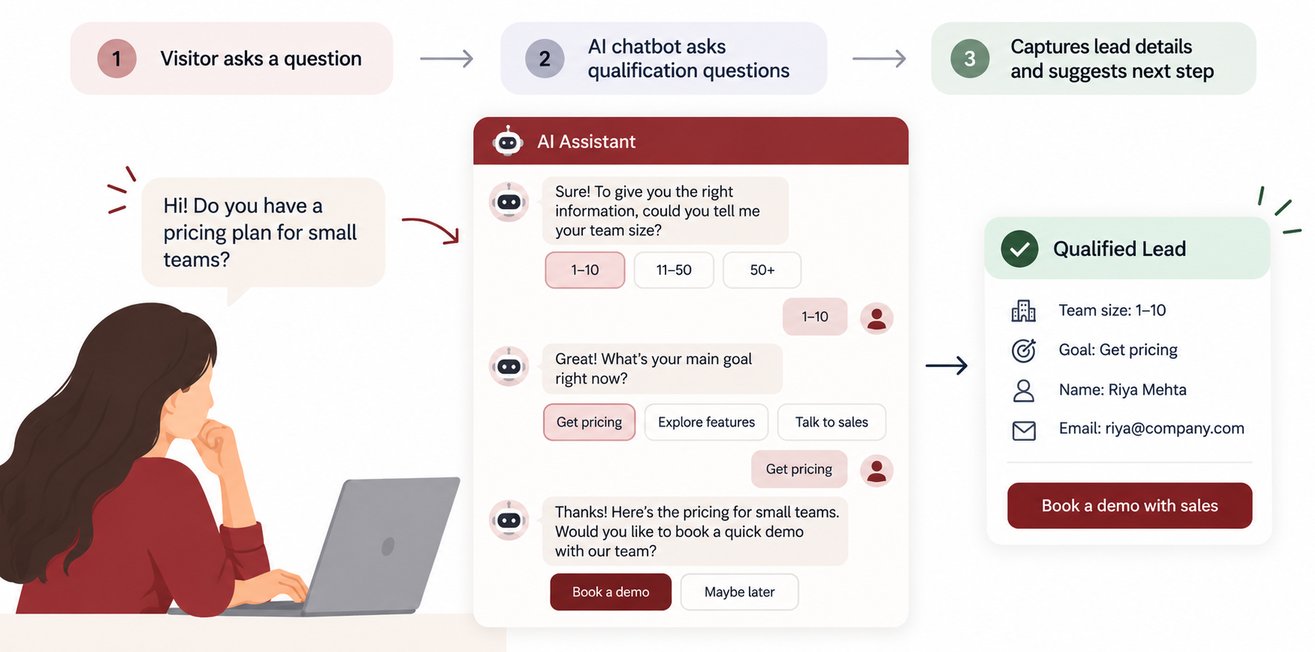
Common applications include:
- Answering product and pricing FAQs
- Asking qualification questions
- Capturing contact details with appropriate consent
- Identifying the visitor’s needs and use case
- Booking meetings
- Routing qualified prospects to the right team
Marketing use: Turn relevant website visits into identifiable, qualified opportunities.
A software company’s website assistant might ask about company size, the problem a visitor wants to solve and their preferred implementation timeline. Based on the answers, it can suggest relevant resources or offer a meeting with sales.
Keep qualification questions short and relevant. Make it easy for visitors to reach a human, and avoid presenting uncertain AI-generated answers as established facts.
Personalised AI Outreach
AI can reduce the research and drafting time involved in email and LinkedIn outreach. It can help sales teams adapt messages to an account’s industry, role, stated priorities and relevant business context.
Applications include:
- Researching target accounts
- Drafting personalised opening lines
- Adapting email and LinkedIn messages
- Creating variations for different audience segments
- Suggesting relevant follow-ups and timing
Marketing use: Make outreach more relevant without requiring every message to be written from scratch.
For example, a message to an operations leader could focus on reducing manual reporting, while a message to a finance leader at the same company might focus on cost visibility. Both should be grounded in the recipient’s role and credible evidence about the business.
The main guardrail is simple: personalisation must be based on real context, not invented details. Review AI-generated messages for accuracy, relevance, tone and compliance before sending them at scale. Test positive replies and qualified meetings, not just email opens.
AI-Powered Lookalike Audiences
Lookalike modelling helps marketers find prospects or audiences that share characteristics with existing high-value customers. AI can identify patterns across customer attributes, behaviours and transactions to support audience expansion.
Relevant inputs may include:
- Characteristics of existing customers
- Behavioural and engagement patterns
- Account or company attributes
- Purchase history and transaction data
- Paid-media audience signals
Marketing use: Expand campaigns beyond existing audiences while maintaining a connection to the characteristics of valuable customers.
B2B lookalike strategies often rely more heavily on firmographic information, account attributes and professional roles. B2C models may use behavioural and transaction data across larger audiences.
The quality of the seed audience matters. If the existing customer group contains poor-fit or low-value customers, the model may reproduce those patterns. Use appropriate data permissions, exclude unsuitable segments and assess the quality of the leads generated.
What Are the Best AI Lead Generation Tools?
The right tool depends on the task you need to improve. Some platforms help you find prospects, while others focus on enrichment, CRM management, account intelligence or website conversations.
| Tool | Best for | Access model |
|---|---|---|
| Apollo | Prospect discovery, contact data and outbound sales workflows | Free plan and paid tiers |
| Clay | Data enrichment and AI-assisted prospect research | Free plan and paid tiers |
| HubSpot | CRM, forms, contact management and lead capture | Free tools and paid tiers |
| 6sense | B2B account intelligence and buying-intent insights | Contact provider for current plan details |
| Qualified | AI-powered website conversations, email engagement and meeting booking | Custom-priced paid plans |
| Instantly | Outbound email campaigns and sequencing | Paid plans and limited trial access |
| Landbot | Conversational forms and chatbot-based lead capture | Free plan and paid tiers |
Tool features, usage limits and pricing can change. Check the provider’s current plan details before choosing a platform.
How to Choose the Right Tool
- Need more prospects? Start with prospecting and data-enrichment tools.
- Need better prioritisation? Evaluate lead scoring and intent data.
- Want to capture website enquiries? Consider conversational forms or AI chat.
- Need more consistent follow-ups? Look at CRM automation and outreach platforms.
- Need account-level buying signals? Evaluate B2B account-intelligence platforms.
Choose based on your workflow, data coverage, integrations, budget and measurable business needs, rather than the number of AI features advertised.
How Do Agentic AI SDR Workflows Work?
Agentic AI SDR workflows connect multiple sales tasks, from prospect research to outreach and lead qualification. They can reduce manual work by coordinating these steps through connected tools and predefined rules.
What Is an AI SDR?
A traditional sales development representative (SDR) researches prospects, contacts potential customers, follows up and qualifies leads before passing suitable opportunities to sales.
An AI SDR uses AI to assist with these tasks. Depending on the platform, it can research accounts, draft outreach, analyse replies and update CRM records.
The key difference: An AI SDR can automate parts of the sales process, while an agentic workflow connects multiple tasks towards a defined goal. Human oversight remains essential for accuracy, sensitive conversations and important decisions.
Example Agentic SDR Workflow
A structured AI lead-generation workflow may follow these steps:
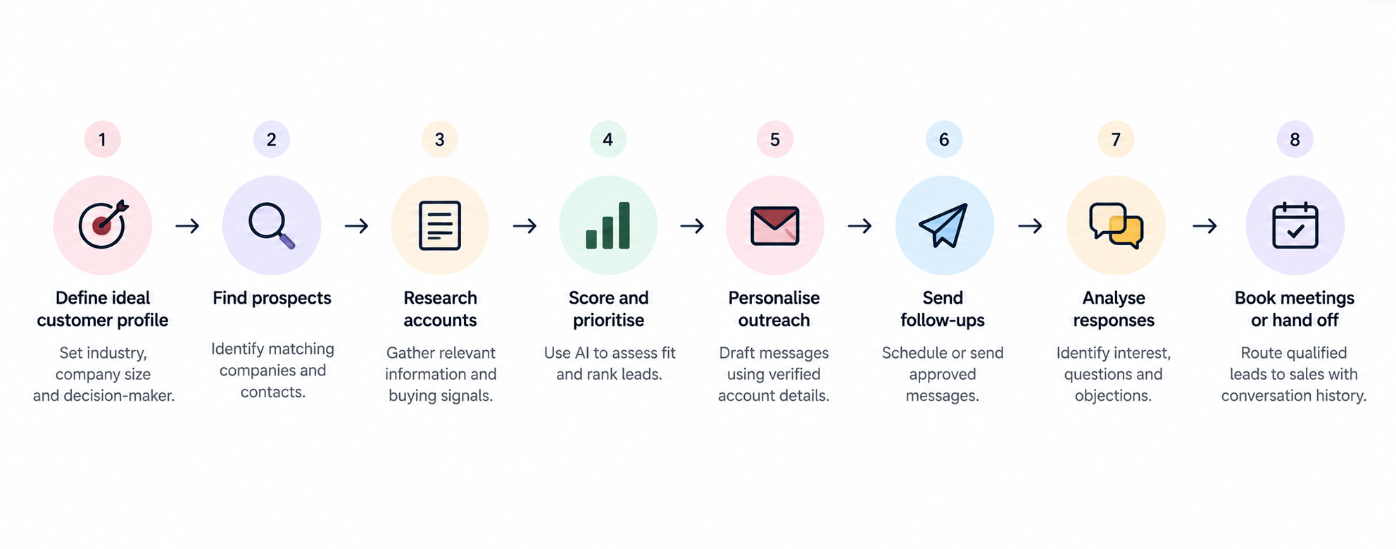
- Identify the ideal customer: Define the target industry, company size and decision-maker.
- Find prospects: Identify matching companies and contacts.
- Research accounts: Gather relevant company information and buying signals.
- Qualify and prioritise leads: Check data, assess fit and assign lead scores.
- Personalise outreach: Draft emails based on verified prospect information.
- Send follow-ups: Schedule or send approved messages.
- Analyse responses: Identify interest, objections and qualification signals.
- Book meetings or hand off leads: Route qualified prospects to a human SDR with their interaction history.
This workflow can reduce repetitive research and administrative work, but each stage depends on the quality of the previous one. Incorrect account data can produce irrelevant messages, while weak qualification criteria can send unsuitable leads to sales.
Where Humans Still Need to Be Involved
Human oversight should be built into the workflow, particularly for:
- Approving ICP criteria and qualification rules
- Setting outreach boundaries and permitted data sources
- Reviewing sensitive or high-value accounts
- Checking high-impact messages and claims
- Handling complex objections or unusual requests
- Taking over qualified conversations
- Monitoring errors, complaints and unintended outcomes
A useful design gives the AI clear responsibilities and limits. It should know when to act, when to ask for approval and when to hand the conversation to a person.
Which Metrics Should You Track for AI Lead Generation?
AI lead generation should be measured across three areas: lead quality, workflow performance and commercial outcomes. Activity metrics alone cannot show whether the system is generating useful business opportunities.
Lead and Funnel Metrics
These metrics show whether leads are progressing through the funnel:
- Qualified leads: Number of leads that meet the team’s qualification criteria.
- MQL-to-SQL rate: Share of marketing-qualified leads accepted as sales-qualified leads.
- Lead-to-opportunity conversion: Share of leads that become sales opportunities.
- Meeting-booking rate: Share of relevant prospects who book a meeting.
- Cost per lead: Total acquisition cost divided by the number of leads generated.
Use consistent definitions. If marketing and sales classify leads differently, changes in conversion rates may reflect inconsistent reporting rather than improved performance.
AI Workflow Metrics
These metrics help evaluate the system itself:
- Lead enrichment accuracy: Percentage of enriched fields verified as correct.
- Lead-scoring precision: Proportion of leads classified as high priority that meet the chosen outcome criteria.
- Chat qualification rate: Share of relevant chat interactions that produce qualified leads.
- Outreach reply rate: Share of delivered outreach messages receiving a response.
- Positive reply rate: Share of messages receiving a genuinely interested or relevant response.
- Human handoff rate: Share of AI-handled interactions escalated to a person.
A higher handoff rate is not necessarily a problem. It may indicate that the workflow is correctly identifying conversations that need human judgement.
Revenue Metrics
Ultimately, AI lead generation should contribute to commercial results. Track:
- Opportunities created
- Qualified pipeline generated
- Customer acquisition cost (CAC)
- Revenue per lead
- Lead-to-customer conversion rate
- Revenue influenced or generated
Where possible, compare performance against a baseline or a control group. Account for changes in campaign spend, audience, seasonality and sales follow-up before attributing improvements to AI.
The central question is not whether AI generated more leads. It is whether it helped generate more qualified opportunities at an acceptable acquisition cost.
Build Practical Skills in AI-Powered Marketing
AI lead generation combines data analysis, predictive intelligence, automation and customer engagement. Teams get the most value when they connect these capabilities to clear business objectives, reliable data and measurable outcomes.
Want to build practical skills in AI-powered marketing? Explore the IIM Tiruchirappalli AI-Powered Marketing & Growth Strategy programme on Varsity to review the programme details and decide whether it fits your goals.
FAQs
1. How do you prevent AI from generating low-quality leads?
Start with a clearly defined ideal customer profile and explicit qualification criteria. Validate contact and company data, combine scoring with relevant intent signals, and review whether leads progress to sales opportunities. Feed conversion outcomes back into the process so that scoring and targeting can improve over time.
2. How much customer data does AI need to score leads effectively?
Predictive scoring generally benefits from sufficient historical data showing which leads converted and which did not. The amount needed depends on the model, the complexity of the sales process and the consistency of the data. Teams with limited history can begin with transparent rules and AI-assisted prioritisation, then evaluate whether they have enough reliable outcomes for predictive modelling.
3. How can you tell whether AI personalisation is improving outreach?
Compare AI-assisted outreach with a suitable baseline or control group. Track positive replies, qualified meetings, opportunities and downstream conversion, not just open rates. Keep the audience and campaign conditions as consistent as possible, and check whether personalisation improves relevance rather than simply increasing message volume.
4. Should AI SDRs send messages without human approval?
That depends on the audience, message risk, brand requirements and the system’s reliability. Teams may permit routine, low-risk actions within strict rules while requiring approval for sensitive claims, high-value accounts or unusual situations. Outreach should follow applicable privacy, consent and anti-spam requirements, with clear escalation and opt-out handling.
5. How do you avoid AI-generated outreach sounding generic?
Give the system verified information about the account, recipient’s role and relevant business context. Ask it to connect that evidence to a specific problem rather than inserting superficial personal details. Keep messages concise, remove unsupported claims and have a human review important communications.
6. What happens when intent data and lead scoring disagree?
Treat the disagreement as a reason to investigate rather than automatically choosing one signal. A high-fit account with low recent intent may still be valuable for long-term nurturing, while a high-intent but poor-fit lead may not be worth immediate sales attention. Combine fit, intent, engagement and qualification, and establish clear rules for prioritisation.
7. How should B2B and B2C teams use AI lead generation differently?
B2B teams often focus on company fit, buying-group roles, account-level intent and longer sales cycles. B2C teams may work with larger volumes of behavioural, engagement and transaction data. Both can use scoring, personalisation and automation, but their qualification criteria, privacy obligations and definitions of conversion differ.
8. When should a company build an AI lead-generation workflow instead of buying another tool?
Consider building a workflow when the team has a clear, repeatable process, reliable data and integration needs that existing products do not address. Buying a tool is often simpler when the requirement is standard, such as prospect discovery, CRM management or conversational forms. Compare implementation effort, maintenance, integration costs and governance requirements before deciding.
9. How do you measure whether an AI SDR is genuinely replacing manual work?
Measure the time spent on research, data entry, drafting, follow-ups and qualification before and after implementation. Then compare those savings with lead quality, qualified pipeline, conversion rates and revenue outcomes. Reduced manual effort is useful only if the workflow continues to produce reliable results and does not create additional correction work for the sales team.