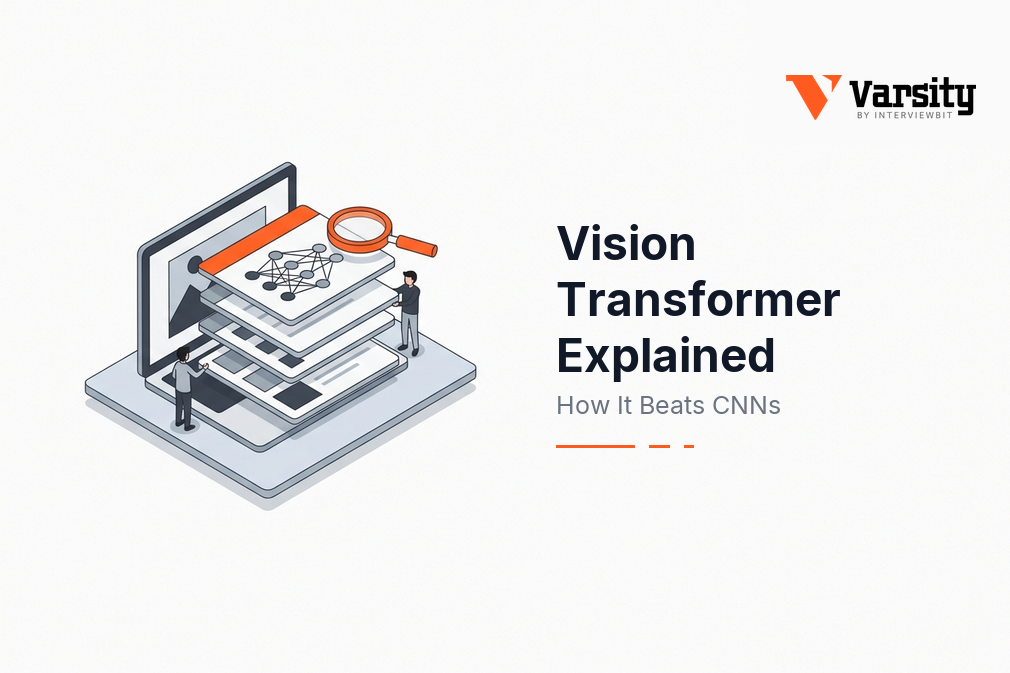
Vision Transformer (ViT) Explained: How It Beats CNNs

Key Insights
- A Vision Transformer (ViT) processes images as sequences of patches, using Transformer encoder layers and self-attention to learn relationships between visual regions.
- ViT architecture combines patch embeddings, a learnable [CLS] token, positional embeddings and Transformer encoder layers to generate representations for image classification.
- Unlike CNNs, which have built-in locality and translation-equivariance biases, ViT can model global relationships between image patches but often benefits from large-scale pre-training.
- ViT can match or outperform CNNs under suitable training conditions, but performance depends on the dataset, model configuration, image resolution and computational resources.
- DeiT improves data efficiency through techniques such as knowledge distillation, while Swin Transformer uses hierarchical representations and shifted-window attention.
- Hugging Face provides pre-trained ViT checkpoints and an image-classification pipeline, enabling developers to run inference and fine-tune models for custom datasets.
A Vision Transformer (ViT) is a deep learning architecture that applies the Transformer model, originally developed for natural language processing, to computer vision. Instead of relying on traditional convolutional layers, a ViT divides an image into fixed-size patches, converts them into embeddings and processes them as a sequence using self-attention. With suitable pre-training and sufficient data, this approach can match or outperform convolutional neural networks (CNNs) on image recognition tasks.
But how can a model understand an image by treating it like a sequence of tokens? The answer lies in how ViT captures relationships between different image regions. This guide breaks down the vision transformer architecture, from patch embeddings and positional encodings to the [CLS] token and Transformer encoder. It also compares ViT with CNNs, explores variants such as DeiT and Swin Transformer, and walks through image classification using Python and Hugging Face.
Why Use Transformers for Computer Vision?
Transformers offer an alternative to conventional convolutional architectures by using self-attention to model relationships between different parts of an image. This makes them useful when visual recognition depends on both local details and broader context.
How do CNNs process images?
Convolutional neural networks apply filters across local image regions to identify patterns such as edges, textures and shapes. As information passes through successive layers, these local features combine into increasingly complex representations.
CNNs also have useful inductive biases: locality encourages the model to learn nearby relationships, while translation equivariance allows detected patterns to respond consistently when their position shifts. These properties can make CNNs effective when training data is limited.
What does self-attention add to vision?
Self-attention allows image regions to exchange information directly. For example, recognising an animal may require connecting its head, body and legs, even when those features appear far apart in an image.
This ability to model broader relationships is a central motivation behind the vision transformer model. However, global self-attention can become computationally expensive as the number of image patches increases.
Vision Transformer Architecture
The vision transformer architecture converts an image into a sequence of patch embeddings, adds a classification token and positional information, and processes the sequence through Transformer encoder layers. The resulting representation can then be used to predict an image class.
How does image patching and patch embedding work?
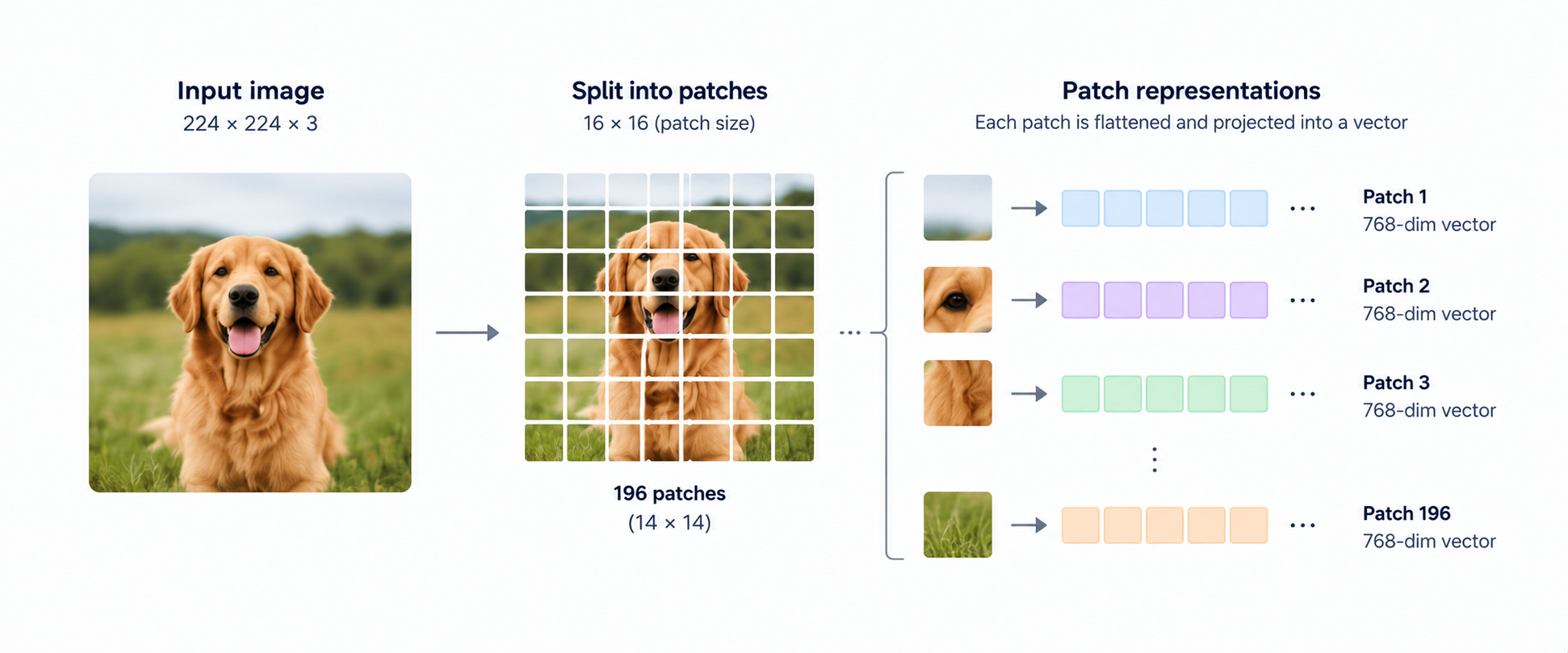
A standard ViT divides an image into non-overlapping patches, commonly 16 × 16 pixels in a Patch16 configuration. Each patch is flattened and projected into a vector of a fixed embedding dimension. This process is called vision transformer patch embedding.
Consider a 224 × 224 RGB image divided into 16 × 16 patches:
- The image produces 14 patches along each dimension.
- The total is 14 × 14 = 196 image patches.
- Each patch becomes an embedding that the Transformer can process.
This converts the image into a sequence of visual tokens rather than processing it exclusively through convolutional filters.
What are the CLS token and positional embeddings?
The [CLS] token in a vision transformer is a learnable token prepended to the patch sequence. As it passes through the encoder, its representation gathers information useful for the classification task. A classification head uses the final [CLS] representation to produce class scores.
The model also adds positional encoding in ViT to indicate where patches originated in the image. Without positional information, the model would not directly know the original spatial arrangement of the patch sequence. Together, these components help the model interpret visual content and its spatial relationships.
How does the Transformer encoder process image patches?
Each Transformer encoder in ViT contains multi-head self-attention and feed-forward networks, alongside normalisation and residual connections. Attention enables the model to relate different patch representations, while the feed-forward layers transform the information within each representation.
The final [CLS] representation passes to a classification head, which maps it to scores for the available classes.
Architecture diagram description: 
Vision Transformer vs CNN: What Is the Difference?
The main difference between ViT vs CNN is how each architecture learns visual relationships. ViT uses self-attention across patch tokens, while CNNs build features through convolutional operations with stronger built-in assumptions about local spatial patterns.
| Aspect | Vision Transformer (ViT) | CNN |
|---|---|---|
| Core operation | Self-attention over patch tokens | Convolutional filters |
| Spatial relationships | Can model global relationships through attention | Combines local features across layers |
| Inductive bias | Weaker built-in locality bias in standard ViT | Strong locality and translation-equivariance biases |
| Data requirements | Often benefits substantially from large-scale pre-training | Can work well with less data in suitable settings |
| Computation | Global attention can become costly as patch count rises | Often efficient for local feature extraction |
| Practical strengths | Flexible global feature interaction and transfer learning | Effective local feature learning and established deployment options |
Why can a vision transformer outperform CNNs? Large-scale pre-training can help ViT learn transferable visual representations, allowing it to perform strongly on downstream recognition tasks. The original ViT research demonstrated this potential across image-recognition benchmarks.
That does not mean ViT always performs better. Results depend on model size, pre-training, dataset, image resolution and task. CNNs can remain a practical choice when data or compute is limited, while vision transformer limitations include attention costs and sensitivity to training conditions. Its computational complexity should therefore be considered alongside accuracy.
What are the Main Vision Transformer Variants?
ViT has inspired variants that address training efficiency, computational cost and the need to represent visual information at different scales.
What is DeiT?
DeiT (Data-efficient Image Transformer) focuses on making ViT training more data-efficient. It uses techniques including knowledge distillation, in which a student model learns from a teacher, and introduces a distillation token in its distillation-based setup.
DeiT is particularly relevant when exploring how to train Transformer-based vision models without relying on the same scale of training data used in the original ViT experiments.
What is Swin Transformer?
Swin Transformer uses a hierarchical vision transformer architecture that builds representations at multiple scales. Instead of applying global attention across all patches at every stage, it computes attention within local windows.
Shifted windows allow information to pass between neighbouring windows across layers. This design makes Swin useful as a backbone for image classification, object detection and image segmentation, where visual features at different scales matter.
How to Use a Vision Transformer in Python with Hugging Face
Hugging Face Transformers provides pre-trained vision transformer models and an image-classification pipeline. This makes Vision Transformer Python experiments accessible without manually implementing patch embedding or attention.
Python code for ViT image classification
Install the library first:
pip install transformers pillow
Then load a pre-trained model and classify an image:
from transformers import pipeline
classifier = pipeline(
    "image-classification",
    model="google/vit-base-patch16-224"
)
predictions = classifier("path/to/image.jpg")
print(predictions[:3])
Replace “path/to/image.jpg” with the path to your image. The pipeline loads the model, applies the required image preprocessing and returns predicted labels with associated scores.
The checkpoint google/vit-base-patch16-224 uses 16 × 16 patches and a 224 × 224 input configuration. The returned scores are model outputs, not guarantees of real-world correctness.
For a custom dataset, you can fine-tune ViT using labelled examples and an appropriate classification head. Hugging Face’s official image-classification guide explains the training and inference workflow. A pre-trained vision transformer can reduce the need to train an entire model from scratch, but successful fine-tuning still depends on data quality, label mappings and suitable evaluation.
Conclusion
Vision Transformers offer a different way to approach computer vision by enabling models to learn relationships across image regions through attention. Their effectiveness, however, depends on how they are trained, the task they are designed for and the resources available. Understanding these trade-offs helps developers make informed decisions when choosing between ViT, CNNs and newer vision architectures for real-world applications.
If you want to build on these concepts and explore how vision models fit into the broader generative AI landscape, explore the Generative AI programme by IIT Delhi, delivered on Varsity by InterviewBit to strengthen your understanding of the technologies shaping modern AI systems.
Frequently Asked Questions
Who introduced the Vision Transformer?
The research paper An Image Is Worth 16×16 Words: Transformers for Image Recognition at Scale, by Alexey Dosovitskiy and co-authors, introduced ViT in 2020. It demonstrated that a pure Transformer applied to image patches could perform strongly on image-recognition tasks.
Is Vision Transformer a CNN?
No. A standard ViT uses Transformer encoder layers rather than conventional convolutional layers. Hybrid architectures can combine convolutional components with attention mechanisms.
Does ViT need a GPU to run?
Not always. Small inference workloads may run on a CPU, while larger models, higher image resolutions and training workloads generally benefit from GPU acceleration. Hardware requirements depend on the model and workload.
Can Vision Transformers work with small datasets?
Yes, particularly when using transfer learning from a pre-trained model. Standard ViT often benefits from large-scale pre-training, while data-efficient approaches such as DeiT can help address training-data constraints.
What happens if the image size changes?
Images must follow the checkpoint’s preprocessing requirements. Some implementations support different resolutions through positional-embedding interpolation, but compatibility depends on the model configuration and implementation.
Can ViT be used for object detection and image segmentation?
Yes. ViT features can serve as backbones for object detection and segmentation systems. These tasks typically require additional components, such as detection heads or segmentation decoders.
What is the difference between ViT and CLIP?
ViT is a vision architecture for processing images. CLIP is a vision-language model trained to align image and text representations. A ViT-style encoder can serve as the image encoder within a larger vision-language system.
Is Vision Transformer suitable for real-time applications?
It can be, depending on model size, hardware, image resolution and latency requirements. Lightweight variants and deployment optimisations can help meet real-time constraints, but performance should be benchmarked for the intended application.
What is the role of self-attention in image classification?
Self-attention allows patch representations to exchange information, helping the model use relationships between different image regions when forming its final representation. The classification head then maps this representation to class scores.
Can a pre-trained ViT model be fine-tuned for a custom dataset?
Yes. Fine-tuning involves adapting the classification head and training the model on labelled examples, with the correct preprocessing and label mappings. Performance should be evaluated on data that was not used for training.