AI Email Marketing: Personalization, Subject Lines & Tools

Key Insights
- Start with a specific problem: Use AI to address issues such as weak engagement, poor segmentation or ineffective follow-ups.
- Match AI to the task: Use predictive models for customer behaviour patterns and simpler automation for predictable actions.
- Treat personalisation as a data problem: Better targeting depends on accurate customer data, not just more AI-generated content.
- Test before scaling: Compare AI-generated subject lines and campaign variations against a control to measure actual improvement.
- Prioritise business outcomes: Clicks, conversions and revenue provide stronger evidence of value than open rates alone.
- Build deliverability checks into the workflow: Review consent, email authentication, personalisation fields and content before sending.
- Choose tools around your workflow: Evaluate integrations, automation, testing features and total cost before investing in an AI email marketing platform.
AI is changing how businesses plan and manage email campaigns. Instead of sending the same message to every subscriber, marketers can use AI to tailor content, identify audience segments and choose more relevant times to send emails.
AI for email marketing can support everything from writing subject lines to predicting customer needs. However, better results depend on more than automation. Marketers still need reliable customer data, clear campaign goals and regular testing.
This guide covers practical AI applications, ready-to-use subject-line prompts, popular tools, deliverability safeguards and the metrics that help measure campaign performance.
Which Email Marketing Tasks Can AI Automate?
AI can help marketers make email campaigns more relevant without manually adjusting every message. The right application depends on the available data, campaign goals and email platform.
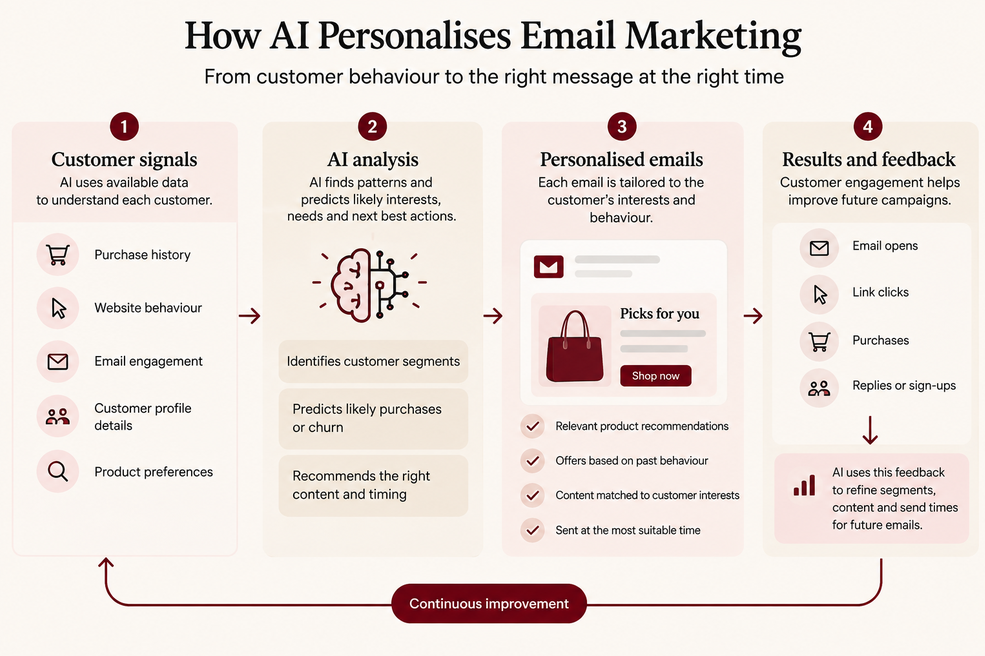
AI-Powered Email Segmentation
Traditional segmentation often groups subscribers by broad characteristics, such as location or age. AI can analyse additional signals, including purchase history, browsing behaviour and past email engagement, to identify more specific groups.
For example, an online store could distinguish between customers who regularly buy skincare products and those who browse but rarely purchase. Each group could receive different recommendations or follow-up emails.
Best use: Creating relevant audience segments based on customer behaviour and likely needs.
Send-Time Optimisation
An email sent at the wrong time may be overlooked, even if its content is useful. AI-powered send-time optimisation estimates when individual subscribers are most likely to engage.
Rather than sending every email at 10 a.m., a platform might recommend different delivery times based on a subscriber’s previous interactions.
These predictions are only as useful as the data behind them. New subscribers and customers with limited activity may not have enough history for reliable recommendations.
Best use: Testing delivery times for audiences with sufficient engagement data.
AI-Generated Subject Lines
AI can generate subject-line variations for different audiences, campaign goals and brand voices. It can also help marketers rewrite vague or overly long lines.
For instance, a welcome email could focus on getting started, while a cart-abandonment email could remind the customer about an unfinished purchase.
AI suggestions are starting points, not proven winners. Test them against a control subject line to find out what your audience actually responds to.
Best use: Producing multiple options quickly and testing which ones perform better.
Dynamic Email Content
Dynamic content changes parts of an email according to customer information or behaviour. Depending on the platform, this could include product recommendations, relevant offers or content tailored to a subscriber’s interests.
A travel company, for example, might show different destination recommendations to subscribers who have expressed interest in beach holidays and mountain trips.
Personalisation should remain useful and appropriate. Incorrect recommendations or overly specific references to customer activity can make emails feel intrusive.
Best use: Making email content more relevant without creating a separate campaign for every customer.
Predictive Email Journeys
Predictive models can estimate the likelihood of actions such as purchasing, becoming inactive or responding to a win-back offer. Marketers can use these signals to plan lifecycle emails.
| Customer situation | Possible email action |
|---|---|
| A new subscriber joins | Send a welcome series |
| A customer may need a refill | Send a replenishment reminder |
| Purchase activity declines | Test a re-engagement campaign |
| A customer completes a purchase | Share relevant next steps or recommendations |
These predictions should guide decisions rather than determine them automatically. Review whether the resulting emails are relevant and whether they improve actual business outcomes.
How Can You Use AI to Write Better Email Subject Lines?
A good subject line tells readers what to expect and gives them a reason to open an email. AI can help generate options quickly, but clarity and relevance should come before clever wording.
AI Email Subject Line Examples
Here are a few starting points for common campaigns.
| Campaign type | Subject line example |
|---|---|
| Welcome | Your first order starts here |
| Cart abandonment | Still thinking it over? Your cart is waiting |
| Re-engagement | Still interested? Here’s what’s new |
| Product recommendation | A few picks based on your preferences |
| Win-back | It’s been a while. See what’s new |
Adapt these examples to your offer, audience and brand voice. Avoid false urgency, misleading personalisation or promises the email cannot fulfil.
Prompts for Generating Email Subject Lines
Clear prompts help AI produce more relevant suggestions. Include the campaign goal, target audience and tone rather than simply asking for catchy subject lines.
Prompt 1: Generate variations
Generate 10 email subject lines for a [campaign type] targeting [audience]. The email’s goal is [goal]. Use a [brand tone] tone. Keep the subject lines concise, specific and relevant. Avoid clickbait, exaggerated claims and false urgency. Explain the angle behind each option.
Prompt 2: Improve existing subject lines
Review these email subject lines for clarity, relevance and audience fit: [insert subject lines]. Suggest five improved versions for [target audience]. Keep the original intent, avoid misleading claims and explain what each revision improves.
Once you have the suggestions, select a few strong options and test them against your existing subject line. Keep the audience and other campaign conditions comparable so you can judge whether the change made a difference.
Which AI Email Marketing Tools Should You Consider?
Different AI email marketing tools serve different needs. Some focus on content generation, while others support customer segmentation, campaign automation or personalised journeys.
| Tool | Potential use |
|---|---|
| Salesforce Marketing Cloud | AI-assisted email personalisation and campaign optimisation |
| Jasper | Email drafts, campaign variations and brand-consistent content |
| Encharge | Lifecycle email automation and AI-assisted workflows |
| Insider | Personalised customer journeys and cross-channel activation |
| Snov.io | AI-assisted email writing and sales outreach workflows |
Before choosing a platform, consider:
- Integration: Does it work with your existing CRM and email system?
- Segmentation: Can it create useful audience groups from your available data?
- Automation: Can you set up welcome, follow-up and re-engagement journeys?
- Testing and reporting: Can you compare campaign variations and track conversions?
- Pricing: Do the available features justify the cost for your team?
Features and pricing vary by plan and may change. Check each provider’s current offering before making a decision.
How Can You Use AI for Email Marketing Without Hurting Deliverability?
Automation can help teams send emails at scale, but mistakes can also affect inbox placement and customer trust. Build these safeguards into your workflow.
Maintain List Quality and Consent
- Send campaigns to permission-based lists.
- Avoid purchased lists and unsolicited bulk emails.
- Remove invalid addresses and review persistently inactive subscribers where appropriate.
A larger list is not necessarily a better list. Focus on reaching people who have a valid reason to receive your emails.
Review AI-Generated Content
AI can produce incorrect details or repeat the same message across campaigns. Before sending, verify:
- Links, prices, discounts and product information
- Names and personalisation fields
- Claims, dates and offer conditions
- Grammar, tone and repeated wording
Keep human review in place for sensitive offers and high-impact communications.
Protect Sender Reputation
Configure appropriate email authentication, including SPF, DKIM and DMARC. Monitor bounce rates, spam complaints and unsubscribe rates to spot potential problems.
Increase sending volume responsibly and follow the requirements of the mailbox providers you use. AI-generated content does not remove the need for sound email-sending practices.
Test Before Sending
Preview each email across devices and email clients. Check links, dynamic content, formatting and fallback text in case a personalisation field is missing.
A message that looks correct in the editor may not render as expected in every inbox. Testing helps catch these issues before they reach subscribers.
Which Metrics Should You Track in AI Email Marketing?
The right metrics depend on what a campaign is meant to achieve. A welcome email, a promotional campaign and a win-back sequence should not all be judged by the same outcome.
| Metric | What it helps assess |
|---|---|
| Click-through rate | Whether email content encourages action |
| Conversion rate | Whether recipients complete the intended goal |
| Revenue per recipient | Commercial value generated per recipient |
| Unsubscribe rate | Whether content or frequency may be misaligned |
| Bounce rate | List quality and delivery issues |
| Spam complaint rate | Recipient dissatisfaction and sender reputation |
Open rates can provide context, but privacy features and automated image loading can make them unreliable. Use clicks, conversions and downstream business outcomes alongside opens.
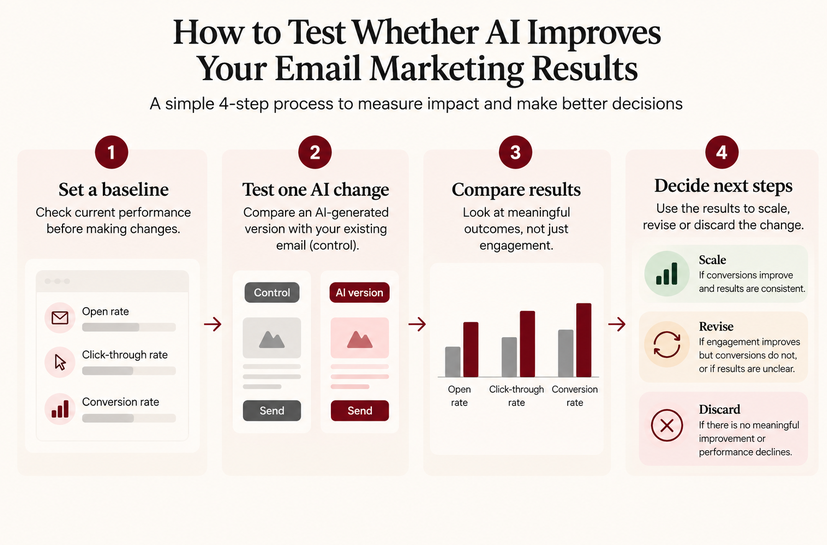
How to Measure Whether AI Improves Results
Follow a simple process:
- Set a baseline: Record performance before introducing an AI feature.
- Test one major change: For example, compare AI-generated subject lines with your existing version.
- Keep conditions comparable: Use similar audience groups and campaign periods.
- Measure business outcomes: Look at conversions or revenue, not just engagement.
- Review the trade-off: Check whether any improvement justifies the cost and effort involved.
An AI feature is useful when it produces a meaningful improvement, not simply because it automates a task.
Conclusion
AI can help email marketers move beyond one-size-fits-all campaigns by improving segmentation, content relevance and lifecycle timing. The best starting point is a specific problem, such as low click-through rates or ineffective follow-ups, rather than adopting every available feature.
Build on reliable data, test changes before rolling them out and keep deliverability checks in place.
To explore how AI supports customer insights and personalised lifecycle journeys, visit the IIM Trichy AI-Powered Marketing & Growth Strategy course.
FAQs
1. How can AI identify the right email audience for each campaign?
AI can analyse purchase history, browsing activity, email engagement and other available customer data to identify behavioural patterns. Marketers can use these patterns to build segments based on purchase intent, product interests or churn risk. Segment quality depends on data accuracy, relevance and whether the model has enough information to identify meaningful patterns.
2. How can marketers use AI for email personalisation without making messages feel intrusive?
Use customer information to improve relevance, not to demonstrate how much the business knows about someone. Personalise product recommendations, content and offers using appropriate data, and avoid sensitive inferences or unexplained references to browsing behaviour. Give subscribers suitable control over their preferences and follow applicable privacy requirements.
3. How do you measure the incremental impact of AI email marketing?
Compare an AI-assisted campaign with a suitable control group while keeping other campaign conditions as consistent as possible. Track differences in conversions, revenue per recipient and other relevant outcomes. Where feasible, use randomised holdout groups to distinguish the effect of AI from changes caused by audience composition, timing or other campaign variables.
4. When should marketers use predictive email marketing instead of rule-based automation?
Rule-based automation works well when actions follow clear conditions, such as sending a welcome email after signup. Predictive email marketing is more useful when decisions depend on patterns across customer behaviour, such as estimating churn risk or purchase likelihood. Predictive models require reliable data and should be evaluated against simpler rules before adoption.
5. How much customer data is needed for AI email marketing?
There is no universal minimum. Subject-line generation and basic content assistance can work without a large customer database, while predictive segmentation and churn models generally need more historical data. The required volume depends on the use case, data quality, customer diversity and model complexity. Marketers should validate performance before relying on predictions.
6. How can AI optimise email send times without reducing campaign performance?
Send-time optimisation estimates when subscribers are more likely to engage using their previous interactions and other available signals. Test the recommendations against a control group rather than assuming that predicted engagement will improve conversions. Also consider campaign deadlines, customer time zones, sending frequency and the risk of repeatedly contacting subscribers.
7. How should marketers test AI-generated email subject lines?
Test AI-generated subject lines against a control version using comparable audience groups. Change one major variable at a time, such as the subject line, and define the primary success metric before sending. Open rates can provide context, but clicks and conversions may offer stronger evidence of campaign value. Allow enough time and volume to interpret results reliably.
8. How can AI email marketing work with an existing CRM?
Integration depends on the email platform, CRM and available connectors or APIs. A connected workflow may use CRM records to segment audiences, trigger lifecycle emails and return engagement or conversion data to customer profiles. Before implementation, check field mapping, data synchronisation, consent status, duplicate records and access permissions.
9. What are the biggest risks of using AI in email marketing?
Key risks include inaccurate content, poor-quality predictions, excessive personalisation, privacy violations and deliverability problems caused by careless sending practices. AI can also optimise an easy-to-measure metric without improving business outcomes. Human review, controlled testing, data governance and regular monitoring help reduce these risks.
10. How can marketers distinguish AI-driven improvements from normal campaign fluctuations?
Use a baseline and compare equivalent groups under similar conditions. Where practical, run randomised experiments and evaluate the results against a predefined metric. Account for factors such as seasonality, promotions, audience differences and changes in email frequency. A single campaign’s improvement is not enough to establish that AI caused the change.
11. How should businesses choose between AI email marketing tools?
Compare tools against the work you need to improve, rather than the number of AI features advertised. Assess integration with your CRM and email platform, segmentation and automation capabilities, experimentation options, reporting, data controls and total cost. Run a small pilot using a measurable use case before committing to a wider rollout.
12. How can businesses calculate the ROI of AI email marketing?
Compare the incremental value generated by AI-assisted campaigns with the total cost of using them. Include software fees, implementation, data preparation, staff time and ongoing review. A practical assessment considers additional conversions or revenue against a baseline, while accounting for discounts, campaign costs and other factors that affect profit. Higher engagement alone does not establish positive ROI.