
AI for SEO: Tools, Workflows & What Actually Works

Key Insights
- AI can expand keyword lists, group search queries by intent and identify content opportunities.
- AI-generated briefs and drafts need to be checked against actual search results, audience needs and original expertise.
- Technical SEO and internal linking benefit from AI-assisted analysis, but proposed changes must be verified before implementation.
- Tools such as Semrush, Ahrefs, Surfer and ChatGPT serve different purposes. No single tool replaces every part of an SEO workflow.
- AI can summarise performance data, but it should not invent reasons for ranking or traffic changes.
- The most useful approach combines automation with human decisions at every important stage.
AI SEO refers to using artificial intelligence to support search engine optimization tasks such as keyword research, content planning, on-page optimization, technical analysis and reporting. It can help SEO professionals process information faster, identify patterns and automate repetitive work.
However, AI does not automatically know which keywords are worth targeting, what searchers actually want or which technical changes are safe to implement. Those decisions still require reliable data and SEO expertise.
This guide explains how to use AI across the SEO process, which tools fit different tasks, how to build an effective workflow and what Google's guidelines mean for AI-generated content. It also distinguishes using AI for SEO from optimising content for AI-powered search experiences.
AI for SEO vs SEO for AI Search
These approaches overlap, but they solve different problems.
| Approach | Main goal | Example |
|---|---|---|
| AI for SEO | Improve SEO work using AI | Cluster keywords by search intent |
| SEO for AI search, often associated with GEO | Improve the chances of content being discovered, understood or cited in AI-generated answers | Make information clear, accurate and easy to extract |
A business may use both approaches. AI can help an SEO team analyse its content while that team also works to make the content useful for traditional search results and AI-generated answers.
How Can AI Help With SEO?
AI can assist with research, content production, optimisation and analysis. Its value depends on whether the output improves a real SEO decision.
AI for Keyword Research
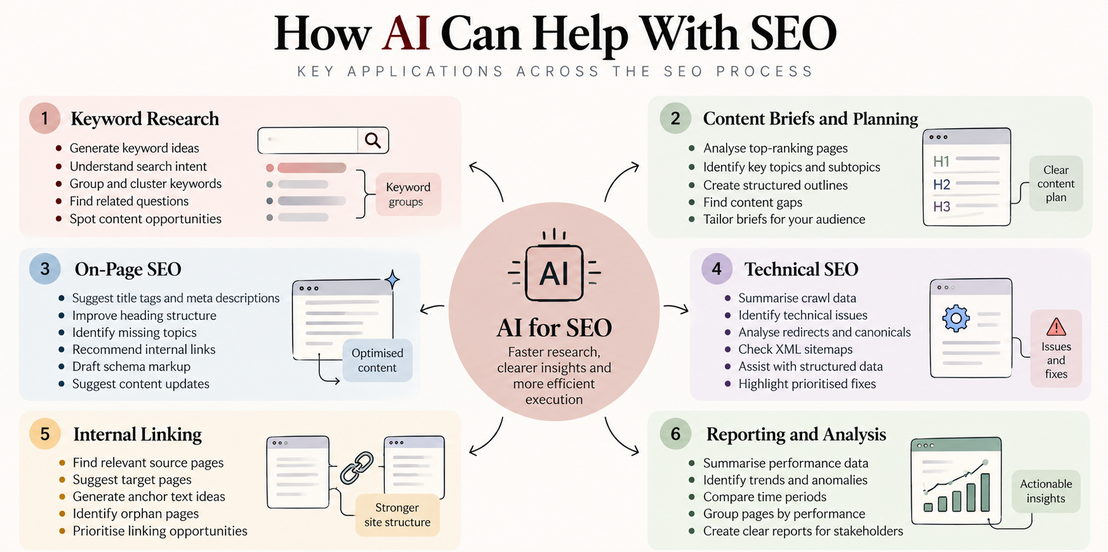
AI can expand keyword ideas and organise them into meaningful groups, but it should not be treated as a source of verified search metrics.
Useful applications include:
- Keyword expansion: Generate related queries, long-tail keywords and question-based searches.
- Search-intent classification: Group keywords by informational, commercial, transactional or navigational intent.
- Keyword clustering: Organise related queries around shared topics and likely page intent.
- Competitor analysis: Summarise keyword gaps identified in competitor research.
- Topic discovery: Identify related subtopics that may deserve coverage.
Human check: Validate search volume, keyword difficulty, actual search results and business relevance using reliable SEO data. AI-generated search volumes should never be presented as verified metrics.
AI for Content Briefs
AI content briefs turn research into a structured plan for creating a page that satisfies search intent.
AI can help with:
- Analysing recurring topics across search results.
- Mapping keywords to likely search intent.
- Suggesting H2s, H3s and supporting questions.
- Identifying potentially missing subtopics.
- Organising information for a specific audience.
For example, an SEO practitioner could supply relevant search results, target keywords and audience details, then ask AI to propose a content outline with the main questions the page should answer.
Human check: Review the outline against the actual search results and remove sections that add no value. Add original expertise, evidence and useful angles rather than copying competitors' structures.
AI for On-Page SEO
AI can help improve how a page communicates its topic to readers and search engines.
Common applications include:
- Drafting title tags and meta descriptions.
- Reviewing heading structure.
- Identifying missing or underdeveloped topics.
- Suggesting contextual internal links.
- Drafting structured data for technical review.
- Identifying content that may need updating.
For instance, AI can compare a page's headings with its intended search queries and flag areas that appear underdeveloped. The SEO practitioner must decide whether those areas genuinely improve the page.
AI for Technical SEO
AI technical SEO uses AI to help interpret crawl data, identify patterns and prioritise technical issues.
It can assist with:
- Summarising website crawl exports.
- Grouping similar errors across URLs.
- Investigating redirect and canonical issues.
- Reviewing XML sitemap problems.
- Drafting structured data.
- Analysing log files or large technical datasets.
Suppose a crawl export contains hundreds of URLs with status-code errors. AI can group the findings by error type and help create an investigation checklist.
Important: AI can misinterpret technical configurations. Verify recommendations against the source data, site architecture and relevant technical documentation before making changes to a live website.
AI for Internal Linking
AI internal linking can help identify relevant connections between pages and highlight pages that receive too few internal links.
A useful process is to:
- Provide a list of existing URLs and their page topics.
- Identify source pages that discuss a related subject.
- Suggest relevant destination pages.
- Draft descriptive anchor text that fits the surrounding sentence.
- Check the links for relevance, accuracy and duplication.
For example, a page about keyword research might link to an existing guide on search intent when the context genuinely supports that connection.
AI can suggest opportunities, but it should not create links to nonexistent pages, force exact-match anchor text or add links that do not help readers.
AI for SEO Reporting
AI can make SEO reports easier to interpret by summarising supplied performance data.
It can help with:
- Comparing traffic, clicks and impressions across periods.
- Identifying pages with significant performance changes.
- Grouping pages by growth or decline.
- Summarising keyword and landing-page performance.
- Preparing stakeholder-friendly reports.
For example, AI can flag that several pages lost clicks during a reporting period and organise those pages for further investigation.
It cannot establish the cause from that pattern alone. Changes in rankings, seasonality, competition, technical issues and search demand may all require separate investigation.
What Are the Best AI SEO Tools?
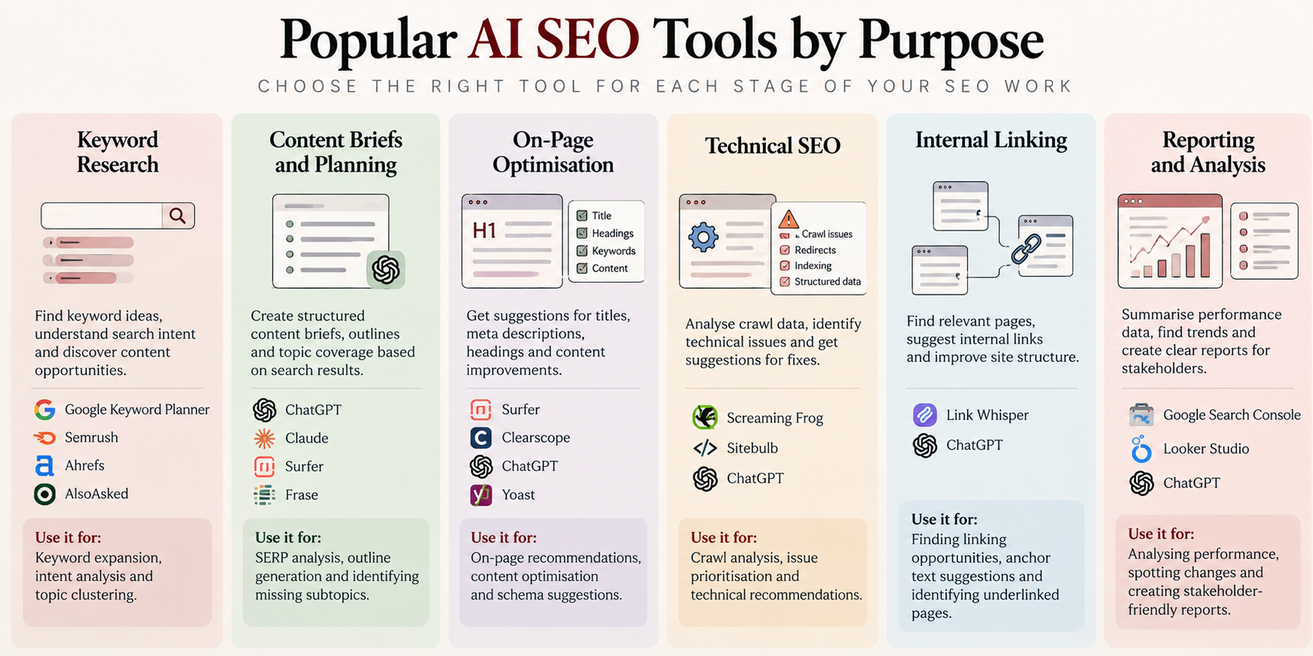
The best AI SEO tools depend on the task, the available data and the team's existing workflow. Choose tools by function rather than assuming one platform can handle every SEO requirement.
| Tool / category | Best for | What to use it for |
|---|---|---|
| Semrush | Keyword and competitive research | Keyword opportunities, competitor analysis and content research |
| Ahrefs | SEO research and site analysis | Keywords, backlinks, competitors and site audits |
| Surfer | Content optimisation | SERP-informed content briefs and on-page recommendations |
| ChatGPT / Claude | Flexible SEO analysis | Keyword clustering, brief drafting, content analysis and reporting support |
| Screaming Frog with an AI-assisted workflow | Technical SEO | Crawl analysis, issue grouping and investigation |
| Google Search Console | Performance validation | Search queries, clicks, impressions and page performance |
AI capabilities differ across platforms and subscription tiers. Check the current features before choosing a tool.
For reliable keyword metrics and performance reporting, use specialist SEO datasets and tools that expose the underlying evidence. General-purpose language models are useful for analysis, but their generated numbers are not a substitute for verified data.
What Can AI Not Replace in SEO?
AI can accelerate SEO execution, but several decisions still require human expertise and accountability.
Search Intent Judgment
AI can classify a keyword's likely intent, but the actual search results provide important evidence about what users expect. Review the SERP before deciding whether a query needs a guide, comparison, product page or another format.
Original Expertise
AI can organise existing information and produce a draft. It does not automatically provide firsthand experience, proprietary research or expert insight. Add evidence and information that genuinely improve the page.
Strategic Prioritisation
AI may identify dozens of keyword opportunities. SEO professionals must decide which ones matter most based on business objectives, audience relevance, available resources and realistic opportunities.
Fact-Checking and Quality Control
AI outputs can contain inaccurate facts, unsupported claims and outdated information. Check important statements against reliable sources and ensure that the final page answers the user's question clearly.
Technical Accountability
AI can flag a potential technical problem, but a human should verify the diagnosis and assess the impact of a proposed fix before implementation. An incorrect canonical, redirect or robots directive can create problems instead of solving them.
The principle: Use AI to reduce repetitive work, not to remove responsibility for the decisions that affect a website.
What Is Google's Stance on AI-Generated Content?
Google's guidance does not treat content as spam simply because AI was used to create it. The focus is on whether the content is helpful, reliable and compliant with spam policies.
Three points matter for SEO practitioners:
- AI assistance is not automatically a problem. Content should be created to help users rather than merely to manipulate rankings.
- Scaled low-value production is risky. Producing large volumes of unoriginal or unhelpful pages to influence search rankings can violate Google's spam policies, regardless of how the content was generated.
- Quality and accountability still matter. Accuracy, originality, relevance and a useful experience should guide content production.
Before publishing AI-assisted content, check facts, add relevant expertise, remove unnecessary repetition and ensure the page provides value beyond what is already available.
Do not build your process around trying to evade AI-content detectors. Focus on the quality of the content and compliance with Google's published guidance.
What Does an AI SEO Workflow Look Like?
An AI SEO workflow connects research, content creation, optimisation and measurement. AI supports individual steps, while the SEO practitioner validates the work before it reaches the next stage.
Example Workflow: From Keyword to Published Page
Let's simplify it so a non-technical reader can follow the process at a glance.
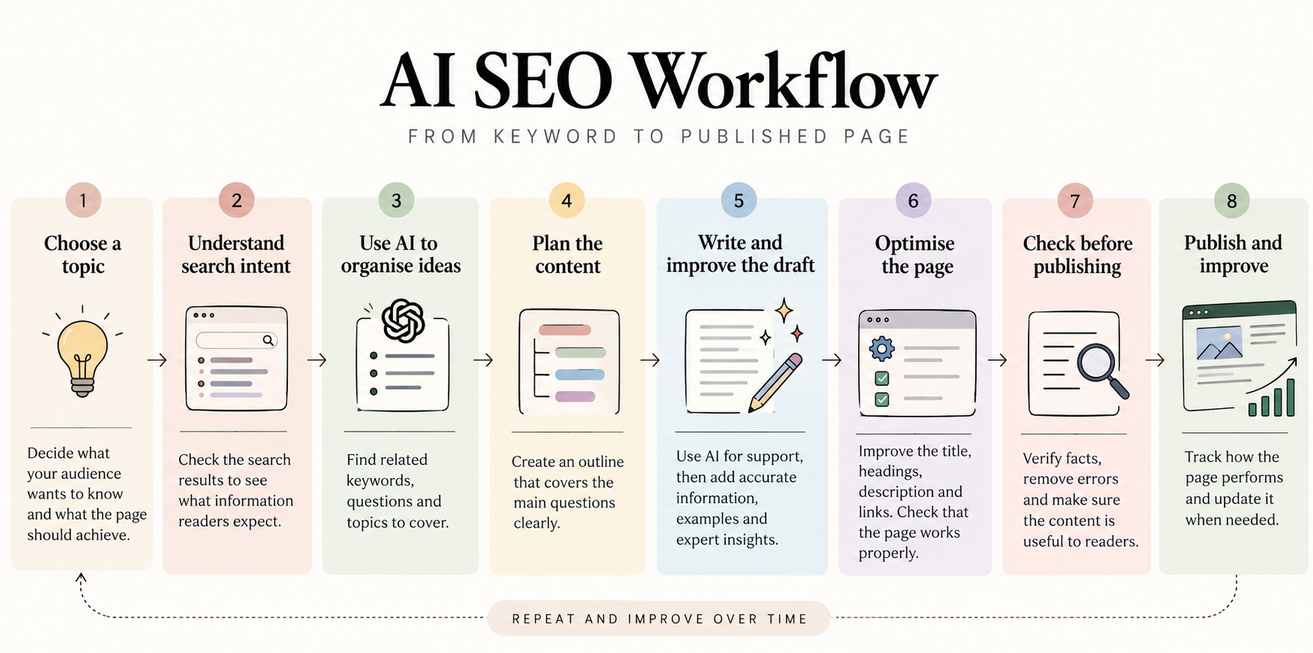
Example Workflow: From Keyword to Published Page
1. Choose a topic
Decide what your audience wants to know and what the page should achieve.
2. Understand what people are searching for
Check the search results to see what information readers expect.
3. Use AI to organise ideas
Find related keywords, questions and topics to cover.
4. Plan the content
Create an outline that covers the main questions clearly.
5. Write and improve the draft
Use AI for support, then add accurate information, examples and expert insights.
6. Optimise the page
Improve the title, headings, description and links. Check that the page works properly.
7. Check before publishing
Verify facts, remove errors and make sure the content is useful to readers.
8. Publish and improve
Track how the page performs and update it when needed.
Where AI Fits vs Where Humans Decide
| SEO stage | AI contribution | Human decision |
|---|---|---|
| Research | Expand, cluster and summarise | Validate intent and opportunity |
| Content creation | Draft, organise and optimise | Add expertise and originality |
| Optimisation | Identify potential issues | Approve relevant changes |
| Reporting | Detect patterns and summarise | Investigate causes and decide actions |
The workflow should be repeatable, but not entirely automatic. Each stage needs enough validation to prevent an early mistake from carrying through to publication.
Conclusion
AI can make SEO work faster by helping practitioners research keywords, prepare content briefs, analyse technical data, identify internal links and interpret performance reports. Its value depends on using it for the right task and checking the results against reliable evidence.
The strongest AI SEO workflow combines automation with human judgement at each critical stage. Start with a clear search goal, validate the data, use AI where it saves meaningful effort, and measure whether the resulting work improves the quality and effectiveness of your SEO process.
Want to build practical AI-powered marketing skills across content, SEO, GEO and workflow automation? Explore the IIM Tiruchirappalli Certificate Programme in AI-Powered Marketing & Growth Strategy.
FAQs
Can AI SEO tools cause keyword cannibalisation?
Yes. If AI generates multiple pages targeting the same search intent, those pages may compete for similar queries. Review existing URLs, assign each page a distinct purpose, and check Google Search Console for overlapping query and page patterns.
How can you check whether AI-generated SEO content is accurate?
Verify factual claims against primary sources, test examples, check statistics and dates, and review technical recommendations before publishing. A fluent answer is not necessarily a correct one.
Should you update old content with AI or publish a new page?
Update an existing page when it already serves the right search intent but has outdated information, weak coverage or declining performance. Create a new page when the topic serves a genuinely different intent. Avoid publishing near-duplicate pages simply to target more keywords.
How do you measure the impact of AI on SEO performance?
Compare outcomes such as organic clicks, impressions, rankings, conversions, content production time and editing effort before and after introducing AI. Use a consistent measurement period and account for seasonality and other SEO changes before attributing improvements to AI.
Can AI help diagnose a sudden drop in organic traffic?
AI can help organise Search Console data, compare affected pages and queries, and generate possible explanations. However, it cannot establish the cause from a traffic chart alone. Check indexing, technical changes, search demand, site releases and Google updates before deciding what to fix.
How should you use AI when a keyword has mixed search intent?
Examine the different needs behind the query, then review the search results for patterns in page type, format and subtopics. Decide whether one comprehensive page can serve those needs or whether separate pages are justified. AI can help classify intent, but the actual search results should guide the decision.
What SEO tasks should you automate, and which should remain manual?
Automate repeatable tasks such as grouping keywords, drafting briefs, flagging missing metadata and summarising reports. Keep human review for search intent, factual accuracy, editorial judgement, technical changes with significant consequences and final publishing decisions.
How can you prevent AI from producing generic SEO content?
Give it specific audience details, original research, expert observations, product knowledge and a clear purpose for the page. Use AI to organise and refine that material rather than asking it to produce an entire article from a broad keyword alone.
Does AI-generated content need a different SEO quality review?
The same core quality standards apply, but AI-assisted drafts often need particular scrutiny for fabricated facts, repeated ideas, unsupported claims, generic examples and missing first-hand expertise. Review the finished page against reader needs, not simply how much text it contains.
How can small SEO teams use AI without adding more tools?
Start with one bottleneck, such as content briefing or performance reporting. Test an existing AI assistant alongside your current SEO tools, measure time saved and check output quality before adding another platform. More tools do not automatically produce better results.
Can AI identify internal linking opportunities across a large website?
AI can suggest links by comparing page topics, entities and contextual relevance. Validate each suggestion against the destination page, anchor text and the reader's likely next step. A semantically related page is not always the most useful link.
How should you use AI when search rankings fluctuate after a content update?
Compare the updated page with its previous version, examine affected queries and landing pages, and review changes to intent coverage, internal links and technical elements. Treat AI-generated explanations as hypotheses, then test them against data instead of making several more changes at once.