Conversational Marketing: Chatbots, Use Cases & Examples

Key Insights
- Start with customer questions that delay purchases, such as pricing, eligibility or product comparisons. These offer a clear use case for conversational marketing.
- Automate predictable queries first. Use AI for varied questions, and keep human support available for complaints or complex decisions.
- Personalise responses using information customers actually share. Avoid collecting unnecessary data or making assumptions about their needs.
- Connect conversations to your CRM to help sales teams follow up on qualified leads without losing context.
- Measure whether conversations lead to meaningful outcomes, such as completed bookings, qualified enquiries or resolved queries. Message volume alone is not enough.
- Review failed conversations regularly. Repeated questions, abandoned chats and frequent handoffs can reveal where the experience needs improvement.
- Choose a platform based on your existing channels, integrations and support needs rather than the number of features it offers.
Customers often have questions before buying. They may want to compare products, check prices, understand eligibility or resolve a concern. If finding an answer takes too long, they may leave without taking the next step.
Conversational marketing uses two-way conversations to help customers find answers, explore options and make decisions. These interactions can happen through website chat, WhatsApp, social media messages and voice assistants. Businesses can use live agents, rule-based chatbots or conversational AI to manage them.
The goal is to make the customer journey easier, not simply automate more messages. This guide explains where conversational marketing fits, how chatbot marketing works and how to build a strategy that supports measurable business outcomes.
Where Does Conversational Marketing Fit in the Customer Journey?
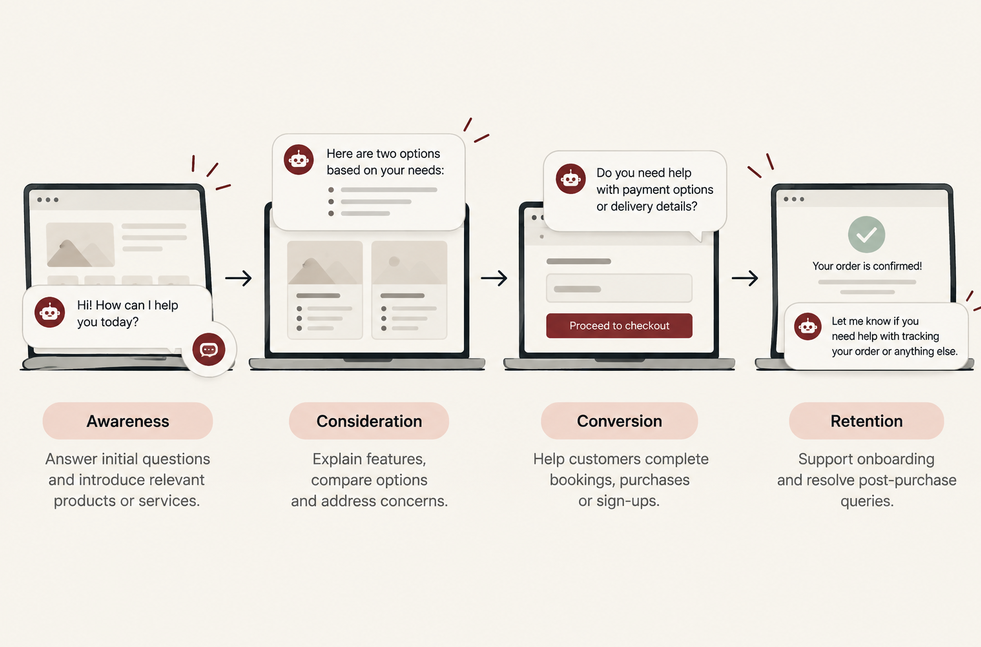
Conversational marketing serves different purposes at each stage of the customer journey.
- Awareness: Answer initial questions about a product or service.
- Consideration: Compare options and address customer concerns.
- Conversion: Resolve last-minute doubts about purchases or sign-ups.
- Retention: Help existing customers with onboarding and support.
For example, a prospective student might ask about course eligibility, compare programmes and seek help with enrolment. A chatbot can handle routine questions, while an admissions adviser can address individual concerns.
Which Channels Can You Use for Conversational Marketing?
Choose channels based on where your customers already interact with your business and what they need to accomplish.
Website Chat
Website chat helps visitors find answers while exploring a product, service or landing page. It can explain pricing, answer eligibility questions and direct visitors to relevant resources.
Example: A visitor on a course page asks about eligibility. The chatbot shares approved information and links to the complete requirements.
WhatsApp supports product enquiries, order updates, bookings and customer service. It can be particularly useful for Indian businesses whose customers already use messaging for everyday communication.
Example: A skincare brand receives a question about products for dry skin. Its assistant shares relevant product information and offers access to a human adviser when personalised guidance is needed.
Businesses should respect customer preferences, follow applicable privacy requirements and comply with WhatsApp Business policies. See the official WhatsApp Business website.
Social Media DMs
Instagram and Facebook messages can turn interest in a campaign into a useful conversation.
Example: Someone watching a clothing Reel asks about sizing. An automated reply shares the size guide and links to the product page.
Voice Assistants
Voice assistants help customers who prefer speaking to typing. They can support routine enquiries, bookings and service requests, provided the system can understand the request and respond reliably.
You do not need every channel. Start with the one that addresses a recurring customer need.
What Are Some Chatbot Marketing Examples?
Chatbot marketing uses automated conversations to support marketing and customer service goals. These are illustrative scenarios, not claims of measured results.
| Use case | Example | Intended outcome |
|---|---|---|
| Lead qualification | A website bot asks about a visitor’s requirements | More relevant sales enquiries |
| Product recommendations | A WhatsApp assistant narrows options based on preferences | Easier product discovery |
| Cart recovery | An opted-in customer receives help with a checkout problem | Fewer unresolved purchase barriers |
| Campaign engagement | An Instagram DM flow shares requested product details | A smoother path to enquiry |
| Customer retention | An assistant answers common post-purchase questions | More accessible support |
The important distinction is between sending automated messages and actually helping customers. A useful interaction answers a question or makes the next step easier.
What Is the Difference Between Chatbots, Conversational AI and AI Agents?
These terms describe different capabilities. The right choice depends on the task, the information available and the level of automation required.
Rule-Based Chatbots
Rule-based chatbots follow predefined menus, keywords and decision trees. They work well for predictable questions, such as business hours, order status and basic product information. They may struggle when a customer asks something outside the configured flow.
Conversational AI Assistants
Conversational AI assistants interpret natural-language questions and respond using available context. They can handle more varied queries, but their accuracy depends on the quality of their information and safeguards. Fluent responses are not necessarily correct.
Agentic AI for Marketing
Agentic AI systems can work towards a defined goal by completing multiple steps using connected tools. For example, an agent might qualify a lead, update a CRM record and prepare a follow-up for approval.
Its ability to perform these actions depends on integrations, permissions and safeguards. Human approval may still be necessary before customer-facing or consequential actions.
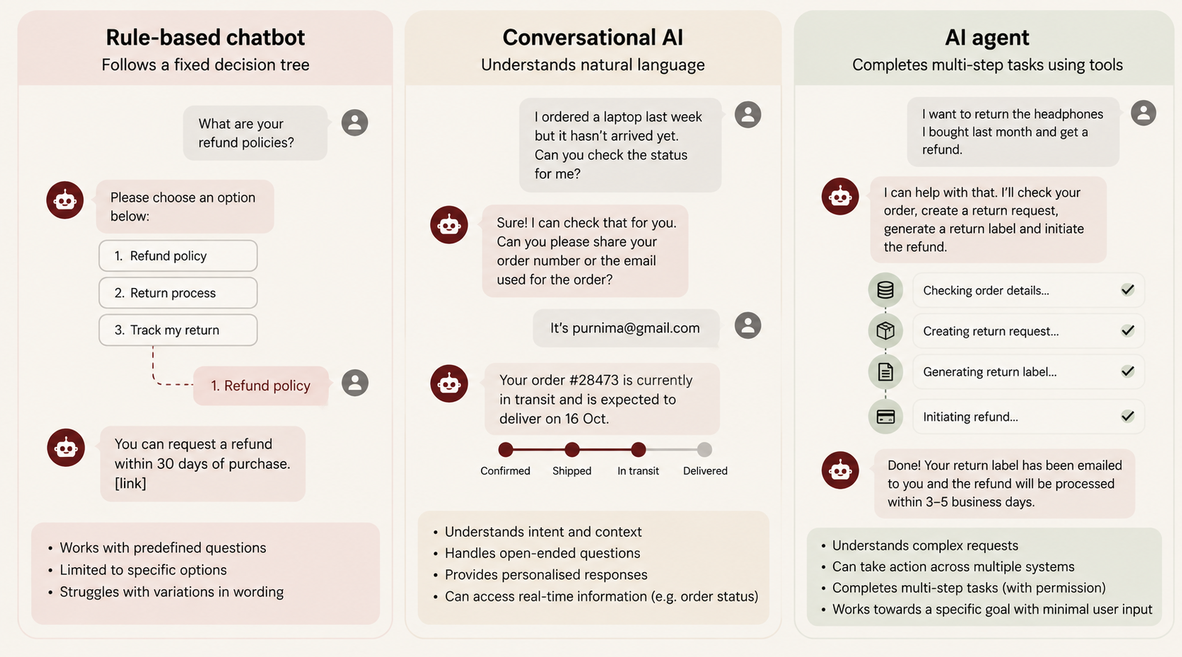
Use the simplest system that reliably meets the customer’s needs. A rule-based bot may be enough for routine questions, while an AI agent may suit a process involving several connected systems.
How Do You Build a Conversational Marketing Strategy?
A practical framework for conversational AI for marketing has three stages: engage, understand and recommend. Human support should remain available when a conversation requires judgement.
1. Engage the Customer
Choose a relevant channel and entry point, such as a visitor opening a pricing page or a customer asking a question after seeing a campaign.
Explain what the assistant can help with. Avoid interruptive pop-ups and unsolicited messages unrelated to the customer’s activity.
2. Understand Their Needs
Ask only the questions needed to identify the customer’s intent. A course enquiry might require the person’s area of interest, while a product enquiry might depend on budget or intended use.
Avoid collecting unnecessary personal information. Offer a human handoff when a request is sensitive, unclear or beyond the assistant’s capabilities.
3. Recommend the Next Step
Provide a relevant answer, product, resource or action. Explain recommendations clearly and avoid unsupported claims.
For example, an assistant comparing two service plans should explain their differences and link to the full terms instead of automatically pushing the more expensive option.
Which Conversational Marketing Metrics Should You Track?
Measure whether conversations help customers and contribute to business goals. Choose metrics based on the purpose of each workflow.
| Metric | What it measures |
|---|---|
| Engagement rate | How often customers start or respond to conversations |
| Lead qualification rate | How many conversations produce qualified leads |
| Conversion rate | How often conversations lead to purchases, bookings or sign-ups |
| Resolution rate | How often queries are resolved without further escalation |
| Human handoff rate | How often automation transfers a conversation to a person |
| Customer satisfaction | How customers rate the interaction |
Set a baseline before launching a workflow and compare results afterwards. Where practical, use controlled experiments to assess whether the change contributed to better outcomes.
Do not judge performance by engagement alone. More conversations do not necessarily mean more sales, and a human handoff is not automatically a failure if the system correctly recognises a complex query.
Which Conversational Marketing Platforms Should You Consider?
Choose a platform based on your existing channels, systems, budget and customer needs. These providers are starting points for research, not a ranking.
- Intercom: Website messaging, AI-assisted support and customer service.
- Drift by Salesloft: Website conversations and B2B lead engagement.
- WATI: WhatsApp-based customer communication.
- Manychat: Social messaging automation.
- Zendesk: Customer service and support conversations.
Before choosing a platform, check its channel support, CRM integrations, human handoff, analytics and privacy controls. Consider total cost and scalability too. Features, integrations and pricing vary by plan, so verify current details with each provider.
Conclusion: Make Every Conversation Useful
Conversational marketing works when it helps customers find answers, compare options or resolve problems. Start with one recurring customer need, choose a suitable channel and define when a human should take over. Measure results against a clear baseline before expanding. The goal is not to automate every interaction, but to make the customer journey easier while keeping support accessible.
Want to understand how AI fits into a wider marketing strategy? Explore the IIM Trichy AI-Powered Marketing & Growth Strategy programme to learn about AI-driven marketing, predictive intelligence, sentiment analysis and agentic AI applications.
FAQs
1. How do you integrate conversational marketing with a CRM?
Connect your chat platform to your customer relationship management (CRM) system so relevant conversation details can be recorded against customer profiles. This can help sales teams track enquiries, follow up on qualified leads and understand previous interactions. Set clear rules for which data gets stored and who can access it.
2. What is the difference between conversational marketing and traditional digital marketing?
Traditional digital marketing often uses content, ads and landing pages to communicate with audiences at scale. Conversational marketing adds direct, two-way interaction. Customers can ask questions, share preferences and receive relevant responses instead of following the same path as every other visitor.
3. How can conversational marketing personalise customer interactions?
Use information customers share, such as their preferences, interests or stage in the buying process, to tailor responses. For example, an online retailer can suggest products based on a customer’s stated needs. Personalisation should use relevant information, respect privacy and avoid assumptions that the available data cannot support.
4. How can B2B companies use conversational marketing to generate leads?
B2B companies can use website chat to answer questions about services, identify business needs and understand whether a visitor is ready to speak with sales. The conversation can collect relevant qualification details and offer a meeting when appropriate. Lead quality matters more than collecting a large number of contact details.
5. What are the limitations of conversational marketing?
Conversational marketing can struggle with unclear questions, outdated information, complex complaints and requests requiring human judgement. Poorly designed automation can frustrate customers or collect unnecessary data. Businesses should test conversation flows, maintain reliable information and provide an easy way to reach a person.
6. How can you improve chatbot conversation flows?
Review conversations to identify where users abandon the interaction, repeat questions or request human help. Simplify confusing prompts, remove unnecessary questions and make response options clear. Test changes against a defined goal, such as completing a booking or resolving a common query.
7. Can conversational marketing work for high-value or expensive products?
Yes. It can help customers understand product features, compare plans and get answers before making a significant purchase. For high-value products, the assistant should provide accurate information and connect customers with a specialist when needed. It should support informed decisions rather than pressure customers to buy.
8. How do you calculate the cost of conversational marketing?
Include platform subscriptions, setup, integrations, message charges, maintenance and staff time. If AI is involved, account for usage costs and the effort needed to review incorrect responses. Compare the total with measurable outcomes, such as qualified leads, resolved queries or additional sales, to judge whether the investment is worthwhile.
9. What should you include in a conversational marketing strategy?
Define the customer problem, target audience, preferred channel and desired outcome. Map the questions customers are likely to ask, prepare reliable responses and establish escalation rules. Choose success metrics before launch, then review conversations and performance data to improve the experience.
10. How can you A/B test conversational marketing campaigns?
Test one meaningful change at a time, such as the chatbot’s opening message, the timing of a prompt or the wording of a call to action. Compare relevant outcomes between groups, such as qualified leads or completed purchases. Keep other conditions as consistent as possible and avoid judging results by clicks or replies alone.
11. How does conversational marketing support customer retention?
It can help existing customers resolve problems, understand product features and complete tasks after purchase. For example, a software company might use chat to guide users through setup or direct them to troubleshooting resources. Track whether these interactions improve resolution and satisfaction rather than assuming automation automatically increases loyalty.
12. What privacy risks should businesses consider when using conversational AI?
Chat conversations may contain contact details, purchase information or other sensitive data. Businesses should limit collection, control access, set retention rules and check how providers use conversation data. They should also review applicable privacy laws and avoid sending confidential information to tools that have not been approved for that purpose.
Sources
- Google Search Central: Creating Helpful, Reliable, People-First Content
- Google Search Central: Guidance on Generative AI Content
- WhatsApp Business
- Ministry of Electronics and Information Technology: Digital Personal Data Protection Act, 2023
- Intercom: Official Website
- Salesloft: Conversational Marketing