MarTech Explained: The Marketing Technology Stack in 2026

Key Insights
- Martech covers the technology behind customer acquisition, engagement, measurement and retention.
- A useful stack connects customer data, marketing execution and measurement instead of creating isolated systems.
- Startups usually need a small, focused stack, while larger companies need stronger integration and governance.
- AI is moving from standalone tools into existing advertising, data, automation and analytics workflows.
- More tools do not automatically mean better marketing. Tool overlap and unused features can create cost and data problems.
- The strongest stack decisions start with a business goal or customer journey, not with a list of popular software.
Martech, short for marketing technology, is the software and technology marketers use to plan, run, automate and measure marketing. It includes everything from CRM and customer data platforms to analytics, advertising, content and automation tools.
But a modern martech stack is more than a list of subscriptions. The real value comes from how these tools share data and work together across the customer journey. In 2026, AI is becoming part of advertising, personalisation, analytics and automation, while companies are also rethinking how many tools they actually need.
This guide breaks down what martech means, the main categories, how stacks change as companies grow, what AI is changing in 2026, and how teams can choose or consolidate their tools.
Martech vs Martech Stack
Martech is the category; a martech stack is the specific collection of tools a company uses.
For example, a company might use one CRM, one marketing automation platform, an analytics tool, advertising platforms and a CMS. Together, those tools form its martech stack.
The important part is the connection between them. A good stack lets customer and campaign data move between systems without constant manual exports or duplicate records.
Why Does Martech Matter?
Martech helps marketing teams do more work with less manual effort while making customer and campaign data easier to use.
It can help teams:
- Automate repetitive marketing tasks
- Keep customer information organised
- Personalise campaigns
- Track campaign performance
- Connect marketing activity with business results
- Move faster across channels
The goal is not to own the most software. It is to build a system that helps the team make better decisions and execute them efficiently.
What Are the Main Categories of Martech?
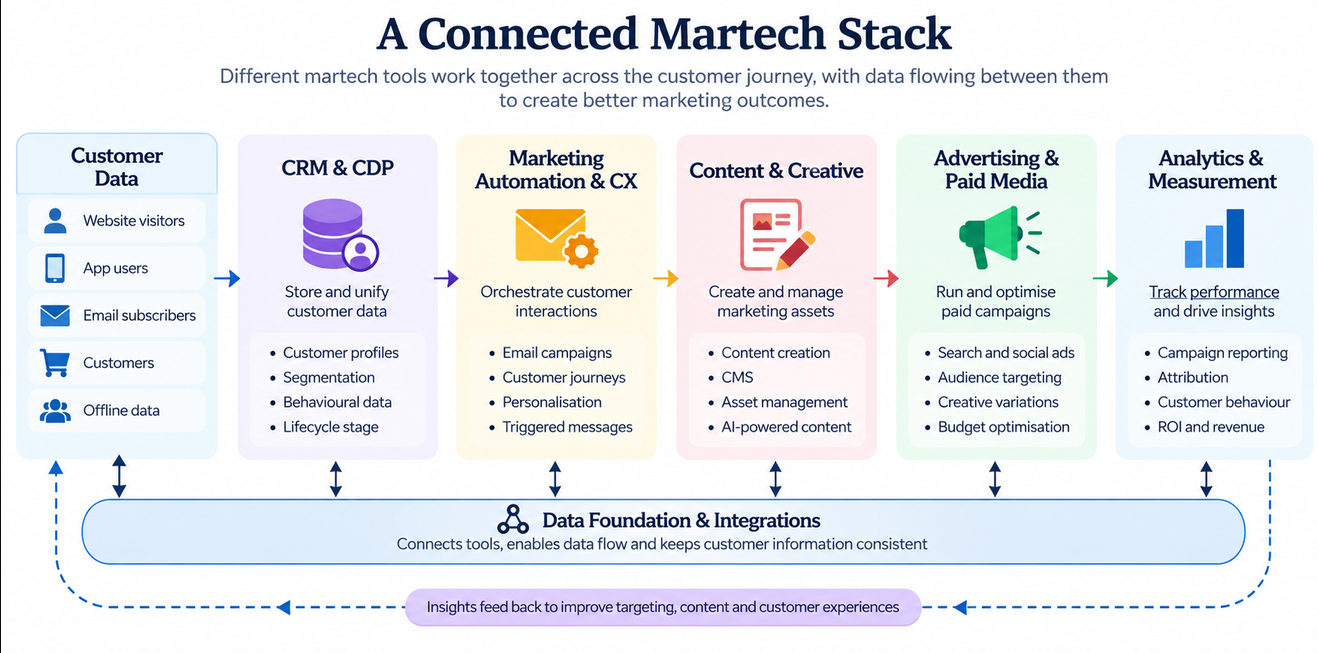
The main martech categories cover customer data, marketing execution, content, advertising and measurement.
CRM and CDP
A CRM manages customer and prospect relationships, while a CDP focuses on bringing customer data from different sources together for marketing use.
They can work together, but not every company needs both. The right setup depends on the customer journey, data needs and existing systems.
Marketing Automation and CX
These tools handle repetitive marketing activities and customer journeys.
Examples include email campaigns, lead nurturing, SMS, customer journeys and triggered messages.
Analytics and Measurement
Analytics tools help marketers understand what customers do and whether marketing is working.
They can track website behaviour, campaign performance, conversions, revenue and other business metrics.
Advertising and Paid Media
This category covers tools used to create, manage and measure paid campaigns across search, social, display and other channels.
Content and Creative Technology
This includes CMS platforms, design tools, content management systems and increasingly AI-powered content tools.
The role is straightforward: help teams create, publish, manage and optimize marketing assets.
Visual concept: A connected martech architecture, showing Customer Data → CRM/CDP → Automation & CX → Content/Ads → Analytics → Data flowing back into the system. This should be a system diagram, not another category table.
How Does a Martech Stack Change by Company Stage?
A martech stack should grow with the company's needs, not simply with its headcount.
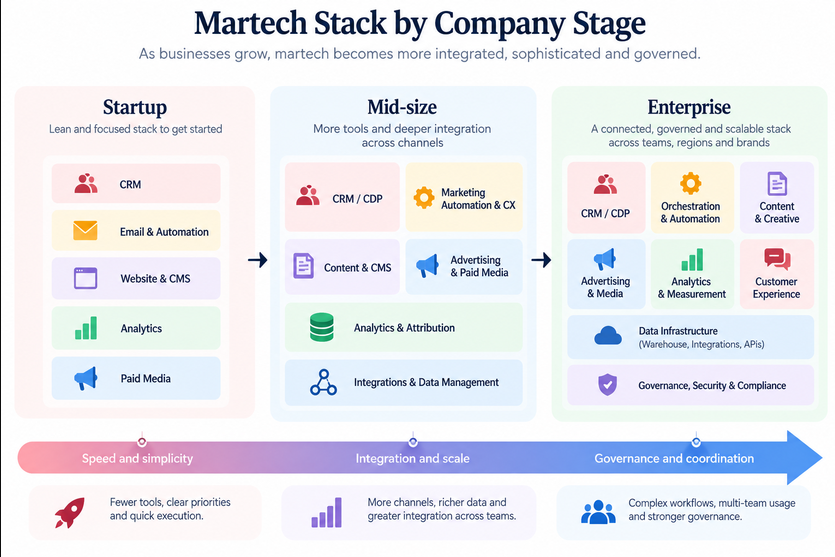
| Company stage | Core stack | Main priority |
|---|---|---|
| Startup | CRM, analytics, email, CMS, paid media | Keep execution simple |
| Mid-size | CRM/CDP, automation, analytics, ads, content | Connect data and workflows |
| Enterprise | Integrated CRM/CDP, automation, analytics, data infrastructure, AI | Scale, governance and orchestration |
Startup Martech Stack
Startups usually need fewer tools with clear jobs.
A basic stack might cover customer management, website analytics, email, content and paid acquisition.
The priority is getting the fundamentals working before adding specialised software.
Mid-size Martech Stack
As marketing grows, integration becomes more important.
More channels, campaigns and customer data can create duplication. Teams may add automation, customer data tools and more advanced analytics.
At this stage, the question changes from “What tool do we need?” to “How should these tools work together?”
Enterprise Martech Stack
Enterprise stacks need stronger integration, governance and ownership.
Large organisations may have many teams, regions, brands and customer journeys using different systems. The challenge is keeping data consistent while allowing teams enough flexibility to work effectively.
This is also where tool consolidation becomes important. The 2026 martech landscape reached 15,505 products, but net growth was only 0.79%, with substantial numbers of products entering and leaving the landscape.
More tools ≠ better martech. A smaller connected stack can outperform a larger collection of disconnected tools.
Visual concept: Three simplified stack architectures side by side: Startup → Mid-size → Enterprise, showing increasing layers of integration and governance rather than repeating the exact table.
How Is AI Changing Martech in 2026?
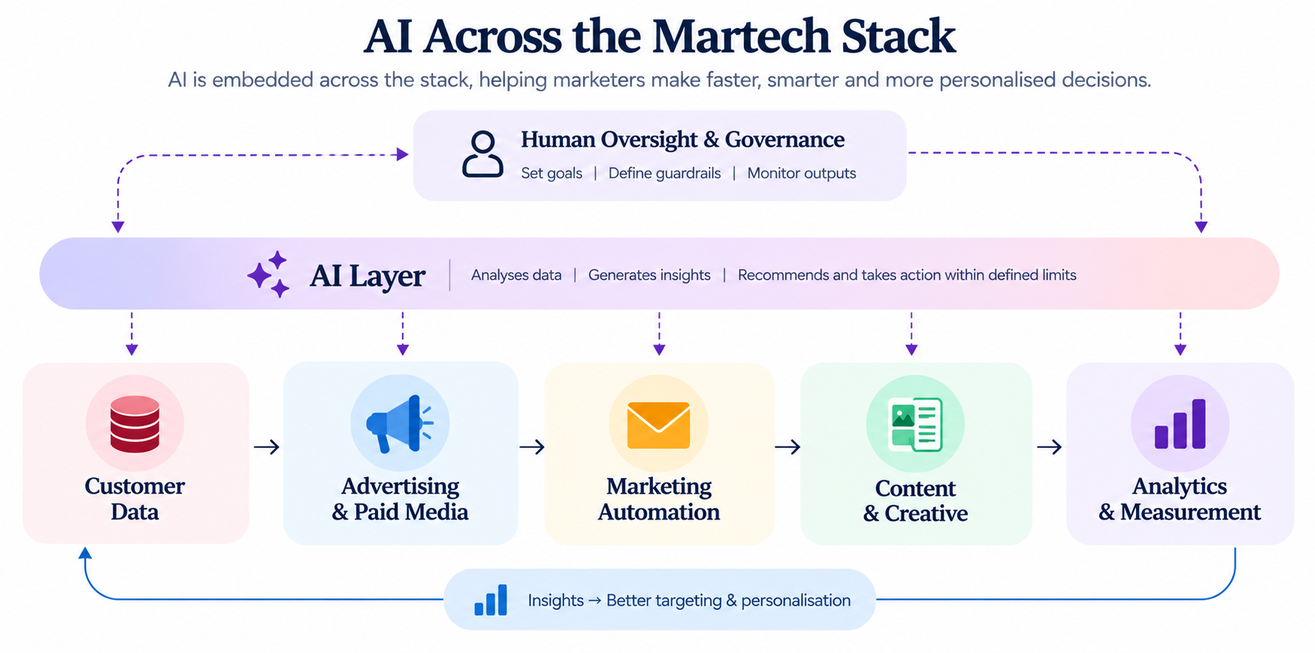
AI is becoming a layer across the martech stack rather than a separate tool sitting beside it.
In 2026, AI is appearing inside advertising, customer data, personalisation, content, analytics and workflow automation. The bigger shift is that some systems can now interpret data, recommend actions and carry out parts of a workflow.
AI Advertising and Media Buying
AI can help marketers identify audiences, generate creative variations, optimize campaigns and adjust bids or budgets.
The marketer still needs to set objectives, constraints and measurement rules. AI does not remove the need for strategy.
AI Customer Data and Personalisation
AI can analyse customer behaviour and help identify patterns across large datasets.
This can support personalized recommendations, audience segmentation and next-best-action decisions.
The quality of these outputs still depends on the quality and accessibility of the underlying data.
AI Marketing Automation
Traditional automation follows predefined rules.
AI can make workflows more adaptive by interpreting information and deciding which action is appropriate within defined limits.
For example, instead of sending every lead through exactly the same sequence, an AI-enabled system may use behaviour and customer information to determine the next step.
From Automation to AI Agents
The next shift is from AI that suggests to AI that can act.
An AI agent may be able to interpret a goal, use connected systems, perform several steps and report the result. This makes integrations, permissions, data quality and governance more important, not less. Current 2026 research describes this movement as a shift from marketer-operated applications toward infrastructure that AI agents can work with.
Visual concept: One AI layer sitting across Data → Ads → Automation → Analytics, with a Human oversight & governance loop around it.
How Should You Choose or Consolidate a Martech Stack?
Start with the marketing problem, then choose the technology.
Start With Marketing Goals and Customer Journeys
First identify what the team needs to achieve.
For example:
Goal → Customer journey → Required capability → Tool
If the problem is poor lead follow-up, the answer may be better automation rather than another analytics platform.
Audit Existing Tools and Overlap
List every tool, its owner, users, cost, purpose, integrations and actual usage.
Look for:
- Duplicate capabilities
- Unused subscriptions
- Data silos
- Broken or manual integrations
- Tools with unclear ownership
A 2026 HubSpot guide recommends auditing overlap and underuse before buying more technology.
Evaluate Integration and Data Flow
Ask:
- Where does customer data live?
- Which system is the source of truth?
- What data needs to move between tools?
- Are integrations reliable?
- Can the tools support future needs?
A tool that works beautifully on its own can still be a poor choice if it creates another isolated data source.
Consolidate Before Adding More
If two tools solve the same problem, consolidate before buying a third.
Stack consolidation means reducing overlapping systems and keeping a smaller set of tools that work well together. It can reduce cost, simplify workflows and make customer data easier to manage.
The 2026 question is therefore less “What new tool should we buy?” and more “What capability are we missing, and can our existing stack already provide it?”
What Roles and Skills Does Martech Need?
Modern martech needs marketers who understand both marketing strategy and how technology supports it.
Martech and Marketing Operations Roles
Marketing operations teams often manage:
- Martech platforms
- Integrations and data flows
- Campaign processes
- Automation
- Reporting
- Tool governance
As stacks become more complex, these roles increasingly sit between marketing, data and technology teams.
Skills Marketers Need
Marketers do not need to become software engineers. But they increasingly need to understand:
- Customer data and privacy
- Analytics and measurement
- Automation
- AI tools and workflows
- Integrations
- Experimentation
- Basic data interpretation
- Martech strategy and tool evaluation
The valuable skill is knowing what should be automated, what should remain human-led, and how the technology connects back to the business goal.
Conclusion
A good martech stack is not the biggest stack. It is the one that helps a marketing team move from customer data to action to measurement without unnecessary friction.
In 2026, that means thinking beyond individual software subscriptions. AI is changing what tools can do, while connected data, integration and consolidation are becoming just as important as adding new capabilities.
The best starting point is simple: define the marketing goal, map the customer journey, audit what you already have, then add technology only where it solves a real gap.
Want to build stronger AI and marketing skills for the changing martech landscape? Explore the AI-Powered Marketing & Growth programme.
FAQs
Does every company need a CDP?
No. A CDP is useful when a company needs to bring customer data from multiple sources together for activation or analysis. Smaller teams may be able to manage their needs through an existing CRM and other connected tools.
Should a CRM or CDP be at the centre of a martech stack?
There is no universal answer. A CRM often acts as the main customer record, while a CDP may become more important when a company has complex customer data across many sources. The right centre depends on the company's architecture and use case.
What is martech tool sprawl?
Martech tool sprawl is the buildup of too many overlapping or poorly connected marketing tools. It can lead to unused subscriptions, duplicate data, more maintenance and confusing reporting.
Can a martech stack work without integrations?
Yes, but disconnected tools create more manual work and make it harder to keep customer data consistent. Integrations become increasingly important as the number of tools and customer touchpoints grows.
What is a composable martech stack?
A composable martech stack uses modular tools that can be connected, replaced or upgraded without rebuilding the entire system. APIs and shared data foundations are central to this approach.
How often should a martech stack be audited?
A quarterly review is a practical starting point. Teams should also review the stack when they change their customer journey, add major channels, replace core systems or approach contract renewals.
Should a company choose one large platform or several specialist tools?
Neither is automatically better. A large platform can simplify integration, while specialist tools can provide deeper capabilities. The better choice depends on the company's needs, resources and ability to manage integrations.
What is the difference between martech and adtech?
Martech covers the broader technology used to manage marketing and customer relationships, while adtech focuses mainly on advertising technology and paid media. The two increasingly overlap as platforms combine more capabilities.
Can AI replace a martech team?
No. AI can automate parts of execution and analysis, but teams still need people to define goals, manage data, set rules, evaluate results and make strategic decisions.
How do you know whether a martech tool is worth keeping?
Look at usage, business impact, integration quality, cost and overlap. A tool that is rarely used, duplicates another system or contributes little to business outcomes is a strong candidate for consolidation.