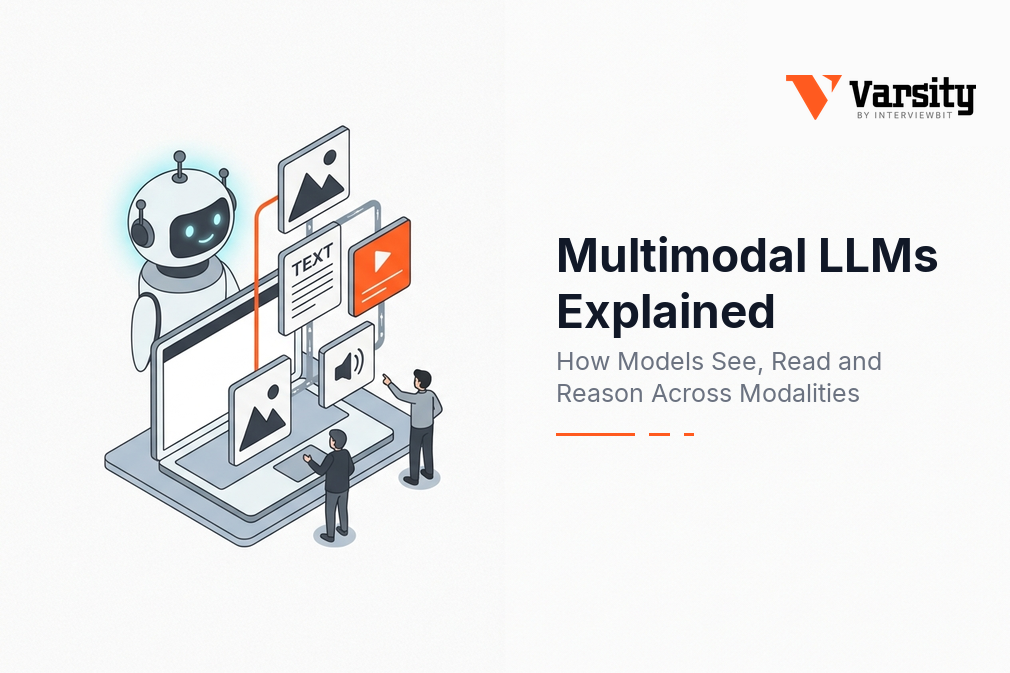
Multimodal LLMs Explained: How Models See, Read and Reason Across Modalities

Key Insights
- Multimodal LLMs process and connect information from multiple modalities, such as text, images, audio and video, to respond to tasks that go beyond text alone.
- A common multimodal LLM architecture combines a vision encoder, a projector or adapter, and an LLM backbone. Implementations vary by model.
- Cross-attention and token fusion are different ways to integrate information across modalities; they are not necessarily mutually exclusive.
- Training typically involves aligning representations across modalities and instruction-tuning models to respond to user prompts about visual or other non-text inputs.
- Models such as GPT-4o, Gemini, Claude, LLaVA and Qwen-VL illustrate different approaches to multimodal capabilities, with varying levels of architectural transparency.
- Applications include visual question answering, document understanding, video analysis and AI-assisted workflows.
- Multimodal models can still misinterpret visual details or generate unsupported answers. Grounding and evaluation can improve reliability but do not eliminate hallucinations.
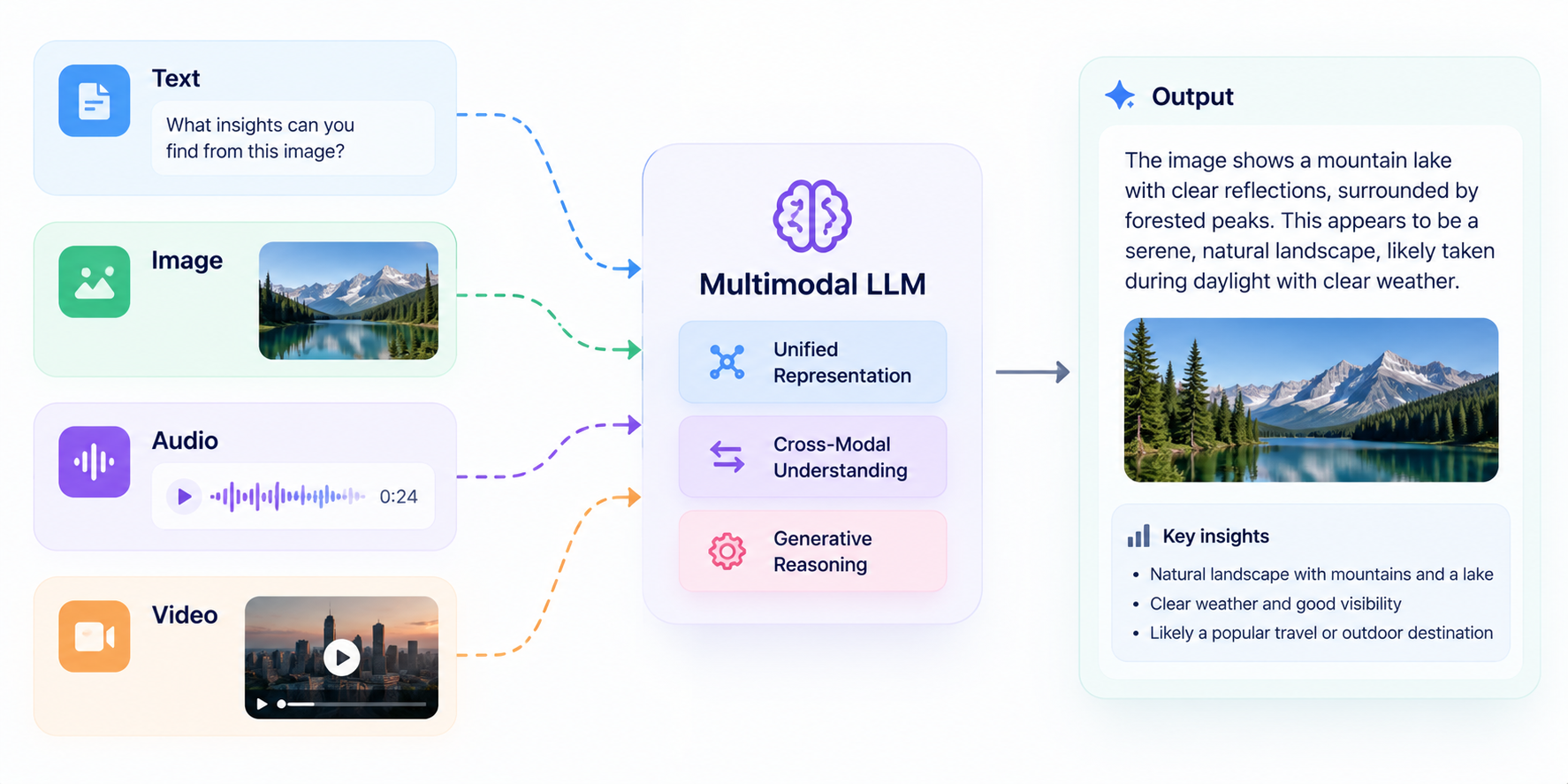
A multimodal large language model (multimodal LLM) is an AI system that processes information from multiple modalities, such as text, images, audio, and video, to generate responses. For example, you could upload a chart, ask the model to explain its trend, and then ask a follow-up question about a particular data point. Unlike text-only models, multimodal LLMs can incorporate visual or other non-text information into their responses, depending on their supported capabilities.
This guide explains what multimodal AI is, how multimodal LLM architecture works, how these models are trained, and where they are used. It also compares representative models and explores their limitations, including hallucinations and visual grounding.
Your roadmap to becoming a Generative AI Engineer
See what you already know, what to learn next and how long the switch to a GenAI engineering role takes. Tap any step for what to study and build.
Personalise your roadmap3 quick questions · takes 30 seconds
What's inside8 stages · 30 steps to job-ready
- Python & engineering foundations
- ML & deep learning essentials
- How LLMs work
- Prompting & building LLM apps
- RAG & model customisation
- Agents & tool use
- Production, evaluation & safety
- Portfolio & job readiness
Stage 1 · Start here
Python & engineering foundations
What to study
- Core Python: data types, functions, classes, modules
- Virtual environments and package management (pip, uv)
- Writing clean, testable scripts
What to build
A command-line script that reads a CSV, cleans it and writes a summary report.
What to study
- SQL joins, aggregations and window functions
- pandas for cleaning and reshaping data
- Working with text data at scale
What to build
A notebook that cleans a messy text dataset and prepares it for a model.
What to study
- Git branching and pull requests
- How REST APIs work: HTTP methods, status codes, auth headers
- Reading and writing JSON
What to build
Call a public API from Python, handle errors and save the results as JSON.
What to study
- Vectors, matrices and dot products
- Probability and distributions
- Gradients and optimisation, intuitively
What to build
Implement cosine similarity and gradient descent from scratch in NumPy.
Stage 2 · Core concepts
ML & deep learning essentials
What to study
- Supervised vs unsupervised learning
- Train/test splits, overfitting and evaluation metrics
- scikit-learn workflows
What to build
Train and evaluate a text classifier with scikit-learn.
What to study
- Tokenisation and text preprocessing
- Word embeddings and semantic similarity
- Sequence models (RNN, LSTM) and why transformers replaced them
What to build
Build a semantic search over 500 short texts using sentence embeddings.
What to study
- Layers, activations, loss functions and backpropagation
- Training loops, batching and GPUs
- PyTorch tensors and autograd
What to build
Train a fully connected network on a small dataset and plot its learning curve.
Stage 3 · Understand the engine
How LLMs work
What to study
- Self-attention and multi-head attention
- Encoder, decoder and encoder-decoder models
- Positional encoding and why scale matters
What to build
Walk through a minimal transformer implementation and explain each block in a short write-up.
What to study
- The Transformers library, model hub and datasets
- Running open-weights models locally
- Fine-tuning a pre-trained model for a task
What to build
Fine-tune a small pre-trained transformer for sentiment or topic classification.
What to study
- Closed vs open-weights model families
- Tokens, context windows, temperature and sampling
- Comparing models on cost, latency and quality
What to build
A comparison table of three models answering the same 20 prompts, with cost and latency.
What to study
- Quantisation, pruning and distillation
- When a small model beats a large one
- On-device and low-cost inference
What to build
Quantise an open model and compare its speed and quality against the original.
Stage 4 · Start shipping
Prompting & building LLM apps
What to study
- System prompts, few-shot examples and chain-of-thought
- Prompt test sets and versioning
- Reducing hallucinations through prompt design
What to build
A prompt library with a 30-example test set and before/after scores.
What to study
- Calling LLM APIs: streaming, rate limits, keys
- Serving with FastAPI and simple UIs with Streamlit
- Caching and cost control
What to build
A small chat app with streaming responses, deployed for others to try.
What to study
- JSON schema outputs and validation
- Function / tool calling
- Retries and graceful failure
What to build
An invoice or resume parser that returns validated JSON.
What to study
- Chains, prompts and output parsers
- Document loaders and retrievers
- When a framework helps and when it gets in the way
What to build
Rebuild your chat app with LangChain and compare the code with your plain-API version.
Stage 5 · Make models useful
RAG & model customisation
What to study
- Embedding models and similarity search
- Vector databases (e.g. pgvector, Pinecone, Weaviate)
- Chunking strategies and metadata filters
What to build
Index a document set in a vector database and query it with filters.
What to study
- Supervised fine-tuning vs prompting vs RAG
- LoRA and other parameter-efficient methods
- Preparing instruction datasets
What to build
LoRA fine-tune an open-weights model on a narrow task and compare it with prompting alone.
What to study
- Vision transformers and CLIP-style models
- Image captioning and visual question answering
- Combining text and image retrieval
What to build
An image search app that finds photos from a text description.
What to study
- The RAG pipeline end to end
- Re-ranking, hybrid search and citations
- Measuring retrieval quality
What to build
A document Q&A assistant that cites its sources, with a retrieval-quality report.
What to study
- Instruction tuning and reward models
- RLHF and DPO, conceptually and with TRL
- Where alignment fits in real products
What to build
Train a small reward model and run a preference-tuning loop on a toy task.
Stage 6 · Automate workflows
Agents & tool use
What to study
- ReAct, planning and reflection patterns
- Single-agent vs multi-agent setups
- Memory: short-term, long-term and retrieval
What to build
A research agent that searches, reads and summarises sources on a topic.
What to study
- Model Context Protocol (MCP) servers and clients
- Connecting agents to databases, CRMs and internal APIs
- Permissions and audit trails for tool calls
What to build
An MCP server that exposes two tools from a real API, used by your agent.
What to study
- Graphs, state and checkpoints
- Human-in-the-loop approvals
- Error handling in multi-step workflows
What to build
Rebuild your research agent as a LangGraph workflow with an approval step.
Stage 7 · Make it reliable
Production, evaluation & safety
What to study
- Docker images for AI apps
- CI/CD basics
- Secrets and environment configuration
What to build
Containerise your RAG assistant and deploy it with a CI pipeline.
What to study
- Building evaluation datasets
- LLM-as-judge and its limits
- Regression testing prompts and models
What to build
An eval harness that scores your assistant on 50 cases and runs on every change.
What to study
- Tracing LLM calls
- Tracking token cost and latency
- Dashboards and alerting
What to build
Add tracing and a cost dashboard to your deployed app.
What to study
- Managed model platforms on AWS, GCP and Azure
- Serverless deployment and autoscaling
- Data privacy and region choices
What to build
Deploy your app on one cloud using a managed model endpoint.
What to study
- Hallucination, bias and privacy risks
- Prompt injection and defences
- PII handling and content filtering
What to build
Add input and output guardrails to your assistant and document the risks you tested.
Stage 8 · Get hired
Portfolio & job readiness
What to study
- GenAI system design questions
- Explaining trade-offs: RAG vs fine-tuning, cost vs quality
- Coding rounds in Python
What to build
Mock-interview notes for three GenAI system design questions.
What to study
- Choosing a domain problem (healthcare, fintech, edtech)
- Writing clear READMEs and architecture notes
- Recording a short demo
What to build
A client-ready AI agent for one domain, with a public demo and write-up.
Fine-tuned text classifier
Adapting a pre-trained transformer to a real task.
Fine-tune a small pre-trained transformer on a labelled dataset, evaluate it properly and compare it with a classic ML baseline.
Structured data extractor
Turning messy documents into clean JSON.
Use an LLM API with schema-validated outputs to extract fields from invoices or resumes, with a prompt test set to track accuracy.
Document Q&A assistant
Retrieval-augmented answers with citations.
Index a document collection in a vector database and build an assistant that answers questions with cited sources and a retrieval-quality report.
LoRA fine-tune of an open model
Customising a model when prompting isn't enough.
Fine-tune an open-weights model with LoRA on a narrow task and document when it beats prompting and RAG, and when it doesn't.
Reward model & preference tuning
Teaching a model what good looks like.
Train a small reward model on preference data and run a preference-tuning loop, with a write-up of what changed.
Multimodal image search
Finding images from plain-language descriptions.
Embed images and text in a shared space and build a search app that retrieves photos from a description.
Tool-using research agent
An agent that plans, acts and asks for approval.
Build a LangGraph agent that searches, reads and summarises sources, calls tools through an MCP server and pauses for human approval.
Deployed GenAI service
From notebook to a monitored production API.
Containerise an LLM app, deploy it on a cloud platform with CI/CD, and add tracing plus a cost and latency dashboard.
Eval harness with guardrails
Proving your AI app works, and stays safe.
Create a 50-case evaluation set, automate scoring on every change, and add input and output guardrails against prompt injection and PII leaks.
Domain AI agent capstone
A client-ready agent for a real industry problem.
Pick a domain such as healthcare, fintech or edtech and ship an agent that combines retrieval, tools, evals and guardrails, with a public demo and write-up.
GenAI glossary 17 terms
Tap a term to see what it means. You will hear these in every GenAI interview.
- LLM
- Large language model: a neural network trained on huge amounts of text to predict and generate language.
- Transformer
- The neural network architecture behind modern LLMs, built around the attention mechanism.
- Token
- A chunk of text (often part of a word) that a model reads and writes. Pricing and limits are counted in tokens.
- Context window
- The maximum number of tokens a model can consider at once, including your prompt and its answer.
- Prompt engineering
- Designing instructions and examples so a model reliably produces the output you need.
- Embeddings
- Numeric vectors that capture meaning, so similar texts end up close together.
- Vector database
- A database built to store embeddings and find the most similar ones quickly.
- RAG
- Retrieval-augmented generation: fetching relevant documents and giving them to the model so answers are grounded.
- Fine-tuning
- Further training a pre-trained model on your own data to specialise it.
- LoRA
- Low-rank adaptation: a parameter-efficient fine-tuning method that trains small add-on weights instead of the whole model.
- Agent
- An LLM system that plans steps, calls tools and acts towards a goal, often over several turns.
- Tool calling
- Letting a model call functions or APIs, such as search or a database query, with structured arguments.
- MCP
- Model Context Protocol: an open standard for connecting AI applications to tools and data sources.
- Evals
- Systematic tests that measure how well an AI system performs on representative cases.
- Guardrails
- Checks on inputs and outputs that keep an AI system safe, on-topic and compliant.
- Hallucination
- When a model states something false or unsupported with confidence.
- Prompt injection
- An attack where malicious text tricks a model into ignoring its instructions.
IIT Delhi CEP × Varsity
Close your gaps with a structured programme
The Certificate Programme in Generative AI from CEP, IIT Delhi covers transformers, fine-tuning, RAG, agents and responsible AI through live weekend classes and hands-on projects.
What is Multimodal AI, and What Is a Multimodal LLM?
Multimodal AI refers to systems that process or combine multiple types of information. A multimodal LLM uses a language-model-based system to interpret or generate responses involving different modalities. Not every multimodal AI system is an LLM.
What does Multimodal Mean in AI?
A modality is a type of information, such as text, images, audio, video, or sensor data. A unimodal system works primarily with one type, whereas multimodal AI combines information across two or more modalities.
Consider a shopping assistant that receives a product image and the question, “Does this bag have an adjustable strap?” The system must interpret the visual information and connect it with the text instruction to produce a relevant answer.
How is a Multimodal LLM Different from a Text-Only LLM?
A text-only LLM primarily processes text tokens. A multimodal large language model can also incorporate representations derived from images, audio, or other supported inputs. Some models can generate outputs in additional modalities, too.
The distinction is not absolute across all systems. A vision-language model specialises in connecting visual and textual information, while multimodal LLMs can extend to audio and video. The supported inputs and outputs depend on the particular model and its architecture.
How do Multimodal LLMs Work?
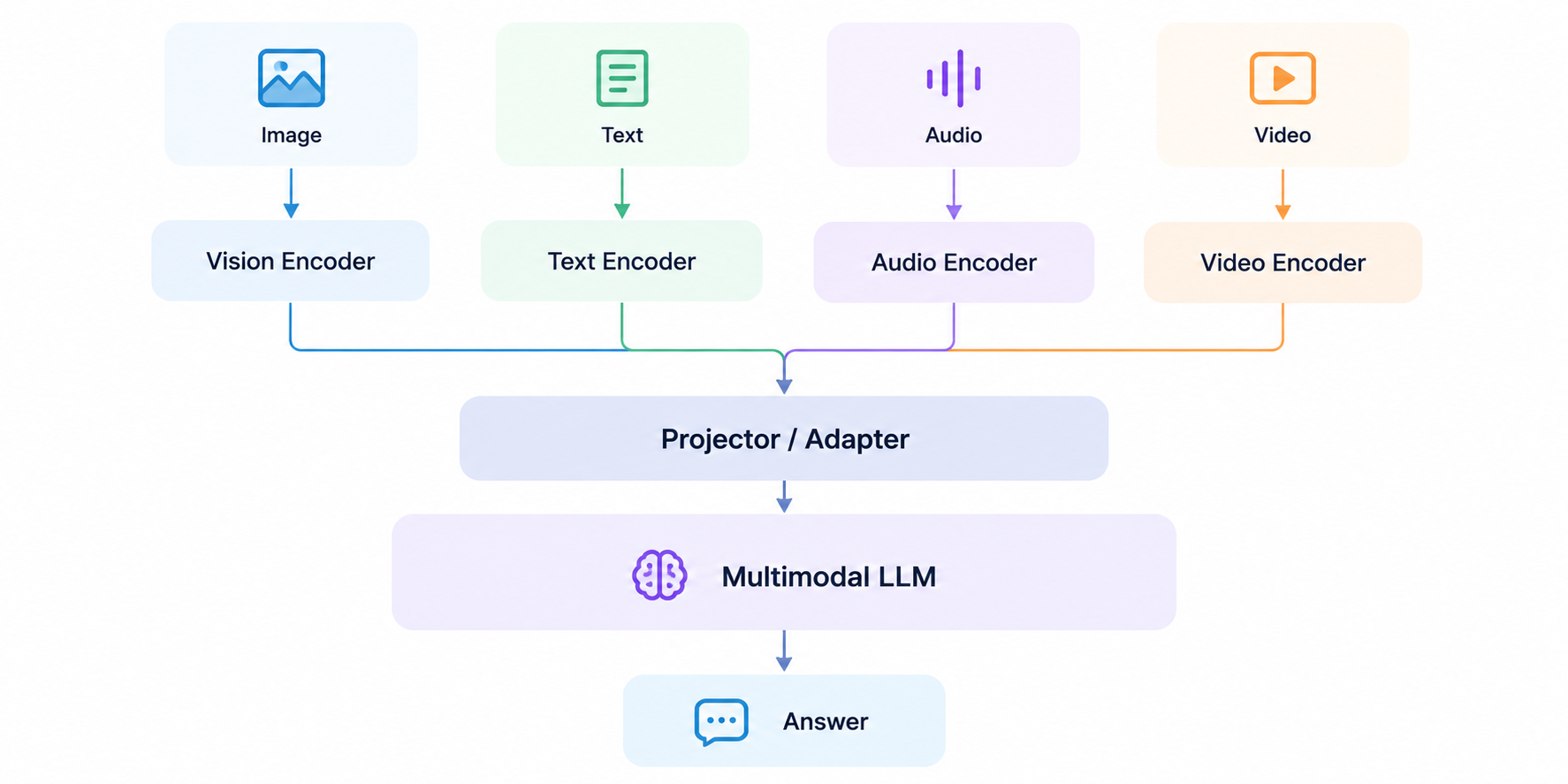
Many multimodal LLMs follow a general pipeline: an encoder converts non-text input into numerical features, a projector or adapter maps those features into a compatible representation, and an LLM backbone processes the combined context to generate a response. Architectures vary, so this is a useful general model rather than a universal design.
What does a Vision Encoder Do?
A vision encoder extracts useful features from an image, such as shapes, objects, text, and spatial relationships. Convolutional neural networks (CNNs) and Vision Transformers (ViT) are two approaches to visual representation learning.
A vision transformer in multimodal AI divides an image into patches and processes them using transformer-based mechanisms. The resulting representations can be passed to later components for interpretation.
The CLIP research paper introduced a method for learning aligned image and text representations using image-text pairs. This helps connect visual content with language, although alignment does not guarantee accurate interpretation of every image.
What are Projectors, Adapters and the LLM Backbone?
Visual features are not automatically compatible with a language model’s token representations. A projector or adapter can map the features into a representation the LLM can process. The LLM backbone then uses the combined context to generate a response.
LLaVA is a research example of this approach: it connects a vision encoder with a language model to support visual instruction following. Other multimodal systems may integrate modalities differently.
Cross-Attention vs Token Fusion
Cross-attention allows one representation, such as text, to attend selectively to features from another modality, such as an image. This can help a model focus on visual regions relevant to a question.
Token fusion combines representations from different modalities into a shared sequence or token stream where the architecture supports it. The model can then process these representations together.
These mechanisms are not mutually exclusive. A multimodal model may use cross-attention at some stages and combine modality tokens at others. The implementation depends on the model’s design.
How are Multimodal LLMs Trained?
Multimodal AI training uses combinations of text and non-text data to teach models relationships across modalities. Training may involve learning visual or audio representations, aligning them with language, and adapting the model to follow user instructions. The exact pipeline differs by model family.
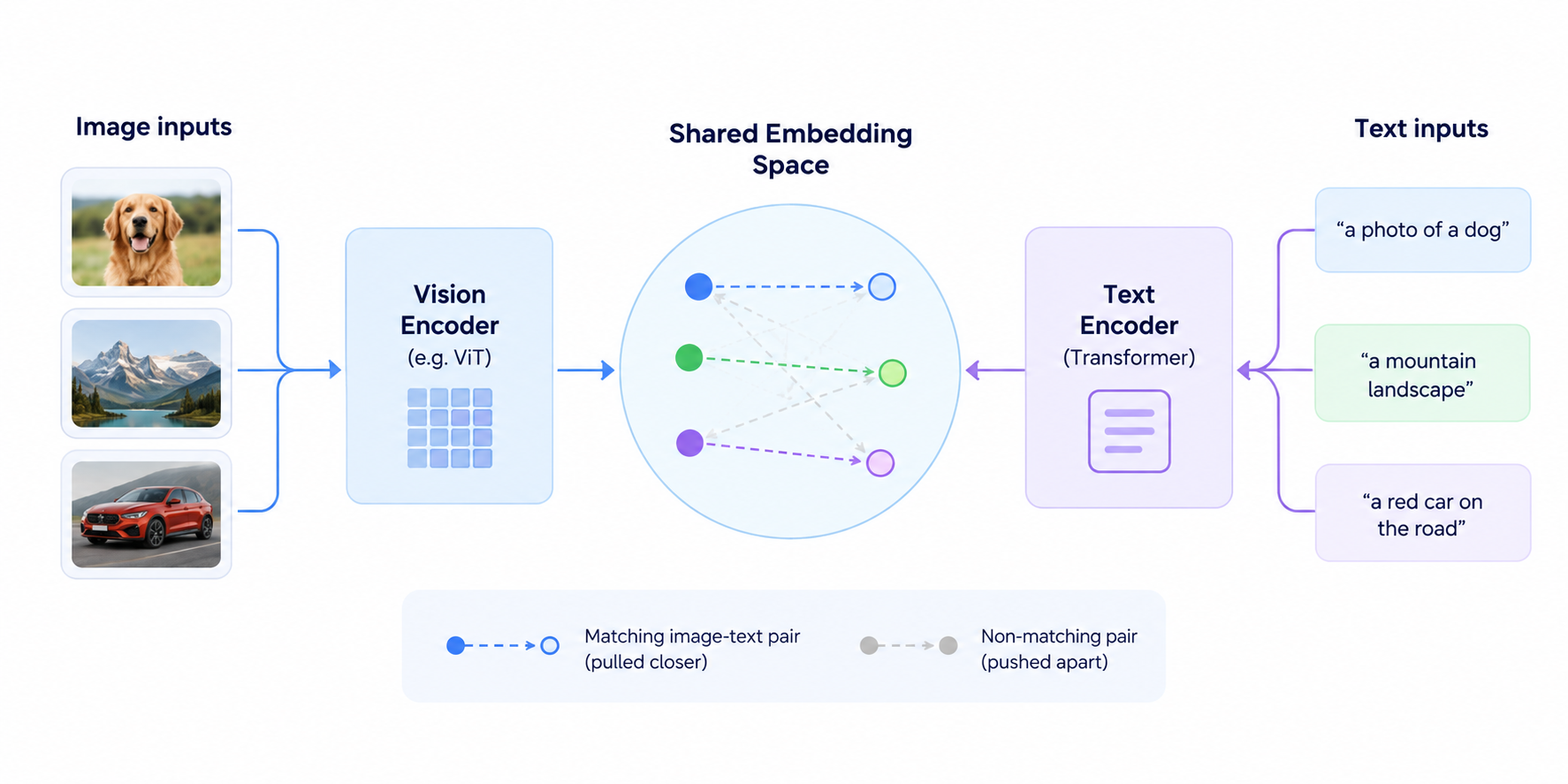
What is Multimodal Alignment Pre-Training?
Multimodal alignment helps a model learn relationships between different forms of information. For example, image-text pairs can teach a system to associate a photograph with a caption.
The CLIP paper demonstrates contrastive image-text learning. The BLIP research paper presents a vision-language pre-training framework designed for both understanding and generation tasks. These are examples of approaches to learning image-text relationships, not a single training pipeline used by all multimodal models.
What is Visual Instruction Tuning?
Visual instruction tuning trains a model on examples that combine visual inputs with instructions and responses. It helps the model learn how to answer questions about images and respond to user requests involving visual content.
The LLaVA visual instruction tuning paper, published as research in 2023, explores using generated multimodal instruction-following data to train a vision-language assistant. Broad pre-training develops representations, while instruction tuning adapts the model to follow requests more effectively.
Multimodal LLMs vs Multimodal AI: Models and Examples
Multimodal AI is the broader category, covering systems that process several types of data. Multimodal LLMs combine multimodal processing with a large language model. The following examples illustrate different approaches and historical milestones, not a ranking or a list of the latest versions.
| Model / family | Notable public milestone | Multimodal focus |
|---|---|---|
| GPT-4o | Announced May 2024 | Designed for real-time interaction across text, vision, and audio, with capabilities described in the official announcement |
| Gemini | Introduced December 2023 | Built to work across text, images, audio, video, and code, as described in Google’s announcement |
| Claude 3 family | Announced March 2024 | Introduced vision capabilities for interpreting images, charts, graphs, and diagrams; see Anthropic’s announcement |
| LLaVA | Research paper released April 2023 | Connects a vision encoder and LLM for visual instruction following; see the research paper |
| Qwen2.5-VL | Released January 2025; technical report published February 2025 | Vision-language research covering visual recognition, document parsing, charts, and video; see the Qwen technical report |
Commercial products and open research models differ in access, deployment, supported inputs, and customisation. Their capabilities also change over time, so check current official documentation before selecting a model for a project.
What are the Applications of Multimodal AI?
Multimodal LLM applications include interpreting documents, answering questions about images, analysing video, and supporting workflows that combine text with visual information. Their reliability depends on the model and the task.
Document Understanding and Visual Question Answering
Multimodal document understanding involves extracting and interpreting information from forms, invoices, tables, charts, and scanned pages. Visual question answering (VQA) allows a user to ask questions about image content, such as identifying a trend in a chart or locating a field in a form.
These tasks may require optical character recognition (OCR), layout understanding, and visual reasoning. Performance can decline with small text, poor image quality, or complex layouts.
Video Understanding and Audio-Visual Interaction
Video understanding AI can summarise a clip, identify events, or answer questions about selected frames. Depending on the system, it may also connect video with audio or text.
Long videos often require specialised processing, such as sampling frames, preserving timestamps, or selecting relevant segments. A model should not be assumed to process every frame equally or retain every detail.
Multimodal Agents and Workflow Automation
Multimodal AI agents can combine visual inputs, text instructions, and tools to support tasks such as interpreting a software interface, assisting with quality inspection, or extracting information from documents.
Their ability to act depends on the surrounding system, tool access, permissions, and model capabilities. A model that can interpret a screenshot does not automatically have permission or reliable ability to perform every action shown in it.
What are the Limitations of Multimodal LLMs?
Multimodal LLM limitations include misreading visual details, overlooking context, and generating confident answers unsupported by the input. Receiving an image or other evidence does not guarantee that a response is grounded in it.
What is Multimodal Hallucination?
A multimodal hallucination occurs when a model describes something that is absent from, or unsupported by, its input. For example, it might report the wrong value from a chart or describe an object that is not present in an image.
Plausible wording does not establish visual accuracy. Developers should verify outputs against the original input, especially when errors could have significant consequences.
How can Developers Improve Grounding and Reliability?
Visual grounding in AI means connecting a response to relevant evidence in an image or other visual input. Developers can improve reliability by:
- Evaluating models on task-specific examples, including dense charts, small text, unusual layouts, and ambiguous images.
- Asking for evidence or references to relevant image regions where the system supports them.
- Using external validation, confidence checks, and human review for consequential decisions.
- Testing failure cases instead of relying on prompts alone to prevent hallucinations.
Grounding methods can help, but they do not eliminate all errors.
Conclusion
Multimodal LLMs extend language-model capabilities by enabling systems to work across text and other data types. Their behaviour depends on how inputs are encoded, aligned, fused, and processed, as well as how reliably responses are grounded in the evidence. Understanding the roles of vision encoders, projectors, LLM backbones, and training methods helps developers assess which model may suit a particular application.
Ready to explore these concepts alongside broader generative AI techniques? Explore the Generative AI programme by IIT Delhi, delivered through Varsity by InterviewBit, to build your understanding of modern AI models and their applications.
Frequently Asked Questions
Is ChatGPT a multimodal LLM?
ChatGPT’s multimodal capabilities depend on the model and features available. Some models can process combinations of text, images, and audio, but supported inputs and outputs vary.
What is the difference between a multimodal LLM and a vision-language model?
Vision-language models focus on connecting visual and textual information. Multimodal LLMs can cover a broader range of modalities, including audio and video, depending on their design.
Can multimodal LLMs understand handwritten text?
Some models can interpret handwriting in images, but accuracy depends on image quality, legibility, language, and layout complexity. Important values should be checked against the source.
Do multimodal LLMs use separate models for images and text?
Some architectures use specialised encoders connected to an LLM, while others integrate modalities more directly. There is no single architecture shared by all multimodal models.
What is the difference between CLIP and LLaVA?
CLIP learns aligned image-text representations, while LLaVA connects a vision encoder to a language model to support visual instruction following and conversational responses.
Can multimodal LLMs generate images as well as understand them?
Some systems support both image understanding and image generation. Image generation may rely on additional components or models rather than the language model alone.
What hardware is required to run an open-source multimodal LLM?
Requirements depend on model size, quantisation, image resolution, context length, and inference setup. Smaller models may run on suitable consumer hardware, while larger models can require substantial GPU memory.
Are multimodal LLMs the same as generative AI?
No. Generative AI is the broader category. Multimodal LLMs are one type of generative AI system, although not every multimodal AI system generates content.
How are multimodal LLMs evaluated?
Evaluation can include visual question answering, document extraction, image-text alignment, instruction following, hallucination rates, and task-specific accuracy. The relevant tests depend on the intended use.
Can multimodal LLMs work with private company documents?
This depends on the model’s deployment, data-handling policies, access controls, and integrations. Before processing sensitive documents, check data retention, privacy, and security requirements.