How Quantum Computing Could Transform Wall Street Forever

Key Insights
- Quantum computing in finance is promising but still early. Most applications in trading, portfolio optimization, risk and pricing remain research or pilot-stage. None has shown a broad, proven advantage over strong classical methods.
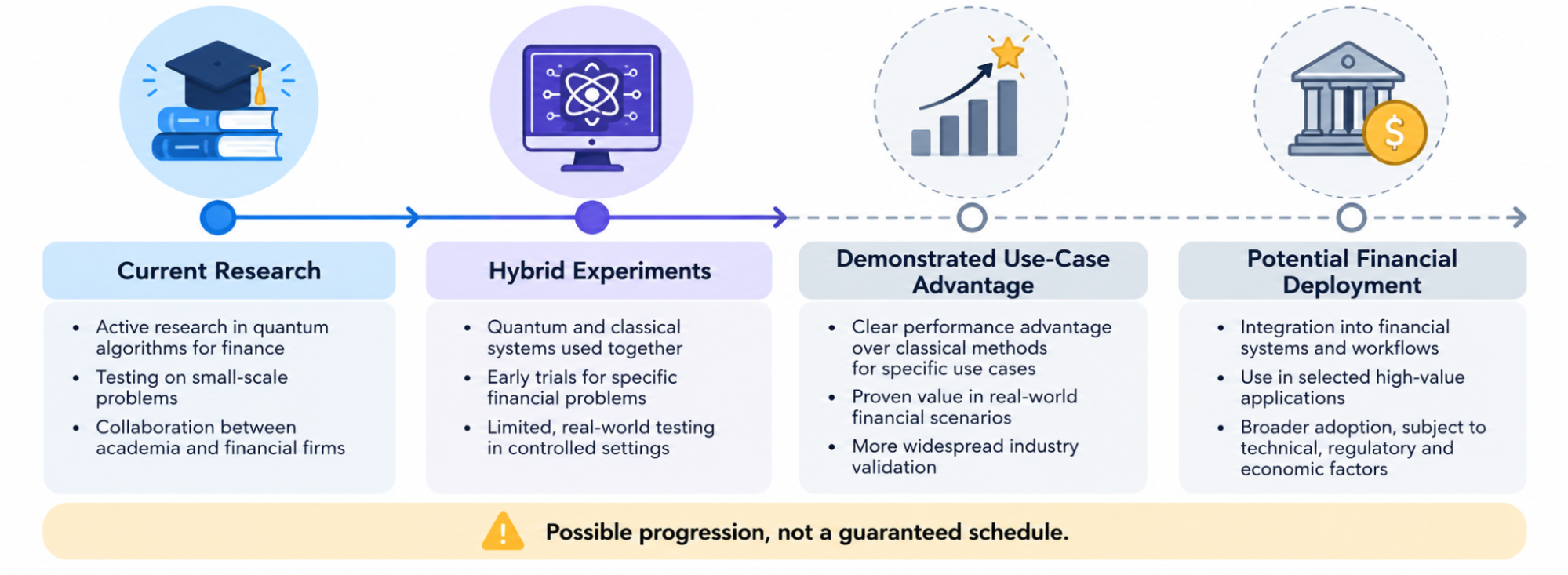
- Hybrid workflows are the realistic model. Classical systems prepare data, quantum processors handle specific algorithmic steps, and classical systems validate the results. Adoption is likely to be selective rather than a replacement of existing infrastructure.
- Quantum advantage is problem-specific. It depends on the algorithm, the hardware, and a fair comparison with optimized classical baselines. Quantum computers do not simply try every answer at once.
- Monte Carlo simulation is a leading research target. Quantum amplitude estimation could theoretically reduce the samples needed for risk analysis and derivatives pricing. Theoretical gains do not automatically become practical speedups on today’s noisy hardware.
- Data loading and overhead can erase gains. Encoding classical data into quantum states, circuit execution time and latency must all be counted. This matters most in real-time trading.
- Security is the most urgent action item. Sufficiently capable fault-tolerant quantum computers could threaten widely used public-key cryptography. NIST has finalized its first post-quantum encryption standards, so institutions should inventory and plan migration now.
- Post-quantum cryptography and QKD are different. Post-quantum cryptography uses classical algorithms built to resist quantum attacks. Quantum key distribution uses quantum properties to help detect interception during key exchange.
- Preparation is practical. Institutions can set classical baselines, test simulators and cloud hardware, partner with researchers, and avoid investment decisions based on unverified performance claims.
Quantum computing is a computing approach that uses quantum-mechanical principles, such as superposition and entanglement, to process information differently from classical computers. Wall Street depends on computational models for trading, portfolio management, pricing, risk analysis, and fraud detection, and some of these tasks are extremely demanding.
Quantum computing in finance explores whether specialized quantum algorithms could improve selected complex calculations and optimization problems. Most applications remain experimental, and quantum computers are not replacing conventional financial systems. This article covers applications, potential benefits, limitations, and the future of quantum finance.
How could Quantum Computing Work in Financial Markets?
Quantum computing processes information using quantum bits, or qubits, and quantum operations. In finance, researchers are investigating whether specialized quantum algorithms can improve certain computationally demanding tasks. These algorithms would run alongside classical computing systems, not in place of them.
How Quantum Computing Differs from Classical Computing?
Classical and quantum machines represent information in fundamentally different ways. The table below summarizes the contrast.
| Feature | Classical Computing | Quantum Computing |
|---|---|---|
| Basic unit | Bit (0 or 1) | Qubit (can be in superposition) |
| Key resources | Logic gates | Superposition, entanglement, interference |
| Best suited for | General-purpose tasks | Specific problem types |
Quantum computers do not try every possible answer simultaneously and return the best one. Any advantage depends on the problem, algorithm, hardware, and comparison with classical methods.
Why Financial Problems Can Be Computationally Difficult?
Many core finance tasks involve huge numbers of variables and possibilities. These are the areas where researchers look for computational gains.
- Portfolio optimization balances returns, risk, and constraints.
- Derivatives pricing may require extensive numerical calculations.
- Risk modeling covers many possible market scenarios.
- Data processing involves large, complex datasets under time constraints.
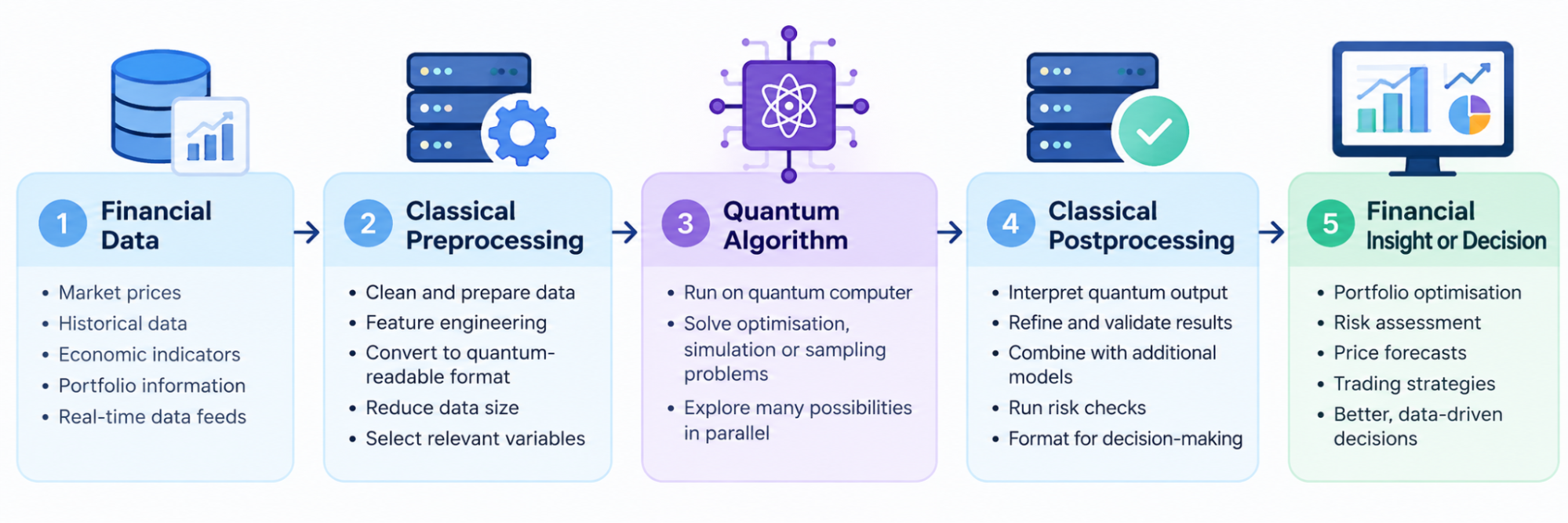
How Quantum and Classical Computing Could Work Together?
Hybrid quantum-classical workflows divide the labor between the two kinds of machine. This lets institutions experiment without replacing existing infrastructure.
- Classical systems prepare data and define the problem.
- Quantum processors handle specific algorithmic steps where suitable.
- Classical systems interpret and validate the results.
Key point: Quantum computing’s potential in finance comes from solving specific computational problems more effectively, not from making every financial calculation faster.
How Could Quantum Computing Transform Portfolio Optimization?
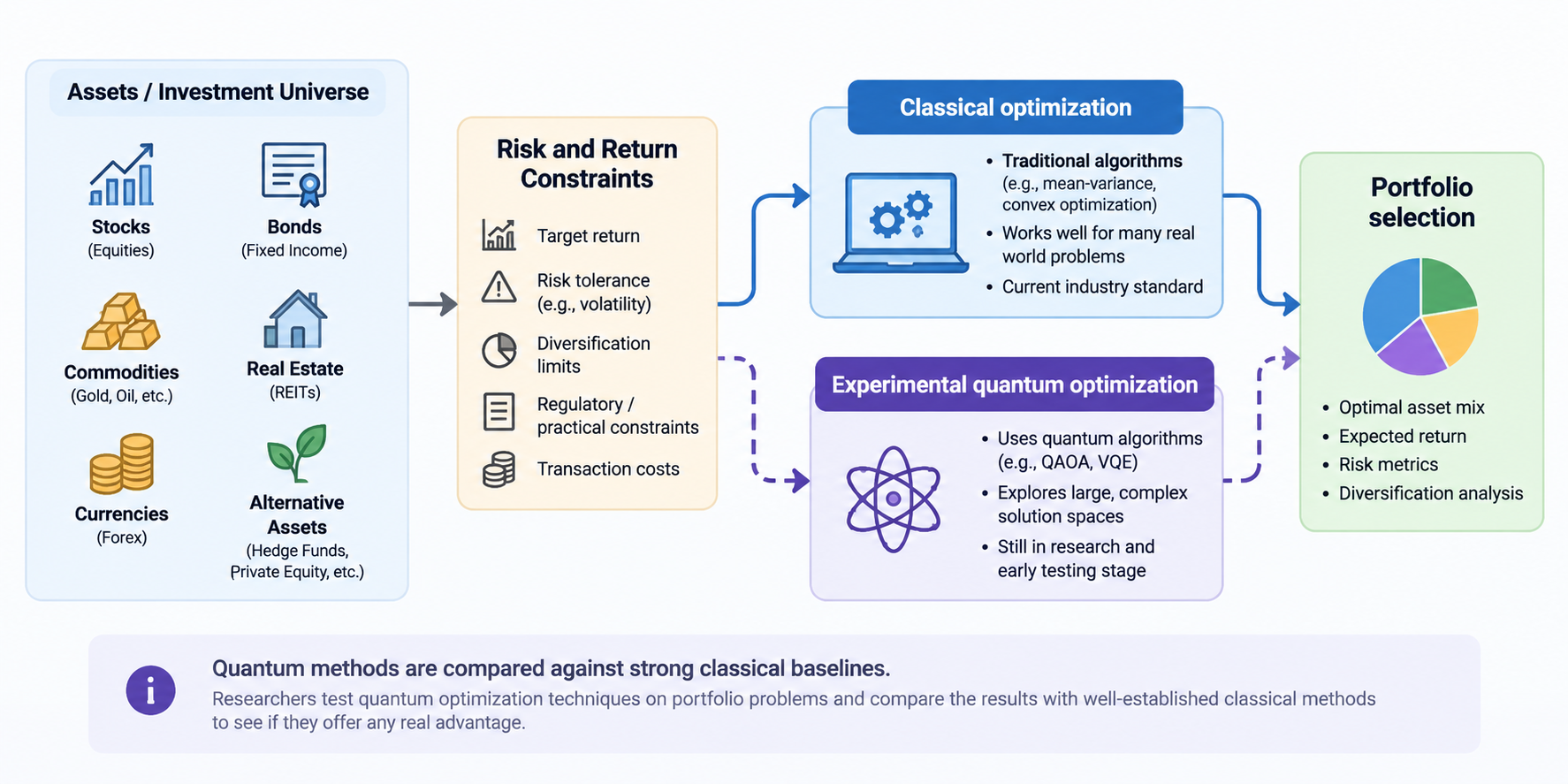
Portfolio optimization involves selecting investments to balance expected returns, risk, diversification, and practical constraints. Quantum algorithms are being studied for some optimization formulations. Practical advantages over classical methods have not been established broadly.
Why Traditional Portfolio Optimization Can Be Challenging
The difficulty grows quickly as portfolios become larger and more realistic. The main pressure points are listed below.
- Large numbers of assets and possible allocations
- Constraints on capital, exposure, and position sizes
- Diversification requirements
- Transaction costs and liquidity limits
- Rebalancing under changing market conditions
How Quantum Algorithms Could Help
Researchers examine quantum approaches to certain combinatorial optimization problems. One example is the quantum approximate optimization algorithm (QAOA), often paired with classical optimizers. The key test is comparing solution quality, execution time, and resource requirements against strong classical baselines.
What this Could Mean for Investment Managers
If results hold up, quantum computing for portfolio optimization could widen what managers can analyze. The possible benefits are modest and conditional.
- Evaluate more complex portfolio constraints
- Test alternative asset allocation strategies
- Support research into rebalancing
- Improve selected workflows if a measurable quantum advantage emerges
Could Quantum Computing Change Algorithmic Trading?
Algorithmic trading uses computer programs to execute trades based on market data, predefined rules, and quantitative models. Quantum computing could eventually support selected optimization or modeling tasks. Its impact on live trading remains uncertain.
Improving Complex Trading Optimization
Trading involves optimization problems under tight constraints. Researchers are investigating portfolio allocation and trade scheduling, along with selected execution decisions. They also explore how transaction costs and liquidity shape the problem, since these frictions often decide whether a theoretical gain is usable.
Analyzing Market Data and Patterns
Quantum machine learning is being studied for selected classification and modeling tasks in quantum computing in trading. It is an active research area, not a proven shortcut to profitable trading signals. Claims of automatic market prediction should be treated with skepticism.
Challenges for Real-Time Trading
Live trading is demanding, and several obstacles stand between research and deployment. The list below shows what a quantum approach must overcome.
- Quantum hardware access and processing overhead
- Data loading and transfer costs
- Latency requirements in trading systems
- Market noise and changing conditions
- The need to beat existing classical algorithms after costs
Key point: A quantum algorithm would need to deliver a measurable advantage within the full trading workflow, including data preparation, execution latency, and transaction costs.
How could Quantum Computing Improve Financial Risk Management?
Financial institutions use risk models to estimate potential losses, assess exposures, and test how portfolios respond to changing market conditions. Quantum computing for risk management is being explored for selected simulation and optimization tasks that underpin these models.
Portfolio Risk Analysis
Risk teams evaluate potential portfolio losses under different scenarios. They also analyze how assets interact in complex ways. Researchers are investigating whether quantum algorithms can improve selected risk calculations, though this remains an open question.
Monte Carlo Simulation
Monte Carlo methods estimate outcomes through repeated random sampling, which makes financial simulations computationally heavy. Quantum amplitude estimation may reduce the samples needed under suitable assumptions. Theoretical query-complexity improvements do not automatically translate into practical speedups on current hardware.
Stress Testing and Scenario Analysis
Stress testing models hypothetical market shocks. It examines correlated asset movements and changing volatility, and researchers are also looking at optimizing stress-test scenarios. Data quality and model assumptions remain critical, because faster computation cannot fix flawed inputs.
Credit and Liquidity Risk
Researchers are exploring selected credit-risk models and portfolio-level liquidity optimization. These are research opportunities rather than proven production applications. Institutions should clearly separate early studies from deployed capabilities when evaluating claims.
Key point: Quantum computing could eventually improve parts of financial risk analysis, but institutions must validate accuracy, computational cost, and practical performance before deployment.
Could Quantum Computing Transform Derivatives Pricing?
Derivatives pricing estimates the value of financial contracts whose payouts depend on underlying assets, rates, or other variables. Some pricing methods rely on simulation and numerical estimation, making them potential areas for quantum algorithm research.
Why Derivatives Pricing Requires Complex Calculations?
Options and other derivatives depend on underlying variables. Pricing models account for volatility, time, interest rates, and contract conditions. More complex products can require extensive simulation and numerical analysis, which is why pricing is a recurring target for quantum algorithms in finance.
How Quantum Algorithms Could Support Pricing?
Research focuses on a few specific directions. Each must be weighed against practical costs.
- Quantum amplitude estimation for selected expectation-value calculations
- Hybrid workflows for simulation-based pricing
- Comparison with optimized classical Monte Carlo approaches
- Accounting for data-encoding and circuit-execution overhead
Potential Implications for Financial Institutions
If practical advantages are demonstrated, the benefits could include faster estimates for certain calculations. They could also include support for demanding pricing research and more efficient scenario analysis in suitable use cases. Selected risk-sensitive valuation workflows might improve as well.
Quantum computers cannot price all derivatives instantly, and quantum pricing models are not universally superior to classical ones.
How could Quantum Computing Affect Fraud Detection and Financial Security?
Financial institutions use statistical models and machine learning to identify suspicious transactions and financial crime. Quantum computing may offer research opportunities for certain data-analysis tasks. Quantum cryptography and quantum-resistant security address different aspects of financial security.
Quantum Machine Learning for Fraud Detection
Researchers are investigating quantum approaches to classification and anomaly detection, including hybrid quantum-classical machine learning. Any claim should be tested on accuracy, false-positive rates, and computational cost versus classical systems. Data encoding, hardware noise, and scalability remain limiting factors.
Quantum Computing and Encryption Risks
Sufficiently capable fault-tolerant quantum computers could threaten widely used public-key cryptographic systems. This is a future risk, not a reflection of current quantum hardware. Institutions should inventory their cryptographic dependencies and plan transitions to post-quantum cryptography.
Post-Quantum Cryptography and Financial Infrastructure
Post-quantum cryptography refers to algorithms designed to resist known quantum attacks. Migration planning matters across payment systems, customer records, and interbank communication. Data that must stay confidential for many years deserves priority.
Quantum Key Distribution
Quantum key distribution (QKD) uses quantum-mechanical properties to help detect interception during key exchange. It differs from post-quantum cryptography, which uses classical algorithms. QKD also has specific infrastructure, distance, and deployment requirements.
Key point: Quantum computing creates both potential analytical opportunities and long-term cybersecurity risks. Post-quantum cryptography is a security preparation priority distinct from experimenting with quantum financial models.
What are the Biggest Challenges of Using Quantum Computing on Wall Street?
Quantum computing is promising for selected financial problems, but practical use depends on hardware reliability, algorithm quality, integration costs, and evidence of advantages over classical computing. Each challenge below can independently delay adoption.
Hardware Limitations and Quantum Noise
Qubits are vulnerable to noise and environmental interference, and the resulting errors can affect calculation accuracy. Large-scale fault-tolerant systems require substantial technical progress. Until then, many proposed financial algorithms cannot run at useful scale.
Limited Evidence of Practical Quantum Advantage
Many proposed finance applications remain experimental, and classical algorithms continue to improve. The points below describe what credible evidence requires.
- Realistic financial datasets
- Strong classical baselines
- Evaluation of the full computational workflow, not isolated algorithm performance
Data and Integration Challenges
Financial data may require extensive preprocessing, and encoding it into quantum states can be expensive. Quantum processors must also integrate with existing financial systems. Sensitive data adds governance and privacy requirements.
Cost, Skills and Regulatory Considerations
Quantum hardware and specialist expertise can be expensive. Financial models also require rigorous validation and auditability. Institutions must maintain governance, explainability, and risk controls, and production deployment requires evidence that benefits justify the cost.
How are Financial Institutions Preparing for Quantum Computing?
Institutions can prepare by researching suitable use cases, building quantum expertise, testing hybrid workflows, and assessing cryptographic risks. None of this assumes that large-scale quantum advantage is imminent. Preparation is deliberately low-regret.
Researching Quantum Finance Use Cases
Teams start by identifying optimization, simulation, or modeling problems with measurable computational costs. They then establish classical performance baselines. Selecting use cases with realistic success criteria keeps experiments honest and decisions evidence-based.
Experimenting with Quantum and Hybrid Platforms
Quantum development frameworks and cloud-accessible hardware make experimentation possible. Teams test algorithms on simulators and available quantum processors. They compare output quality, runtime, and total resource requirements against classical alternatives.
Collaborating with Quantum Researchers
Institutions work with quantum computing specialists and academic groups to test algorithms against realistic financial problems. Findings should be validated independently before any production use. External collaboration also helps firms build skills faster than working alone.
Preparing for Post-Quantum Security
Security preparation is concrete and can begin immediately. The steps below outline a sensible order.
- Inventory cryptographic systems and dependencies.
- Identify long-lived sensitive information.
- Plan migration to appropriate post-quantum cryptographic standards.
- Test interoperability and operational readiness.
Key point: A practical preparation strategy combines targeted research into quantum applications with immediate attention to long-term cryptographic security.
What could the Future of Quantum Computing on Wall Street Look Like?
The future of quantum finance will depend on progress in hardware, error correction, algorithm design, and real-world benchmarking. Adoption is likely to be selective rather than a sudden replacement of conventional financial computing.
Near-Term Possibilities
In the near term, activity is likely to center on research into portfolio optimization and simulation, hybrid quantum-classical experiments, and quantum skills development. Post-quantum cryptography migration is also a near-term priority.
Longer-Term Possibilities
Longer term, quantum processors may become more capable through improved error correction. That could produce advantages for selected optimization and simulation problems and tighter integration with classical high-performance computing. New approaches to specialized financial calculations may follow, if evidence supports them.
What Wall Street Should Prioritize Now?
Firms can act today without betting on a specific quantum timeline. The priorities are listed below.
- Strengthen classical data and computing infrastructure
- Track quantum research and benchmark results
- Develop internal expertise and partnerships
- Prepare cryptographic systems for post-quantum migration
- Avoid basing investment decisions on unverified quantum performance claims
Transform Financial Operations with AI
Discover how AI can streamline complex workflows, strengthen data-driven decision-making, and improve operational efficiency with the Certificate Programme in AI-Powered Operations & Process Transformation by IIM Tiruchirappalli.
Frequently Asked Questions About Quantum Computing and Wall Street
What skills do finance professionals need to work in quantum computing?
A solid grounding in quantitative finance, linear algebra, probability, and programming (often Python) is useful. Familiarity with quantum frameworks and optimization methods helps with hybrid workflows.
How can investors evaluate claims about quantum computing stocks and financial technology?
Look for peer-reviewed results, benchmarks against strong classical methods, and realistic timelines. Be wary of promises of guaranteed returns or universal speedups.
What is the difference between quantum finance and traditional quantitative finance?
Traditional quantitative finance applies mathematical and statistical models on classical computers. Quantum finance investigates whether quantum algorithms can improve selected parts of those computations.
Can quantum computing help financial institutions manage complex investment portfolios?
Possibly, for some optimization formulations. Practical advantages over classical methods have not been broadly established, so current work is experimental.
How could quantum computing change the way hedge funds develop investment strategies?
It could expand how funds test complex constraints and allocation ideas. It does not predict markets or guarantee higher returns.
What are the limitations of quantum machine learning for financial predictions?
Key limits include data-encoding costs, hardware noise, scalability, and unproven advantages over classical models. Market noise also makes prediction difficult regardless of the computing method.
How can banks assess whether a quantum computing solution is worth the investment?
Compare it against classical baselines using realistic data. Measure total cost, runtime, accuracy, and integration effort, and require independent validation.
What role do quantum computing startups play in financial services innovation?
Startups often provide hardware access, software tools, and specialized algorithms. Banks use them for experimentation and skill building, though their claims still need independent validation.
How can financial institutions protect customer data against future quantum attacks?
Inventory cryptographic dependencies, prioritize long-lived sensitive data, and plan migration to post-quantum cryptographic standards. Test interoperability before deployment.
What is the difference between quantum computing, quantum communication, and quantum cryptography?
Quantum computing performs calculations using qubits. Quantum communication transmits quantum information, and quantum cryptography uses quantum properties for secure key exchange, as in QKD.
Can financial analysts use quantum computing through cloud-based platforms?
Yes. Several providers offer cloud access to simulators and quantum processors. These are mainly used for research, prototyping, and training.
What factors will determine how quickly quantum computing is adopted by financial institutions?
Hardware reliability, error correction, algorithm quality, integration costs, regulatory requirements, and demonstrated advantages over classical methods will all matter.