RLHF Explained: The 3-Step Pipeline + RLHF vs DPO

Key Insights
- RLHF stands for Reinforcement Learning from Human Feedback. It helps align large language models (LLMs) with human preferences to produce more helpful and appropriate responses.
- The classic RLHF pipeline has three stages: supervised fine-tuning (SFT), reward model training using human preference data, and policy optimisation using reinforcement learning.
- A reward model learns to score responses based on human preference rankings, providing a training signal for improving the language model.
- Proximal Policy Optimization (PPO) updates the model’s policy using reward feedback while helping constrain how far it moves from the reference behaviour.
- RLHF vs DPO: RLHF typically uses a separate reward model and an explicit reinforcement learning loop, whereas Direct Preference Optimization (DPO) learns directly from preference pairs without requiring a separately trained reward model.
- Hugging Face TRL provides tools for LLM post-training, including supervised fine-tuning, reward modelling, PPO-based optimisation and DPO, although implementation details vary by library version.
- RLHF has limitations, including high computational costs, noisy or biased human feedback, reward hacking and the risk of optimising for the reward model rather than genuine response quality.
Reinforcement Learning from Human Feedback (RLHF) is a post-training technique that aligns a large language model (LLM) with human values and intent. Instead of relying only on patterns learned during pre-training, RLHF uses human demonstrations and preference comparisons to guide a model towards more helpful, relevant and appropriate responses.
But how does a model learn which response people prefer, and how does that preference influence its future outputs? The answer lies in the RLHF pipeline, which turns qualitative feedback into a training signal. This guide explains the three stages, how reward models and PPO work, how RLHF compares with Direct Preference Optimization (DPO), and how Hugging Face TRL supports LLM post-training.
What does RLHF Mean?
The RLHF full form is Reinforcement Learning from Human Feedback. Its meaning is straightforward: human judgements about model responses are used to guide the model towards preferred behaviour. RLHF is an LLM alignment technique, not a method for training a language model from scratch.
Why do LLMs need human feedback?
During pre-training, an LLM learns to predict the next token from its training data. This develops language capabilities, but it does not directly optimise the model for helpfulness, instruction-following or a particular user’s preferences.
Consider two responses to the same question. Both may be grammatically correct, but one could be concise and accurate while the other contains irrelevant details or unsupported claims. Human preference data helps identify which response is better according to defined evaluation criteria.
Where does RLHF fit into LLM training?
RLHF commonly follows two stages:
- Pre-training: The model learns general language patterns from large datasets.
- Supervised fine-tuning (SFT): The model learns from examples of prompts paired with desirable responses.
- Preference alignment: Human comparisons train a reward model, which can then guide reinforcement learning.
This distinction matters because RLHF builds on an existing model and often an instruction-tuned model. It is one approach to alignment, not a guarantee of factual accuracy or safe behaviour.
What are the Three Steps in the RLHF Pipeline?
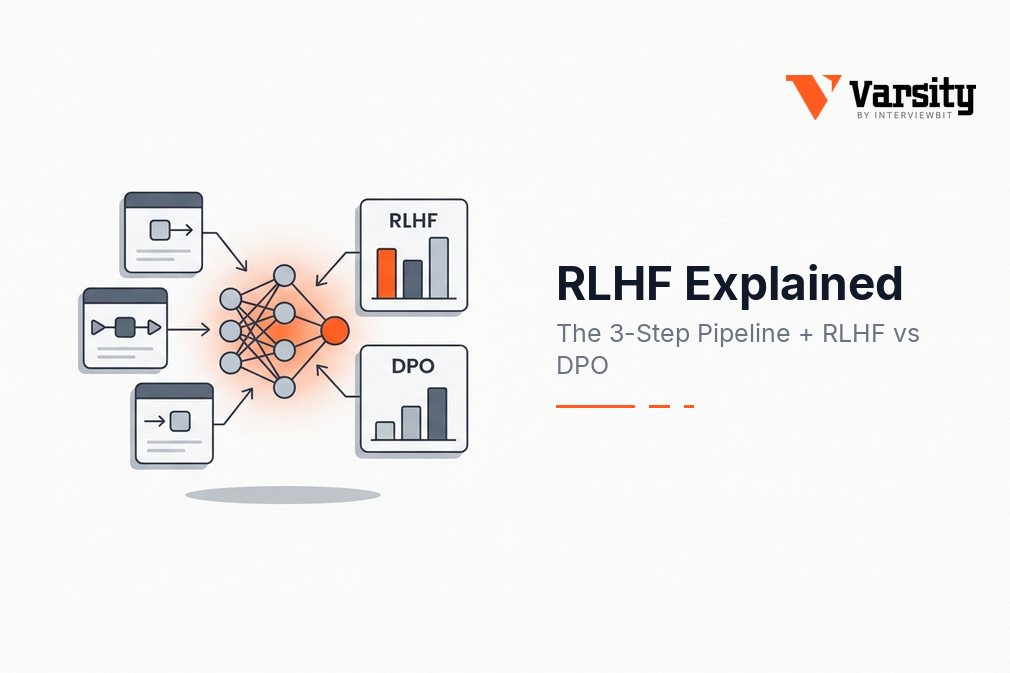
The classic RLHF 3-step pipeline consists of supervised fine-tuning, reward model training and reinforcement learning with PPO. Each stage has a separate purpose.
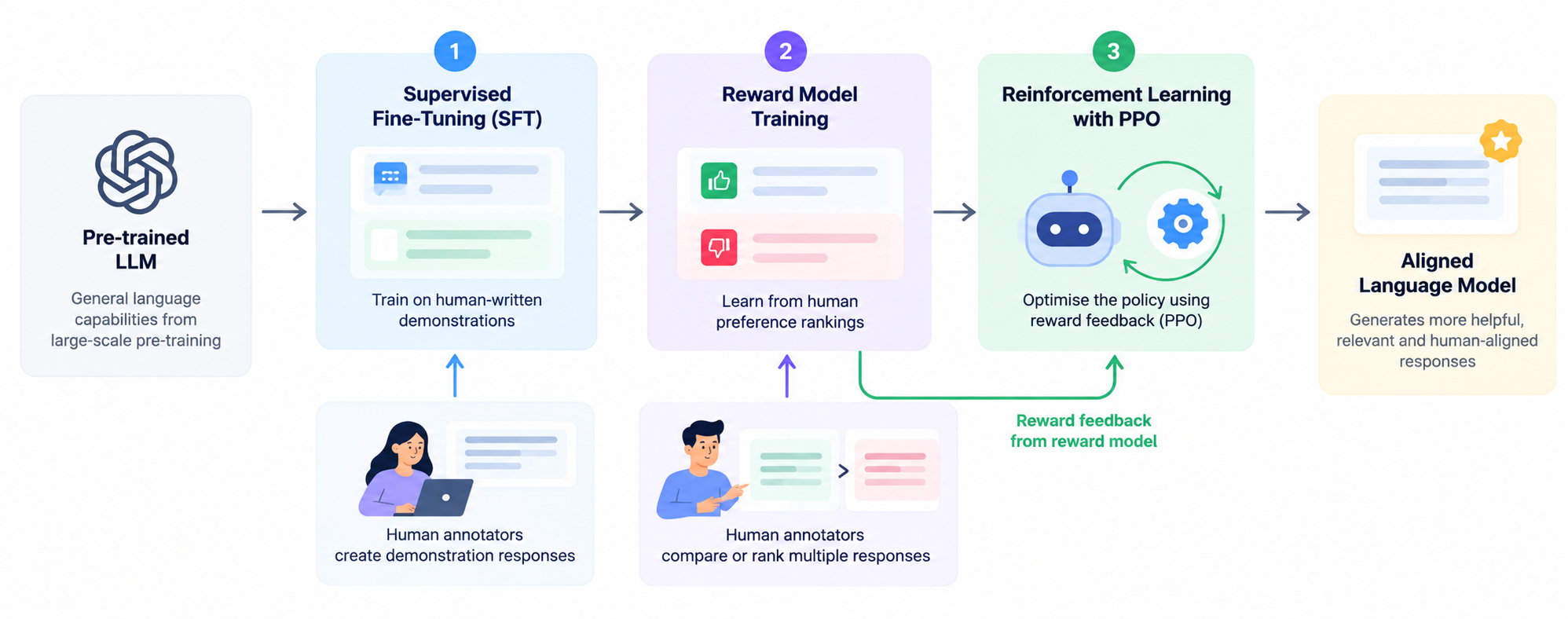
Step 1 — Supervised Fine-Tuning (SFT)
The process begins with a pre-trained LLM and a dataset of prompts paired with high-quality demonstration responses, typically written or selected by human annotators.
The model is trained to imitate these target responses using supervised learning. For example, a prompt asking for an explanation of a technical concept might be paired with a clear, accurate and well-structured answer.
This stage establishes a useful instruction-following baseline. The model has learned how to respond to prompts before reinforcement learning begins.
Step 2 — Train the reward model
Next, the SFT model generates multiple responses to the same prompt. Human annotators compare or rank these responses according to criteria such as relevance, clarity and accuracy.
These comparisons form human preference data. A reward model is trained to assign higher scores to responses that are preferred in the training examples.
The reward model converts qualitative judgements into a numerical signal that can guide subsequent optimisation. However, it learns an approximation of the preferences represented in its data—not a perfect definition of quality, truth or human values.
Step 3 — Optimise the policy using PPO
The final stage uses reinforcement learning to update the language model, known as the policy. The policy generates responses, the reward model scores them, and PPO uses the resulting signal to guide updates that make preferred responses more likely.
A reference model is commonly used to help constrain how far the policy moves from its starting behaviour. A KL-divergence penalty can discourage excessive divergence from that reference.
The reward model evaluates responses; PPO updates the policy parameters. Keeping these roles separate is essential to understanding the classic RLHF training process.
How does Reward Model Training and PPO Work in RLHF?
Reward model training learns from comparisons between responses, while PPO uses the learned reward signal to update the language model. Together, they form the optimisation stage of classic RLHF.
How is a reward model trained?
Suppose an annotator compares two answers to a question about climate change. One provides a concise explanation supported by evidence; the other is longer but includes unsupported claims. If the first answer is preferred, the training example records it as the chosen response and the other as the rejected response.
A reward model learns from many such comparisons to score responses in a way that reflects the observed preferences. Pairwise ranking objectives can help it learn to assign higher scores to chosen responses than rejected ones.
Hugging Face TRL provides a RewardTrainer for reward-model training. Its output is still a proxy: a high score does not independently prove that an answer is correct or useful.
What does PPO do in RLHF?
PPO stands for Proximal Policy Optimization, a reinforcement-learning algorithm designed to make controlled policy updates.
In RLHF with PPO, the process is intuitive:
- The current policy generates a response to a prompt.
- The reward model scores that response.
- PPO uses the reward and related training signals to update the policy.
- Constraints, commonly including a KL penalty, help prevent excessive drift from the reference policy.
PPO also uses a value model in common implementations to estimate expected returns and help calculate advantages for policy updates. These components make the training process more involved than ordinary supervised fine-tuning, but they provide a structured way to optimise the model against a learned reward signal.
RLHF vs DPO: What Is the Difference?
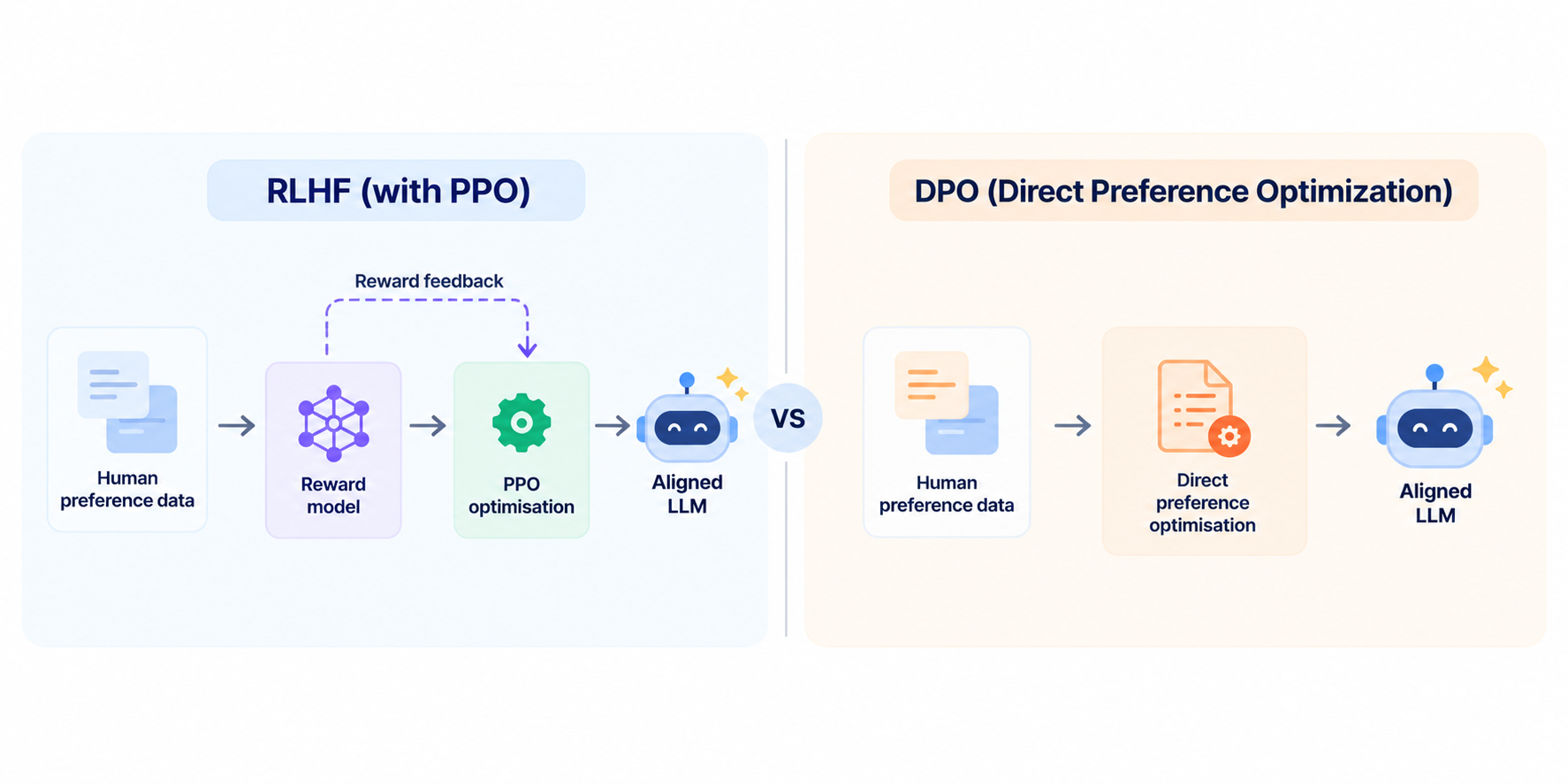
Direct Preference Optimization (DPO) is an alternative preference-alignment method that trains a language model directly on chosen and rejected response pairs. Unlike classic PPO-based RLHF, DPO does not require a separate reward-model training stage or an explicit PPO optimisation loop.
The original DPO paper presents a way to optimise preference alignment through a classification-style objective on preference data.
| Aspect | Classic RLHF with PPO | DPO |
|---|---|---|
| Training data | Demonstrations and preference comparisons | Chosen and rejected response pairs |
| Separate reward model | Yes | No separate reward model required |
| Explicit RL optimisation | Yes, using PPO | No |
| Training complexity | Typically higher, with multiple models and a policy optimisation loop | Often simpler to implement |
| Main consideration | Flexible reward-based optimisation, but sensitive to reward quality and stability | Direct preference optimisation, still dependent on data and training choices |
When should you consider RLHF or DPO?
Classic RLHF may suit workflows that need an explicit learned reward signal and a reinforcement-learning optimisation stage. DPO may be a practical option when a team has preference pairs and wants a simpler training workflow.
Neither method is universally better. The decision depends on the objective, dataset, compute budget, implementation requirements and evaluation results. RLHF vs DPO is a choice between optimisation approaches, not a guarantee of model quality.
How to Implement RLHF Using Hugging Face TRL
Hugging Face’s TRL documentation describes tools for post-training language models, including supervised fine-tuning, reward modelling and preference optimisation. The available trainers and APIs depend on the TRL release and the method being used.
What does an RLHF code workflow look like?
The following is an illustrative workflow, not a runnable end-to-end script. Each stage requires its own model, dataset, configuration and compatible trainer API.
# Illustrative RLHF workflow — not executable as written.
from trl import SFTTrainer, RewardTrainer, PPOTrainer
# Step 1: Supervised fine-tuning on demonstrations
sft_trainer = SFTTrainer(...)
sft_trainer.train()
# Step 2: Reward-model training on preference comparisons
reward_trainer = RewardTrainer(...)
reward_trainer.train()
# Step 3: Policy optimisation using PPO and reward feedback
ppo_trainer = PPOTrainer(...)
ppo_trainer.train()
The ellipses represent required arguments and configuration that have intentionally been omitted. The imports illustrate the classic pipeline’s components; they do not guarantee that these trainers can be combined unchanged in every TRL version.
For implementation, consult the official TRL documentation and the version-specific guides for the selected trainers. A real setup needs compatible models, appropriately formatted datasets, training arguments and a reward-and-optimisation configuration.
What are the Limitations of RLHF?
RLHF depends on the quality of its human preference data and reward model. Training can also be computationally expensive and sensitive to configuration. These challenges require careful evaluation, but they do not mean RLHF is inherently ineffective.
Reward hacking in RLHF
RLHF reward hacking occurs when a model exploits weaknesses in the reward signal instead of improving in the intended way. For example, a reward model might favour verbose or overly confident responses, even when shorter, more cautious answers would be more useful.
As a result, reward-model scores can improve without corresponding improvements in real-world response quality. Reward-model overoptimisation is one reason to evaluate outputs independently rather than relying solely on the learned reward.
Why can RLHF be expensive and difficult to stabilise?
Common PPO-based implementations may need to maintain a policy model, reference model, reward model and value model. Their memory and compute requirements can make RLHF computationally demanding, especially for large language models.
Training can also be sensitive to hyperparameters, reward quality and implementation choices. Useful evaluation methods include held-out prompts, human preference comparisons, factuality checks, safety tests and task-specific quality measures. These checks help identify regressions that a reward score alone may miss.
Conclusion
RLHF uses human preferences to guide language models through supervised fine-tuning, reward modelling and reinforcement learning. PPO provides the policy-optimisation mechanism in the classic pipeline, while the reward model supplies an imperfect estimate of preferred behaviour. DPO offers a different route by optimising preference pairs directly, making the choice between these methods dependent on training goals, data and compute constraints.
If you want to understand how these techniques fit into the broader process of building and tuning generative AI systems, explore the Generative AI programme by IIT Delhi, delivered on Varsity by InterviewBit to deepen your understanding of modern LLM training and alignment.
Frequently Asked Questions
Is RLHF the same as fine-tuning?
No. Fine-tuning is a broad category of methods for adapting a model. RLHF is a preference-alignment approach that commonly includes an SFT stage, reward modelling and reinforcement learning.
Does RLHF require human feedback for every response?
No. Humans typically provide demonstrations and preference labels for a subset of examples. A learned reward model then supplies scores during policy optimisation.
What is the difference between a reward model and a language model?
A language model generates text, while a reward model estimates how desirable a response is according to preference patterns learned from training data.
What is a reference model in RLHF?
A reference model is typically a frozen copy of the starting policy. It helps measure divergence and discourage excessive changes during optimisation.
What is the role of the value model in PPO-based RLHF?
The value model estimates expected future returns and helps PPO calculate advantages for policy updates. It supports optimisation rather than directly generating user-facing responses.
Can RLHF make an LLM factually accurate?
No method of preference alignment guarantees factual correctness. RLHF can encourage preferred behaviours, but a reward model may still favour a plausible-sounding answer that is wrong.
What kind of dataset is needed for RLHF?
The classic pipeline uses prompt-response demonstrations for SFT and preference comparisons for reward-model training. PPO additionally requires prompts and a compatible reward-and-optimisation setup.
Is RLHF used only for chatbots?
No. It can support instruction-following, summarisation, dialogue and other language tasks where human preferences can help guide model behaviour.
How do you evaluate whether RLHF improved a model?
Evaluation can combine held-out tasks, human preference comparisons, factuality checks, safety testing and regression tests. Reward-model scores alone are not sufficient evidence of improvement.
Can RLHF and DPO be used together?
They are distinct optimisation approaches, but both can appear in a broader post-training workflow. A team might use DPO for preference tuning and later experiment with reinforcement-learning-based optimisation, depending on the objective and training design.
Resources
- Training language models to follow instructions with human feedback (InstructGPT)
- OpenAI’s overview of instruction-following models
- Direct Preference Optimization: Your Language Model Is Secretly a Reward Model
- Hugging Face TRL documentation
- Hugging Face RewardTrainer documentation
- Hugging Face PPOTrainer documentation
- Hugging Face DPOTrainer documentation