Sentiment Analysis in Marketing: How AI Reads Customer Emotion

Key Insights
- Sentiment analysis helps marketers classify customer feedback by the attitude it expresses, commonly as positive, negative, neutral or, in some systems, mixed sentiment.
- AI can analyse feedback from reviews, social media, surveys, customer support and other text sources at a scale that would be difficult to handle manually.
- Marketing applications include brand monitoring, review analysis, social listening, campaign feedback and customer experience, where sentiment becomes useful only when it leads to a marketing action.
- Sentiment scores become more useful when combined with themes, channels, products, campaigns and customer segments, rather than viewed as a single overall number.
- Aspect-based sentiment analysis can show how customers feel about specific attributes such as price, delivery, product quality or customer service.
- AI sentiment analysis still has limitations. Sarcasm, context, mixed opinions, code-mixed language and model quality can affect results, so important findings should be validated against the original customer feedback.
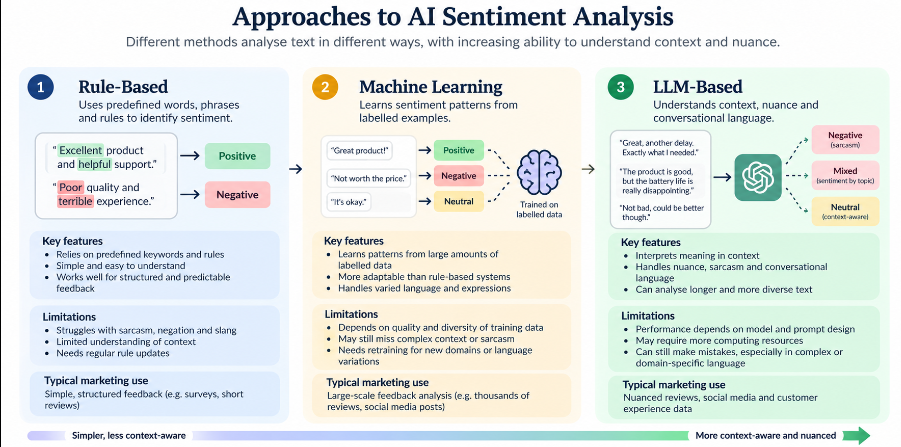
Sentiment analysis uses AI to examine customer text and identify the attitude expressed in it, such as positive, negative or neutral sentiment. For marketers, this means turning large volumes of reviews, social posts, survey responses, chats and customer messages into signals they can act on.
The challenge is scale. A brand may receive thousands of comments across different channels, making manual analysis slow and inconsistent. AI can process this feedback much faster and help teams spot patterns across customers, products, campaigns and channels. Modern approaches range from simple rules to machine learning and large language models (LLMs), with different strengths for different types of feedback.
This guide explains how sentiment analysis works, where marketers use it, the tools available, how to build a practical workflow, which metrics to track and where AI sentiment analysis can go wrong.
What Does Sentiment Analysis Identify?
Sentiment analysis looks at the language in a piece of text and assigns a sentiment category or score.
For example: “The product arrived early and the quality is excellent.”
A sentiment analysis system would likely classify this as positive.
Compare that with: “The product looks good, but delivery took two weeks.”
This contains both praise and criticism. A more advanced system may identify it as mixed sentiment or analyse the sentiment attached to different topics.
Some systems use only positive, negative and neutral labels. Others use more detailed scales, such as very positive, positive, neutral, negative and very negative. The exact labels and scoring method depend on the tool.
Sentiment Analysis vs Emotion Analysis
Sentiment analysis identifies the general direction of an opinion, while emotion analysis attempts to identify a more specific emotional state.
For example:
| Sentiment analysis | Emotion analysis |
|---|---|
| Positive | Excitement |
| Negative | Anger |
| Neutral | Frustration |
| Mixed | Satisfaction + disappointment |
A customer saying, “I love the product, but I am furious about the delivery” may have positive sentiment toward the product and negative sentiment toward the delivery experience.
This distinction matters for marketers because knowing that feedback is negative is useful, but knowing what is causing the negative reaction can make the insight much more actionable.
How Does AI Sentiment Analysis Work?
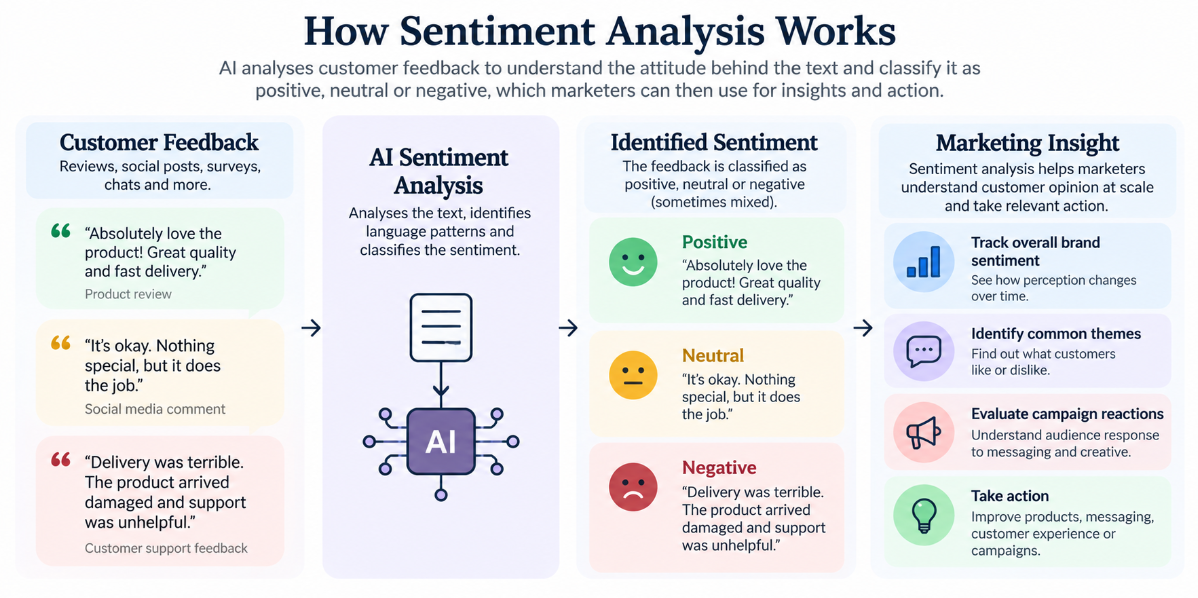
AI sentiment analysis processes text, identifies language patterns and assigns a sentiment classification or score. The underlying approach can range from simple rules to machine learning and LLM-based analysis.
Rule-Based Sentiment Analysis
Rule-based sentiment analysis uses predefined words, phrases and linguistic rules.
For example, a system may associate words such as excellent, love and helpful with positive sentiment, while poor, broken and disappointed may signal negative sentiment.
This approach is relatively easy to understand and can work well when the language is predictable. Its weakness is context. A rule-based system may struggle with sarcasm, negation, slang or phrases whose meaning changes depending on context.
Machine Learning Sentiment Analysis
Machine learning models learn sentiment patterns from labelled examples rather than relying only on predefined word lists.
A model can be trained using customer comments that have already been classified as positive, negative or neutral. It then uses patterns in new text to predict the appropriate category.
This makes ML more adaptable than a simple keyword system, particularly when analysing large volumes of varied customer feedback.
LLM-Based Sentiment Analysis
Large language models can interpret sentiment while considering more of the surrounding context.
This can be useful for:
- Conversational customer feedback
- Long-form reviews
- Social media posts
- Mixed opinions
- Informal language
- Context-dependent statements
For marketers, the benefit is not simply a more complicated model. It is the ability to analyse what the customer means in context, rather than counting positive and negative words.
| Approach | How it works | Marketing use |
|---|---|---|
| Rule-based | Uses predefined words and rules | Simple, structured feedback |
| Machine learning | Learns patterns from labelled data | Large-scale feedback analysis |
| LLM | Interprets language in context | Nuanced reviews, social and CX data |
How Is Sentiment Analysis Used in Marketing?
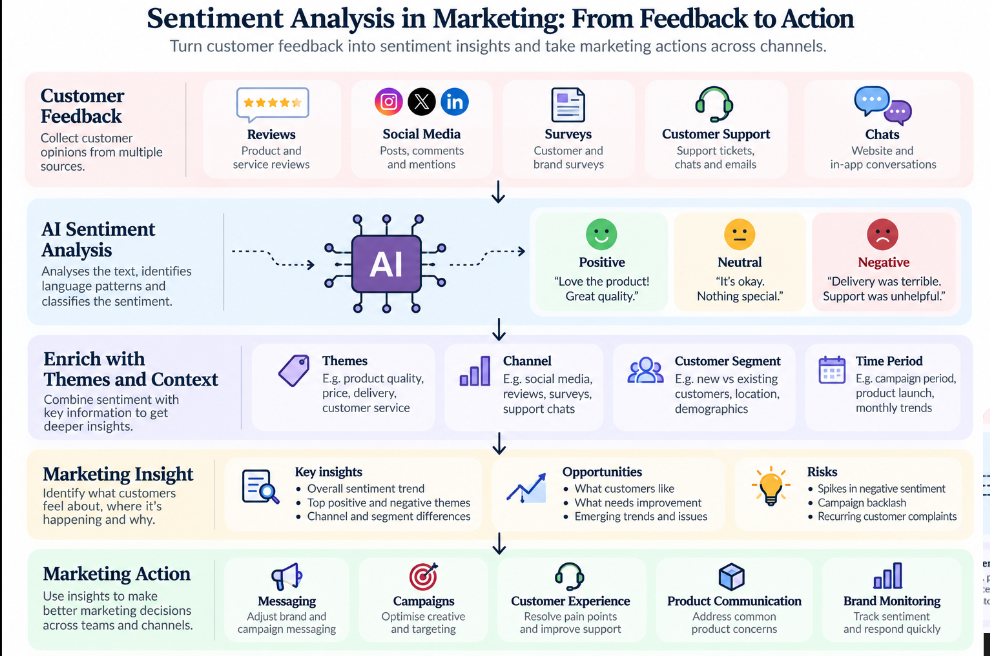
Marketers use sentiment analysis to understand how customers react to brands, products, campaigns and experiences, then connect those findings to specific actions.
The useful chain is:
Customer feedback → Sentiment insight → Marketing action
Brand Monitoring
Sentiment analysis can help teams track how brand perception changes across online conversations.
For example, a sudden increase in negative sentiment after a product announcement could prompt a brand team to investigate the underlying comments rather than relying only on total mention volume.
Brandwatch, for example, uses sentiment analysis alongside social listening to help brands monitor public perception and identify changes in online conversations.
Customer Reviews
Reviews contain detailed information about what customers like and dislike.
Sentiment analysis can help marketers identify recurring patterns such as:
- Positive reactions to product quality
- Complaints about delivery
- Frustration with pricing
- Praise for customer service
- Problems with product usability
Instead of reading every review individually, marketers can first identify the dominant themes and then examine representative comments.
Social Listening
Social listening platforms can analyse sentiment around brands, products, competitors, launches and campaigns.
For example, a brand launching a new product can track whether online conversation is becoming more positive, negative or mixed after the launch.
The important part is to combine sentiment with volume, topic and timing. A 70% positive sentiment rate means something different when it comes from 100 mentions versus 100,000 mentions.
Campaign Feedback
Sentiment analysis can help marketers understand audience reactions to advertising and campaign messaging.
A campaign may generate high engagement but also trigger negative reactions. Looking at sentiment alongside comments can help teams identify whether the issue is the creative, message, product promise or audience response.
Customer Experience
CX teams can analyse sentiment in surveys, support conversations and customer feedback to identify frustration or satisfaction.
For example, negative sentiment associated with “delivery” across thousands of responses could point to an operational problem that marketing teams need to account for in their messaging.
Qualtrics’ Text iQ, for example, can analyse sentiment in customer feedback and connect sentiment with topics for deeper CX analysis.
What Are the Best Sentiment Analysis Tools?
The right sentiment analysis tool depends on where customer feedback lives and how marketers plan to use the output.
Brandwatch
Brandwatch focuses strongly on social listening and online conversation analysis. Marketers can use its sentiment capabilities to monitor brand perception, examine conversations and identify changes across channels.
Talkwalker
Talkwalker’s sentiment analysis is built into its consumer intelligence and social listening offering. It can analyse sentiment across sources such as social media, online reviews, news and survey responses, helping teams connect customer opinion with broader brand and audience insights.
Qualtrics Text iQ
Qualtrics Text iQ is designed around customer and experience feedback, including survey responses and CX data. It can assign sentiment, analyse topics and support workflows based on sentiment or actionability.
Google Cloud Natural Language
Google Cloud’s Natural Language API provides sentiment scores and magnitude values for analysed text. It is more suited to teams that want to build sentiment analysis into their own applications or data workflows rather than use a marketing dashboard alone.
The choice should therefore depend on the data source, required level of control, language coverage, integration needs and marketing use case, rather than simply choosing a tool because it uses AI.
How to Perform Sentiment Analysis for Marketing
A practical sentiment analysis workflow starts with a clear marketing question and ends with an action, not just a sentiment dashboard.
1. Define the Marketing Question
Start with the decision you want the analysis to support.
Examples:
- Why are customers unhappy with a new product?
- How did customers react to our campaign?
- Which part of the customer experience creates the most frustration?
- Has brand perception changed after a launch?
A specific question makes the resulting analysis easier to interpret.
2. Collect Customer Feedback
Bring together relevant text from sources such as:
- Product reviews
- Social media
- Surveys
- Customer chats
- Support tickets
- Email feedback
- Online communities
Use only data relevant to the marketing question rather than collecting everything available.
3. Clean and Categorise the Data
Remove or flag spam, duplicate responses and irrelevant content.
Where possible, organise feedback by useful dimensions such as product, campaign, channel, date or customer segment.
This makes it possible to compare sentiment rather than looking at one large undifferentiated dataset.
4. Run Sentiment Analysis
Choose an approach based on the data.
Simple, predictable feedback may work with rule-based analysis. Large and varied datasets may benefit from machine learning, while nuanced or conversational feedback may require more context-aware models.
5. Analyse Sentiment by Theme and Channel
An overall sentiment score rarely tells the complete story.
Break the results down by:
- Product
- Campaign
- Channel
- Customer segment
- Topic
- Time period
For example, overall sentiment could be positive while sentiment around delivery is strongly negative.
6. Turn Insights Into Marketing Actions
The final step is action.
Depending on the finding, marketers may:
- Change campaign messaging
- Address recurring product concerns
- Adjust customer communication
- Escalate CX problems
- Update FAQs or content
- Modify launch messaging
- Investigate negative brand conversations
The goal is not to collect sentiment scores. It is to use customer opinion to make better decisions.
What Metrics Are Used in Sentiment Analysis?
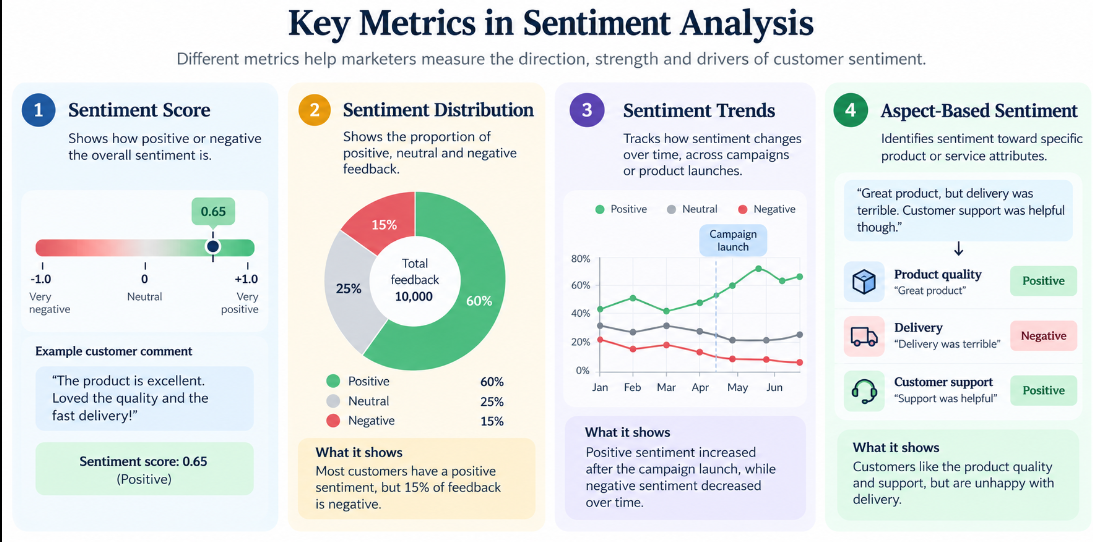
Sentiment metrics help marketers measure the direction, strength and movement of customer opinion.
Sentiment Score
A sentiment score converts sentiment into a numerical value.
The scale depends on the tool. For example, Google Cloud’s Natural Language API uses a sentiment score from -1.0 to +1.0, where negative values indicate negative sentiment and positive values indicate positive sentiment. It also provides a magnitude value representing the amount of emotional content.
Because scoring systems differ, marketers should not compare scores from different platforms without checking how each score is calculated.
Sentiment Distribution
Sentiment distribution shows the share of feedback classified into each category.
For example:
- 60% positive
- 25% neutral
- 15% negative
This is useful for understanding the overall direction of customer opinion.
Sentiment Trends
Sentiment trends track how customer opinion changes over time.
Marketers can compare sentiment:
- Before and after a campaign
- Before and after a product launch
- Across months or quarters
- Between channels
- Across customer groups
A sudden change can signal an event worth investigating.
Aspect-Based Sentiment
Aspect-based sentiment connects sentiment to a specific attribute or topic.
For example:
“The phone is excellent, but the battery life is disappointing.”
Overall sentiment may be mixed, but aspect-based analysis can separate:
- Product quality → Positive
- Battery life → Negative
This is particularly useful for marketing because it tells teams what customers are reacting to, not just whether they are happy or unhappy. Entity and topic-level sentiment analysis are supported by modern text-analysis systems.
What Are the Limitations of AI Sentiment Analysis?
AI sentiment analysis is useful at scale, but its output should not be treated as a perfect reading of customer emotion.
Sarcasm and Context
Sarcasm can reverse the apparent meaning of words.
For example:
“Great, another delay. Exactly what I needed.”
The word “great” appears positive, but the overall message is clearly negative.
Sarcasm, irony and idiomatic language remain difficult for sentiment systems because meaning often depends on context rather than individual words.
Indian Languages and Code-Mixing
Indian customer feedback can move between languages within the same sentence.
Examples include:
- “Product acha hai but delivery was too late.”
- “Service theek hai, but price is too high.”
- Hindi written in Roman script
- Regional-language expressions mixed with English
A model may perform differently across languages, dialects, transliteration and code-mixed text. Language support therefore needs to be checked for the specific tool and use case.
For example, Qualtrics states that its sentiment model is optimised for a defined set of languages and notes that prediction quality may vary for other languages.
Ambiguous or Mixed Sentiment
A customer can praise one part of an experience while criticising another.
“The product quality is excellent, but customer service was terrible.”
A single positive/negative label hides that distinction.
This is why topic or aspect-level analysis can be more useful than relying only on an overall sentiment score.
Accuracy Depends on Data and Models
Results depend on factors such as:
- Training data
- Model quality
- Language
- Domain
- Data quality
- Context
- Classification thresholds
Human review is especially important when sentiment analysis is being used for major brand decisions or when the cost of misclassification is high.
Conclusion
Sentiment analysis gives marketers a way to turn large amounts of customer language into structured signals about how people perceive a brand, product, campaign or experience. Its value becomes clearer when sentiment is connected to specific topics, channels, customer groups and business questions.
AI has made this analysis more scalable and context-aware, but it has not eliminated the messy nature of human language. Sarcasm, mixed opinions, code-mixed language and ambiguous comments can still challenge automated systems.
The strongest marketing workflow therefore treats sentiment analysis as a starting point for investigation and action, not the final answer. Combine the model’s output with customer evidence, marketing metrics and human judgement to turn customer emotion into useful marketing decisions.
Want to build practical AI and marketing analytics skills? Explore the IIM Trichy AI-Powered Marketing & Growth Strategy programme.
Frequently Asked Questions About Sentiment Analysis
How accurate is sentiment analysis?
Accuracy varies by model, language, dataset and use case. Performance can fall when feedback contains sarcasm, slang, mixed sentiment, code-mixing or domain-specific language. Testing the system against manually reviewed examples is a useful way to assess performance for a particular dataset.
Can sentiment analysis analyse emojis?
Some sentiment systems can use emojis as additional signals, but their treatment varies by model and platform. Marketers should test emoji-heavy social content separately rather than assuming that every tool interprets emojis consistently.
Can sentiment analysis analyse images or videos?
Traditional sentiment analysis focuses primarily on text. Analysing images, video or audio requires additional technologies such as computer vision, speech recognition or multimodal AI.
How do you validate a sentiment analysis model?
Create a representative sample of customer comments, have people classify the sentiment, and compare those labels with the model’s predictions. Review errors by category to identify recurring problems such as sarcasm, negation or industry-specific language.
Can sentiment analysis be used for competitor research?
Yes. Marketers can analyse public conversations about competitors to compare customer perceptions around areas such as pricing, service, product quality or campaigns. The comparison should use consistent data sources and time periods.
Can sentiment analysis predict customer churn?
Sentiment alone does not predict churn reliably. However, sentiment can be combined with behavioural and customer data to identify signals associated with dissatisfaction or declining engagement.
How can marketers combine sentiment analysis with customer segmentation?
Sentiment can be added to existing customer segments to identify differences in customer attitudes. For example, a brand could compare sentiment among new customers, repeat customers and high-value customers to identify groups with different concerns.
What is aspect-based sentiment analysis used for?
Aspect-based sentiment analysis identifies sentiment toward specific attributes within a piece of feedback. It can help marketers separate reactions to factors such as price, product quality, delivery or customer service.
Can sentiment analysis work in real time?
Yes, some platforms can analyse incoming conversations or mentions quickly enough to support near-real-time monitoring. The actual speed depends on the data source, platform and analysis workflow.
Should marketers rely only on sentiment scores?
No. A score is a signal, not an explanation. Marketers should examine the underlying comments and combine sentiment with topics, volume, timing and business metrics before making important decisions.