Problem Statement
Given a matrix of size M x N, where ‘1’ represents land, while ‘0’ represents water. The task is to return the number of islands present in the matrix. An island is a group of 1’s surrounded either vertically or horizontally.
Examples:
Input:

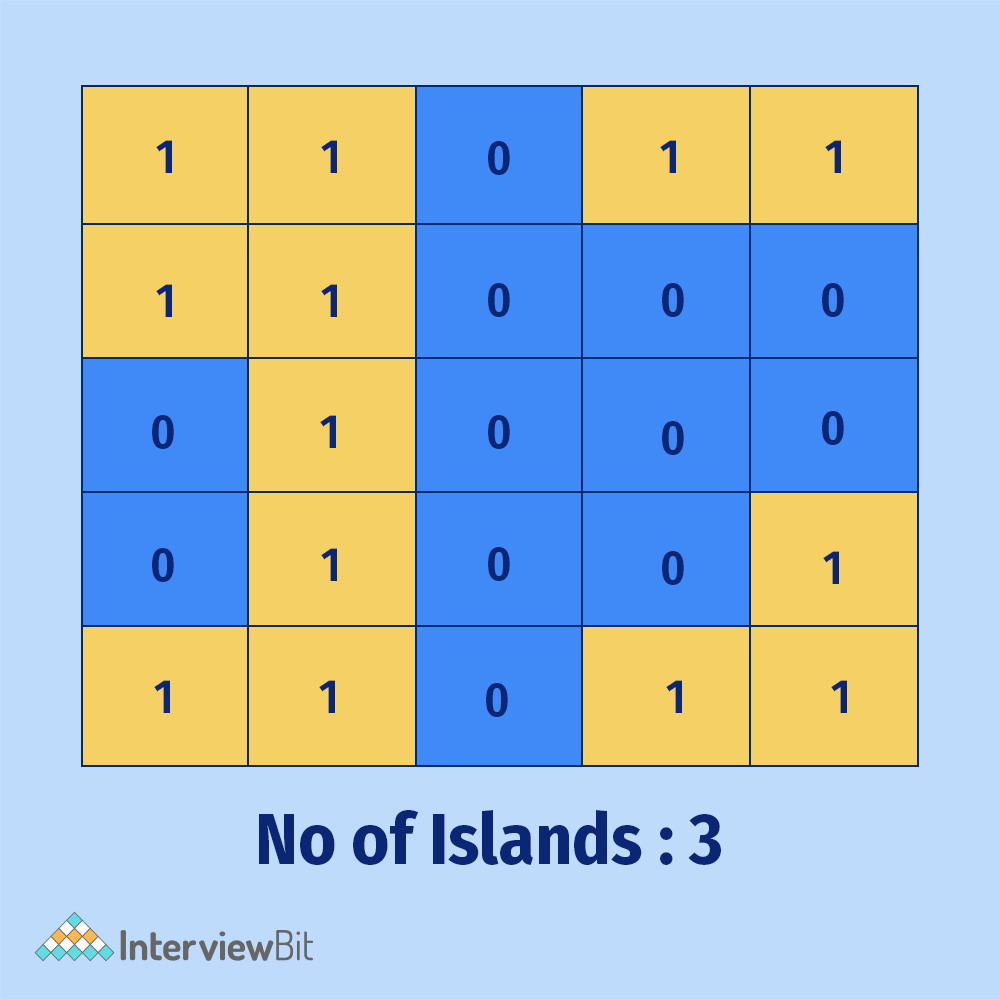
Output: 3
Explanation: Shown in the image
Approach 1: DFS
The idea is to consider the given matrix as a graph, where each cell is a node of the given graph. Two nodes contain an edge if and only if there is a ‘1’ either horizontally or vertically.


Algorithm
- Scan the matrix from (0,0) to (N, M).
- If the current element is ‘1’, start a DFS.
- In the DFS traversal, mark every visited node.
- Count the number of islands as the number of nodes that trigger the DFS.
- Return count.
C++ Code Implementation
void dfs(vector < vector < char >> & grid, int r, int c) {
  int nr = grid.size();
  int nc = grid[0].size();

  grid[r][c] = '0';
  if (r - 1 >= 0 && grid[r - 1][c] == '1') dfs(grid, r - 1, c);
  if (r + 1 < nr && grid[r + 1][c] == '1') dfs(grid, r + 1, c);
  if (c - 1 >= 0 && grid[r][c - 1] == '1') dfs(grid, r, c - 1);
  if (c + 1 < nc && grid[r][c + 1] == '1') dfs(grid, r, c + 1);
}

int numIslands(vector < vector < char >> & grid) {
  int nr = grid.size();
  if (!nr) return 0;
  int nc = grid[0].size();

  int num_islands = 0;
  for (int r = 0; r < nr; ++r) {
    for (int c = 0; c < nc; ++c) {
      if (grid[r][c] == '1') {
        ++num_islands;
        dfs(grid, r, c);
      }
    }
  }

  return num_islands;
}
Java Code Implementation
 void dfs(char[][] grid, int r, int c) {
  int nr = grid.length;
  int nc = grid[0].length;

  if (r < 0 || c < 0 || r >= nr || c >= nc || grid[r][c] == '0') {
    return;
  }

  grid[r][c] = '0';
  dfs(grid, r - 1, c);
  dfs(grid, r + 1, c);
  dfs(grid, r, c - 1);
  dfs(grid, r, c + 1);
}

public int numIslands(char[][] grid) {
  if (grid == null || grid.length == 0) {
    return 0;
  }

  int nr = grid.length;
  int nc = grid[0].length;
  int num_islands = 0;
  for (int r = 0; r < nr; ++r) {
    for (int c = 0; c < nc; ++c) {
      if (grid[r][c] == '1') {
        ++num_islands;
        dfs(grid, r, c);
      }
    }
  }

  return num_islands;
}
Python Code Implementation
def numIslands(self, grid):
    if not grid:
        return 0

    count = 0
    for i in range(len(grid)):
        for j in range(len(grid[0])):
            if grid[i][j] == "1":
                self.dfs(grid, i, j)
                count += 1
    return count


def dfs(self, grid, i, j):
    if i < 0 or j < 0 or i >= len(grid) or j >= len(grid[0]) or grid[i][j] != "1":
        return
    grid[i][j] = "#"
    self.dfs(grid, i + 1, j)
    self.dfs(grid, i - 1, j)
    self.dfs(grid, i, j + 1)
    self.dfs(grid, i, j - 1)
- Time Complexity: O(M * N), where M and N are the size of the matrix
- Space Complexity: O(M * N).
Approach 2: BFS
The problem can also be solved using the BFS approach. The logic remains the same as the previous approach.
Algorithm
- Scan the matrix from (0,0) till (N, M).
- If the current element is ‘1’, start a BFS.
- Consider a queue and put the current node into the queue.
- Iteratively visit its neighbours vertically and horizontally and mark them as visited.
- The count is the total number of times the BFS has been invoked.
- Return count.
C++ Code Implementation
int numIslands(vector < vector < char >> & grid) {
    int nr = grid.size();
    if (!nr) return 0;
    int nc = grid[0].size();

    int num_islands = 0;
    for (int r = 0; r < nr; ++r) {
      for (int c = 0; c < nc; ++c) {
        if (grid[r][c] == '1') {
          ++num_islands;
          grid[r][c] = '0'; // mark as visited
          queue < pair < int, int >> neighbors;
          neighbors.push({
            r,
            c
          });
          while (!neighbors.empty()) {
            auto rc = neighbors.front();
            neighbors.pop();
            int row = rc.first, col = rc.second;
            if (row - 1 >= 0 && grid == '1') {
              neighbors.push({
                row - 1,
                col
              });
              grid = '0';
            }
            if (row + 1 < nr && grid == '1') {
              neighbors.push({
                row + 1,
                col
              });
              grid = '0';
            }
            if (col - 1 >= 0 && grid == '1') {
              neighbors.push({
                row,
                col - 1
              });
              grid = '0';
            }
            if (col + 1 < nc && grid == '1') {
              neighbors.push({
                row,
                col + 1
              });
              grid = '0';
            }
          }
        }
      }
    }

    return num_islands;
Java Code Implementation
public int numIslands(char[][] grid) {
  if (grid == null || grid.length == 0) {
    return 0;
  }

  int nr = grid.length;
  int nc = grid[0].length;
  int num_islands = 0;

  for (int r = 0; r < nr; ++r) {
    for (int c = 0; c < nc; ++c) {
      if (grid[r][c] == '1') {
        ++num_islands;
        grid[r][c] = '0'; // mark as visited
        Queue < Integer > neighbors = new LinkedList < > ();
        neighbors.add(r * nc + c);
        while (!neighbors.isEmpty()) {
          int id = neighbors.remove();
          int row = id / nc;
          int col = id % nc;
          if (row - 1 >= 0 && grid == '1') {
            neighbors.add((row - 1) * nc + col);
            grid = '0';
          }
          if (row + 1 < nr && grid == '1') {
            neighbors.add((row + 1) * nc + col);
            grid = '0';
          }
          if (col - 1 >= 0 && grid == '1') {
            neighbors.add(row * nc + col - 1);
            grid = '0';
          }
          if (col + 1 < nc && grid == '1') {
            neighbors.add(row * nc + col + 1);
            grid = '0';
          }
        }
      }
    }
  }

  return num_islands;
}
Python Code Implementation
from collections import deque


def numIslands(grid):
    if not grid:
        return 0
    lands = set(
        [
            (i, j)
            for j in xrange(len(grid[0]))
            for i in xrange(len(grid))
            if grid[i][j] == "1"
        ]
    )
    count = 0
    while lands:
        count += 1
        i, j = lands.pop()
        connected = deque()
        connected.append((i, j))
        while connected:
            i, j = connected.popleft()
            if (i + 1, j) in lands:
                connected.append((i + 1, j))
                lands.remove((i + 1, j))
            if (i - 1, j) in lands:
                connected.append((i - 1, j))
                lands.remove((i - 1, j))
            if (i, j + 1) in lands:
                connected.append((i, j + 1))
                lands.remove((i, j + 1))
            if (i, j - 1) in lands:
                connected.append((i, j - 1))
                lands.remove((i, j - 1))
    return count
Time Complexity:O(M * N), where M and N is the size of the matrix
Space Complexity:O(min(M,N)).
Practice Question
FAQs
Q.1: What is the time and space complexity of the DFS approach?
Ans: The time and space complexity of the DFS approach is O(M * N) and O(M * N).
Q.2: In terms of space complexity, is the BFS approach efficient over DFS?
Ans: Yes, the space complexity for the BFS approach is O(min(N,M)), in the worst case when the grid is filled completely with 1’s, whereas for DFS it is O(N*M).