Advanced certification in AI: From ML to Agentic AI
Master ML. Build agents. Ship AI.
A programme offered by the Continuing Education Programme (CEP), IIT Delhi.
6 Months100+ hrs · live + optional campus immersion
Applications Open
Enquiry about programme
Six months to build real AI systems, from machine learning to autonomous agents - and open doors across AI engineering, research and product roles.
PROGRAMME OVERVIEW
What this programme is?
This is not a tools workshop. You will move from the mathematics under modern AI to the architectures defining its frontier: Transformers, fine-tuning, RLHF, RAG, and autonomous AI agents, so you don't just use Generative AI, you can build with it.
6 Months
live online
6 Projects
+ 1 capstone
Online Lectures
+ optional IITD immersion
STEM Graduate
+ programming exposure
Industry vetted curriculum
From first principles to your first real model.
Six modules, 100+ hours of live sessions plus an optional 2-day campus immersion at IIT Delhi, across four phases. Every module ends in a working artefact: a model or system you can point to, defend, and reuse.
How is this module future-proof
Model architectures turn over every year; linear algebra, probability and the data layer beneath them do not. This is the part of the stack that never needs relearning.
Module 1
Data Science Essentials
Maths foundations: linear algebra & probability · data measures, distributions & estimation.
Linear Algebra & ProbabilityData Measures, Distributions & EstimationSQL, NoSQL & Vector DatabasesStorytelling & Business DashboardsPython Primer
How this module is helpful
01
Builds the linear algebra, probability and estimation you need to reason about how models actually learn, rather than treating them as black boxes.
02
Gets you fluent in the data layer every AI system sits on — SQL, NoSQL and vector databases — before a single model is trained.
03
Ends in a working data foundation with a business dashboard, so the maths is immediately attached to something you can show.
Want to dive deeper into the details?
Ready to join the Advanced certification in AI: From ML to Agentic AI and take your first step towards success?
PROJECTS YOU WILL SHIP
Built to ship, not just to study
Six graded builds accumulate into a portfolio, and the programme converges on a live, defended agentic system at Demo Day, IIT Delhi. Capstone topics and tools are indicative. Programme faculty may update them to reflect current industry needs at time of delivery.
Project 01 · Data Foundations
Build the data foundation and tell its story
A working data layer across SQL, NoSQL and vector stores, with distributions and estimation applied to a real dataset, closing in a storytelling dashboard a business audience can read.
SQL / NoSQLVector storesDashboard
Ships: a queryable data foundation with a business dashboard on top.
Project 02 · ML & Deep Learning
Train regression, ensemble and clustering models
Optimisation applied end to end: regression and derivative-based training, then trees, random forests and boosting, plus hierarchical and K-means clustering, each evaluated properly.
OptimisationEnsemblesClustering
Ships: trained regression, ensemble and clustering models with their evaluations.
Project 03 · ML & Deep Learning
Build neural networks from feedforward to Transformers
Deep feedforward networks, CNNs and LSTMs trained on vision and sequence tasks, then a Transformer with attention — with explainable-AI analysis of what the network actually learned.
CNNs & LSTMsAttentionExplainable AI
Ships: trained neural models with an attention and explainability write-up.
Project 04 · Generative AI
Fine-tune an LLM and ground it with RAG
A large language model fine-tuned to a task, then grounded in your own corpus through a retrieval-augmented pipeline — embeddings, a vector store and a chunking strategy you can justify.
Fine-tuningRLHFRAG
Ships: a fine-tuned LLM served through a working RAG pipeline.
Project 05 · Agentic AI
Build a tool-using agent with memory
An autonomous agent built on the perceive-plan-act-learn loop and the ReAct pattern, with function calling and MCP for tool use, short- and long-term memory, and agentic RAG.
ReAct loopTool use & MCPAgent memory
Ships: a working agent that uses tools, remembers, and completes a real task.
Project 06 · Agentic AI
Ship an agent evaluation and guardrail harness
The reliability layer: a cost-per-task and latency model with caching and routing, guardrails and prompt-injection defence, and trajectory evaluation that scores how the agent reached its answer.
Cost & routingGuardrailsTrajectory eval
Ships: an evaluation and guardrail harness with a cost and latency model.
Project 01 · Data Foundations
Build the data foundation and tell its story
A working data layer across SQL, NoSQL and vector stores, with distributions and estimation applied to a real dataset, closing in a storytelling dashboard a business audience can read.
SQL / NoSQLVector storesDashboard
Ships: a queryable data foundation with a business dashboard on top.
Project 02 · ML & Deep Learning
Train regression, ensemble and clustering models
Optimisation applied end to end: regression and derivative-based training, then trees, random forests and boosting, plus hierarchical and K-means clustering, each evaluated properly.
OptimisationEnsemblesClustering
Ships: trained regression, ensemble and clustering models with their evaluations.
WHO SHOULD ENROL
Is this for you?
Admission is selective. Candidates are admitted by IIT Delhi Programme Coordinators based on eligibility and a screening review. You will fit if you have a working foundation in engineering, computing, or a technical discipline. No prior AI experience required.
6 Months
DURATION
Online live
FORMAT
100+ hrs
LEARNING HOURS
28th Nov'26
STARTS
01
Core engineering & computing
Final or pre-final year, or graduates in CSE, IS, EIE, ECE, EE, IT and related disciplines.
02
B.Sc / BCA students
In Mathematics, Statistics, Computing, or Data Science, converting strong fundamentals into applied, hands-on AI skills.
03
STEM graduates & professionals
Graduates or post-graduates in any STEM field with demonstrated programming exposure. Professionals with coding or programming experience are also welcome. No prior AI/ML experience required; the curriculum builds from foundational mathematics upward.
LEARNING OUTCOMES
You will not just use AI. You will build with it.
Every module ends in a working artefact and a capability you can defend. By the end of the programme you can take an AI system from mathematical foundations to a deployed, autonomous agent, and reason about its cost, reliability and safety.
01
Build the data & ML foundation — work maths, SQL/NoSQL and vector data, then train regression, ensemble and clustering models.
02
Train deep neural networks — feedforward nets, CNNs and LSTMs through to Transformers, attention and explainable AI.
03
Build generative models — VAEs, GANs and diffusion, plus LLM architecture, training, fine-tuning and RLHF.
04
Engineer RAG pipelines — prompt engineering and in-context learning, embeddings, vector stores and chunking strategies.
Ship agents reliably — reason about agent economics, guardrails, prompt-injection defence and trajectory evaluation.
Programme Faculty
Taught by researchers who define the field.
Three IIT Delhi faculty lead the programme, working across machine learning, applied AI, and data-driven modelling, from core research to real-world engineering and business systems.
Professor · Dept. of Chemical Engineering, IIT Delhi
Research in machine learning, optimization, and evolutionary algorithms, applied to data-driven modelling and AI-based decision systems.
Impact · 1,300+ citations · h-index 18
Machine Learning · Deep Learning · AI for engineering systems
Prof. Hariprasad Kodamana
Associate Professor · Dept. of Chemical Engineering & School of Artificial Intelligence, IIT Delhi
Ph.D. from IIT Bombay, postdoctoral research at the University of Alberta. Research spans machine learning, deep learning, and data-driven modelling.
Applied Machine Learning · Business Intelligence · Data Visualization
Prof. Agam Gupta
Associate Professor · Dept. of Management Studies (DMS), IIT Delhi
Fellow, IIM Calcutta. Works at the interface of technology and business: applied machine learning, business intelligence, and data visualization.
Honours · IIT Delhi Teaching Excellence Award
Professor · Dept. of Chemical Engineering, IIT Delhi
Research in machine learning, optimization, and evolutionary algorithms, applied to data-driven modelling and AI-based decision systems.
Impact · 1,300+ citations · h-index 18
Machine Learning · Deep Learning · AI for engineering systems
Prof. Hariprasad Kodamana
Associate Professor · Dept. of Chemical Engineering & School of Artificial Intelligence, IIT Delhi
Ph.D. from IIT Bombay, postdoctoral research at the University of Alberta. Research spans machine learning, deep learning, and data-driven modelling.
Applied Machine Learning · Business Intelligence · Data Visualization
Prof. Agam Gupta
Associate Professor · Dept. of Management Studies (DMS), IIT Delhi
Fellow, IIM Calcutta. Works at the interface of technology and business: applied machine learning, business intelligence, and data visualization.
Honours · IIT Delhi Teaching Excellence Award
TOOLS AND TECHNOLOGIES
The stack you build in
You build in the tools the industry actually uses. Named tools are illustrative of the current industry stack; SQL, NoSQL and vector databases, agent frameworks and evaluation tooling are introduced in the relevant modules and may be substituted at faculty discretion. Tools shown are indicative and may be modified to fit the programme.
WHY NOW
Build the skill the market can't stop bidding for.
AI has moved from research lab to enterprise core faster than any recent technology cycle, and the frontier has already shifted again, from generative models to autonomous agents. Organisations that can build these systems are pulling away from those that can only buy them, and the engineers who can build them, across ML, GenAI, and agentic AI, are the scarcest resource in the market.
33%
Agentic AI goes mainstream. Share of enterprise software applications set to embed agentic AI by 2028, up from under 1% in 2024.
Gartner
Gartner forecast: 33% of enterprise applications to include agentic AI by 2028 (from <1% in 2024).
3.2:1
The talent runs dry. Global AI demand-to-supply ratio, roughly 1.6M open roles against only ~518K qualified candidates.
Industry estimates
Industry AI-talent demand-to-supply estimates, ~1.6M open roles vs ~518K qualified candidates, 2026.
+280%
Agent builders wanted. Year-on-year growth in agentic-AI job postings in 2026, with average pay near $190K.
Market analyses
Agentic-AI job-posting growth and pay bands, 2026 market analyses.
~40%
A trillion-dollar wave. Compound growth of the generative-AI market, forecast to pass $1.2T by 2034.
Analyst forecasts
Generative-AI market CAGR and 2034 outlook (Fortune Business Insights; Grand View Research). Figures are cited as reported and vary by research firm.
HOW YOU LEARN
Learn the way the work actually happens
A fully live online cadence built around a working week, with every module closing on a working artefact — and an optional campus immersion at IIT Delhi for the capstone and Demo Day.
01
End-to-end, not add-on
One connected build from maths foundations and ML through to autonomous agents, not GenAI with agents bolted on at the end.
02
Build-first by design
Every module ends in a working artefact, and the programme converges on a live, defended agentic system at Demo Day.
03
IIT Delhi faculty
Taught by named, active IIT Delhi researchers in ML, applied AI and data-driven modelling, not platform-recorded lectures.
04
Role-ready layer
A structured career layer — personal branding, business communication, job-search strategy and interview preparation — runs alongside the curriculum, delivered by Varsity by InterviewBit.
05
Demo Day at IIT Delhi
An optional two-day campus immersion at IIT Delhi where the capstone agent is built hands-on and presented live at Demo Day.
CAMPUS IMMERSION
Two days at IIT Delhi. Build it, then defend it.
This programme is delivered live online, built to fit around a full-time job. An optional two-day campus immersion adds a hands-on capstone build and Demo Day at IIT Delhi, where your agentic AI application is presented live to faculty.
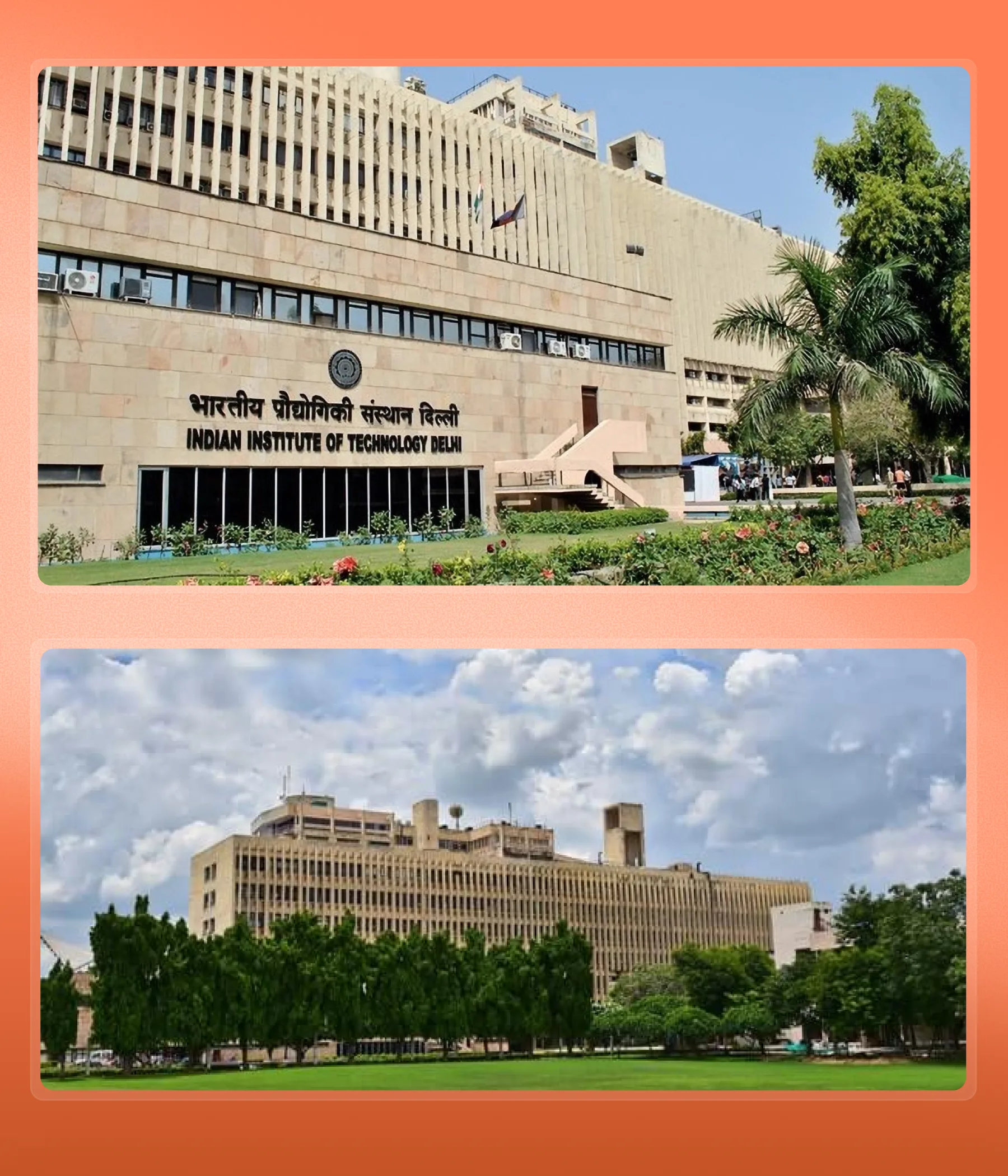
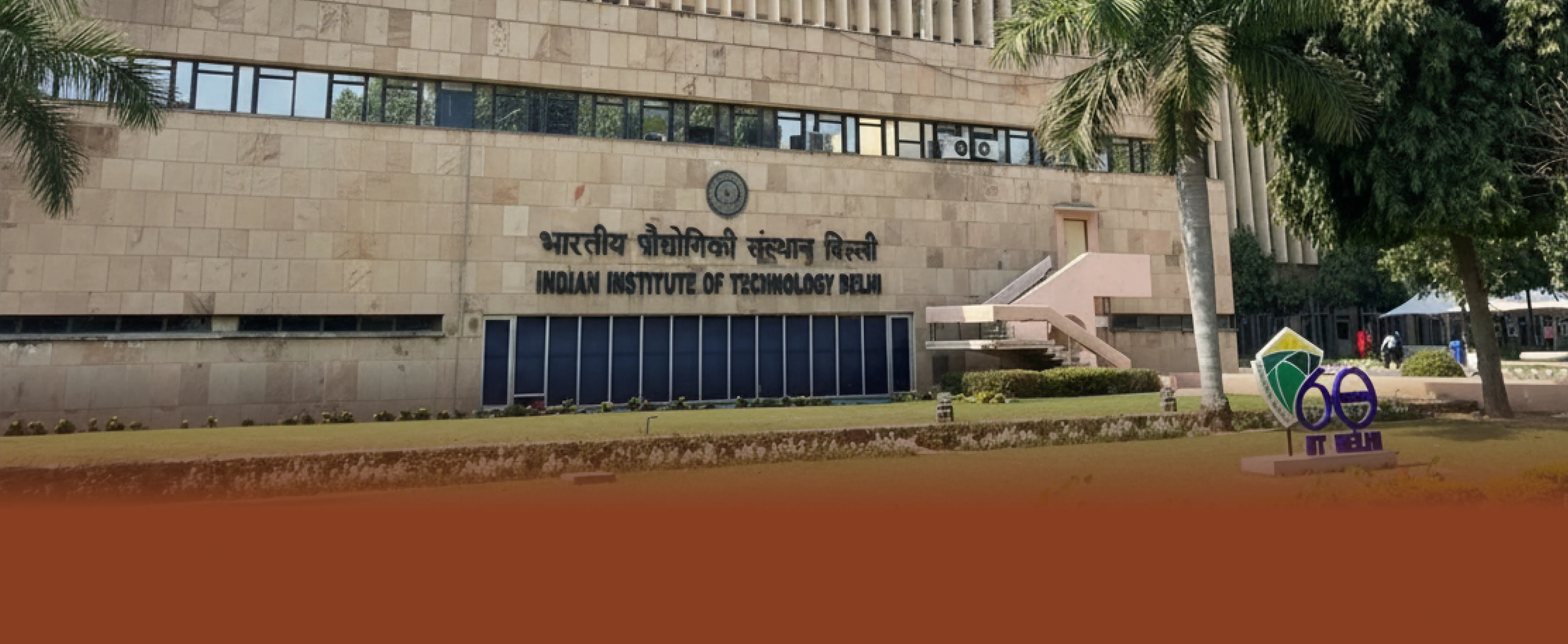
Indian Institute of Technology - Delhi
An optional two-day in-person immersion for the capstone build and Demo Day on the IIT Delhi campus.
Note: Travel and accommodation cost will be borne by the learners. IIT Delhi will not be responsible for the same.
A hybrid option will be open to candidates who are unable to come on campus.
Hands-on capstone build
Build your end-to-end agentic AI application on campus, alongside faculty and your cohort.
Demo Day at IIT Delhi
Present and defend the working agent live in the room, in front of IIT Delhi faculty.
Peer networking
Build a lasting network with a driven cohort of engineers and working professionals.
Certificate
A credential issued in the IIT Delhi name.
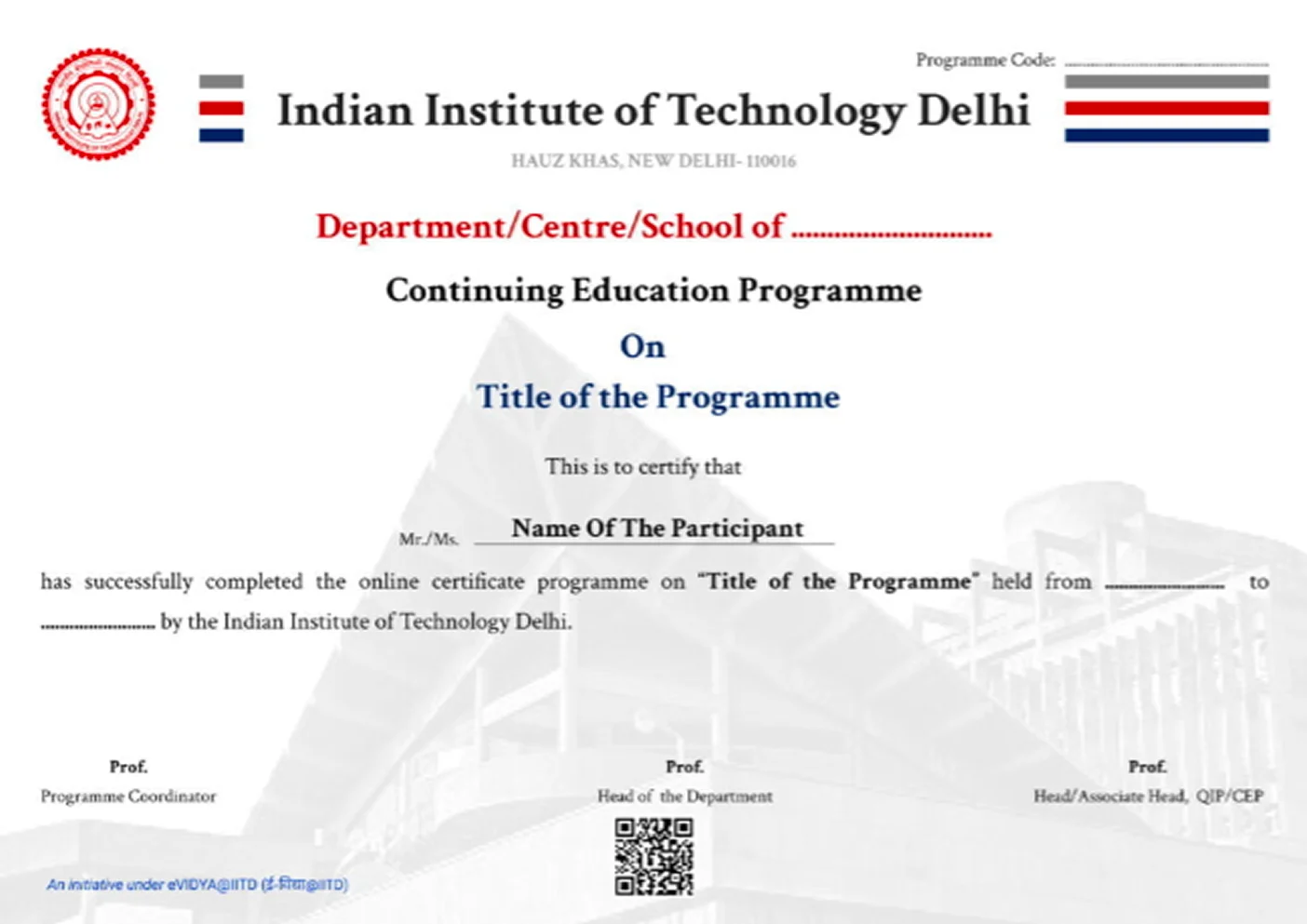
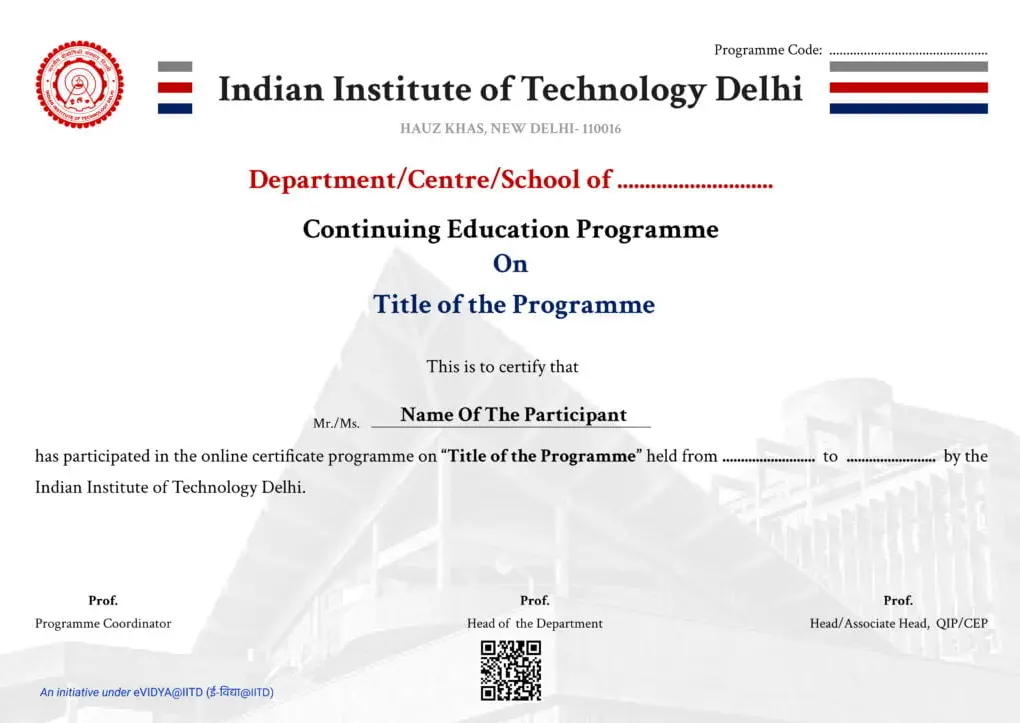
On completion, participants receive a certificate from the Continuing Education Programme (CEP), IIT Delhi. Two certificate types are issued, based on attendance and assessment performance. A Certificate of Successful Completion is awarded to candidates who score at least 50% marks overall and have a minimum attendance of 50%; a Certificate of Participation to candidates who score less than 50% marks overall and have a minimum attendance of 50%. A verifiable e-certificate only is issued — no printed copy. It reflects the programme title, learning hours, completion status and grade band (where applicable).
Certificate of Successful Completion
Awarded to candidates who score at least 50% marks overall and have a minimum attendance of 50%.
Certificate of Participation
Awarded to candidates who score less than 50% marks overall and have a minimum attendance of 50%.
Admissions
Know important dates and the admission process.
Follow the steps to understand how cohort information works.
Cohort Calendar
25th Nov'26Last date of application
28th Nov'26Cohort starts
May 2027Cohort Ends
Admission Process
1Submit application - a ~10-minute online form via the CEP, IIT Delhi programme page. ₹1,000 application fee.
2Shortlist & screening - shortlisting and vetting by IIT Delhi Programme Coordinators. Shortlisted candidates are intimated by email.
3Offer & payment - confirm your seat by paying the first instalment (₹30,000 + GST) within 4 days of offer roll-out.
4Orientation - join the live orientation. Meet your faculty, cohort and learning team. Start building.
5Refund policy - candidates can withdraw within 15 days from the programme start date; 80% of the total fee received is refunded, and the applicable tax amount paid is not refunded. Candidates withdrawing after 15 days from the start of the programme session are not eligible for any refund. To withdraw, email cepaccounts@admin.iitd.ac.in and refunds_varsity_del@interviewbit.com. Refunds, if applicable, are processed within 30 working days.
The application fee is separate from the main programme fee and is non-refundable. The balance may be paid one-shot or via EMI, basis the learner's preference; for EMIs, interest applies as per NBFC terms & tenure. The full programme fee must be paid before the programme starts.
All fees should be submitted in the IIT Delhi CEP account only; details will be shared post-selection. Receipts are issued by the IIT Delhi CEP account and are downloadable from the CEP portal. Loan and EMI options are services offered by Varsity by InterviewBit; IIT Delhi is not responsible for the same. The application fee is non-refundable, non-transferable, and is not adjusted against the total programme fee.
FAQ
The questions you are already asking
Honest answers to the questions that might be holding you back.
Who is this programme for?
It is built for engineering and computing students and graduates (CSE, IS, EIE, ECE, EE, IT), B.Sc/BCA students in Mathematics, Statistics, Computing or Data Science, and STEM graduates or professionals with programming exposure who want to build AI systems — from machine learning through to autonomous agents — not just use them.
Do I need prior AI or machine-learning experience?
No. No prior AI/ML experience is required — the curriculum builds from foundational mathematics upward. You do need a working foundation in engineering, computing or a technical discipline, and demonstrated programming exposure.
How selective is admission?
Admission is selective. Candidates are admitted by IIT Delhi Programme Coordinators based on eligibility and a screening review; shortlisted candidates are intimated by email.
Users write prompts. This programme prepares you to build the systems that answer them.