Download PDF

 Expand in New Tab





What is it like to go into the interview process for a Full-Stack Developer role? It is quite common to feel anxious at first, especially if this is your first time on the hot seat. One of the most popular and hottest professions in the tech industry is a Full Stack Development role.
Full-stack developers do not only specialize in front-end and back-end development but are also experts with a wide range of skill sets and knowledge. Its high level of responsibility makes it one of the most important careers in tech and companies are willing to pay handsomely for those with the right skillset and diverse knowledge.

Likewise, if you're thinking about a career in Full Stack Development, the future is yours. The InterviewBit team has put together a list of 30+ full stack developer interview questions and answers that will help you prepare for this role. These questions have been hand-picked based on what you will likely encounter in the interview.
Before we begin, let's first determine who exactly is a full-stack developer.
Who is a Full-Stack Developer?
A full-stack web developer is a person who can develop both client and server software. Simply put, full-stack developers comprehend all the technologies that go into making a website. The responsibilities of Front-end Developers include developing and designing front-end (client-side) web architecture, server-side (back-end) applications, working alongside graphic designers to create web design elements, developing APIs and RESTful services, testing, and debugging software, ensuring cross-platform compatibility and optimization, etc. In addition to mastering HTML and CSS, he/she also knows how to:
- Program a browser (like using JavaScript, jQuery, Angular, or Vue)
- Program a server (like using PHP, ASP, Python, or Node)
- Program a database (like using SQL, SQLite, or MongoDB)
Now let's look at the most common Full Stack Developer interview questions for both freshers and experienced candidates.
Full Stack Developer Interview Questions for Freshers
1. Which language is the most preferred by full-stack developers?
Full Stack Developers utilize several programming languages. Ideally, a candidate should be fluent in several languages, preferably some for designing the front end and others for fixing the back end. Since Full Stack developers work with a variety of technologies and applications, they must be proficient in at least two to three of the most popular languages such as Java, Python, Ruby, PHP, C++, etc.

 Real-Life Problems
 Prep for Target Roles
 Custom Plan Duration
 Flexible Plans

2. Explain Pair Programming.
In pair programming, two programmers share only one machine and work together. During the development process, one programmer will be the driver who codes and another will act as the observer (navigator) who will make sure the code is written correctly, proofread and spell-check it, while also deciding where to go next. Roles can be swapped at any time: the driver becomes the observer and vice versa. You can also call it "pairing", "paired programming", or "programming in pairs".

Advantages:
- Two of them will fix the problem if the driver encounters any issues with the code.
- The two programmers working on the same program are only 15% slower than if they worked independently instead of 50%.
- As a result of having another programmer look over your work, you are more likely to write better code. One study showed that it results in 15% fewer bugs than code written by a single programmer.
- It leads to improved collaboration, higher quality, better code, and sustained improved development practices.
- During the project, each person teaches the other, resulting in more efficient and expedited knowledge exchange.
- The team develops better communication skills.
3. What do you mean by CORS (Cross-Origin Resource Sharing)?
CORS refers to cross-origin resource sharing. It's a browser mechanism that allows web pages in one domain to have controlled access to resources in other domains (cross-domain requests). This allows scripts that are run on a browser client to interact with and access resources from other origins. In doing so, it extends and provides greater flexibility to the SOP (Same-Origin Policy). Same-origin policies restrict the ability of a website to access resources outside of its source domain. For example, a JavaScript app that wants to make a call to an API (Application Programming Interface) that runs on another domain will be blocked due to the SOP. A CORS policy was implemented to circumvent restrictions caused by same-origin policies.

In addition, if a website's CORS policy is not configured properly, it may be vulnerable to cross-domain attacks. This means that it cannot stop cross-origin attacks like CSRF (Cross-Site Request Forgery).
4. What is Callback Hell?
Callback Hell, or Pyramid of Doom, is a common anti-pattern seen in asynchronous programming code (multiple functions running at the same time). This slang term describes a large number of nested "if" statements or functions. In simple terms, Callback hell is a situation where you have multiple asynchronous functions. Those functions depend on one another, so it could get quite messy with so many callback functions nested in so many layers. The use of callback functions leaves you with code that is difficult to read and maintain, and looks like a pyramid as shown below:
This also makes it more difficult to identify the flow of the application, which is the main obstacle to debugging, which is the reason for the famous name of this problem: Callback Hell.
5. Explain Long Polling.
Long polling is defined as a web application development technique used to push information/data from servers to clients as quickly as possible. When a request is made from the client to the server, long-polling maintains the connection between the two. This connection is maintained until the information is ready to be sent from the server to the client. Once a server receives a request from a client, the connection does not close immediately; the connection is only closed once the server has sent the data back to the client or when a timeout threshold has been reached (connection timeout).

 Learn via our Video Courses
6. Can you tell me what are the latest trends in Full Stack Development? Also, how do you keep yourself updated about the new trends in the industry?
Each business needs emerging technology to thrive, whether it is mobile or web application development. This is why they hire front-end developers, back-end developers, or full-stack developers depending on their technology needs. According to industry experts, candidates who are passionate about full-stack development should be aware of these trends:
- The rise in frameworks and libraries like ReacJs and VueJs, progressive apps, real-time web apps, and mobile web development.
- Enhancements to JavaScript are beneficial to programming
- The emergence of a more compatible extension.
The interviewer may ask you how you keep updated with new trends in the industry. You can explain how you gain your knowledge and understanding by learning from friends, colleagues, or online. That's an appropriate way of answering the question. This is a good time to show off any personal projects you have undertaken that apply your skills. Also, you might mention the webinars or forums that you attend regularly.
7. State difference between GraphQL and REST (Representational State Transfer).
For decades, REST (Representational State Transfer) has been a popular architectural way to design APIs (Application Programming Interfaces), but the popularity of GraphQL over the past few years threatens to topple REST. In general, REST and GraphQL both aim to transfer data over internet protocols including HTTP. How they do so differs greatly, however.

| GraphQL | REST |
|---|---|
| It is a Query Language for APIs that enables declarative data fetching to provide clients control over which data to retrieve from the API. | It is an API design architectural style that defines a set of constraints to create web services. |
| GraphQL is known for its high predictability. With this, you can send requests to your API and get the exact results you are looking for without having to include anything you don't need. GraphQL queries give predictable results, which improves their usability significantly. | On the other hand, REST's behaviour depends on the HTTP and URI methods used. API consumers can therefore be unsure of what to expect when calling an endpoint. |
| API security can be ensured by GraphQL, though the security features aren't as mature as those of REST. GraphQL, for instance, assists in integrating data validation, but users are left to figure out how to apply authentication and authorization measures. | API security can be enforced in several ways using REST. You can implement multiple methods of API authentication, such as HTTP authentication, to ensure REST API security. |
| With GraphQL, you can retrieve everything you need through a single API request. You can specify the structure of the information you need, and the server will return the same structure to you, so there is no need to over-and under-fetch. | Consequently, since REST APIs have rigid data structures that return the specified data whenever they are accessed, you may end up with unwanted data or have to make multiple requests before getting the right data. As a result, the server's response time (to return information) can be prolonged due to these shortcomings. |
| It only supports JSON format. | XML, YAML, JSON, HTML, and other formats are supported, as well. |
| The main use cases of GraphQL are mobile applications and multiple microservices. | Rest is mainly used for simple applications and resource-driven applications. |
 Real-Life Problems
 Detailed reports
8. What is CI (Continuous Integration)?
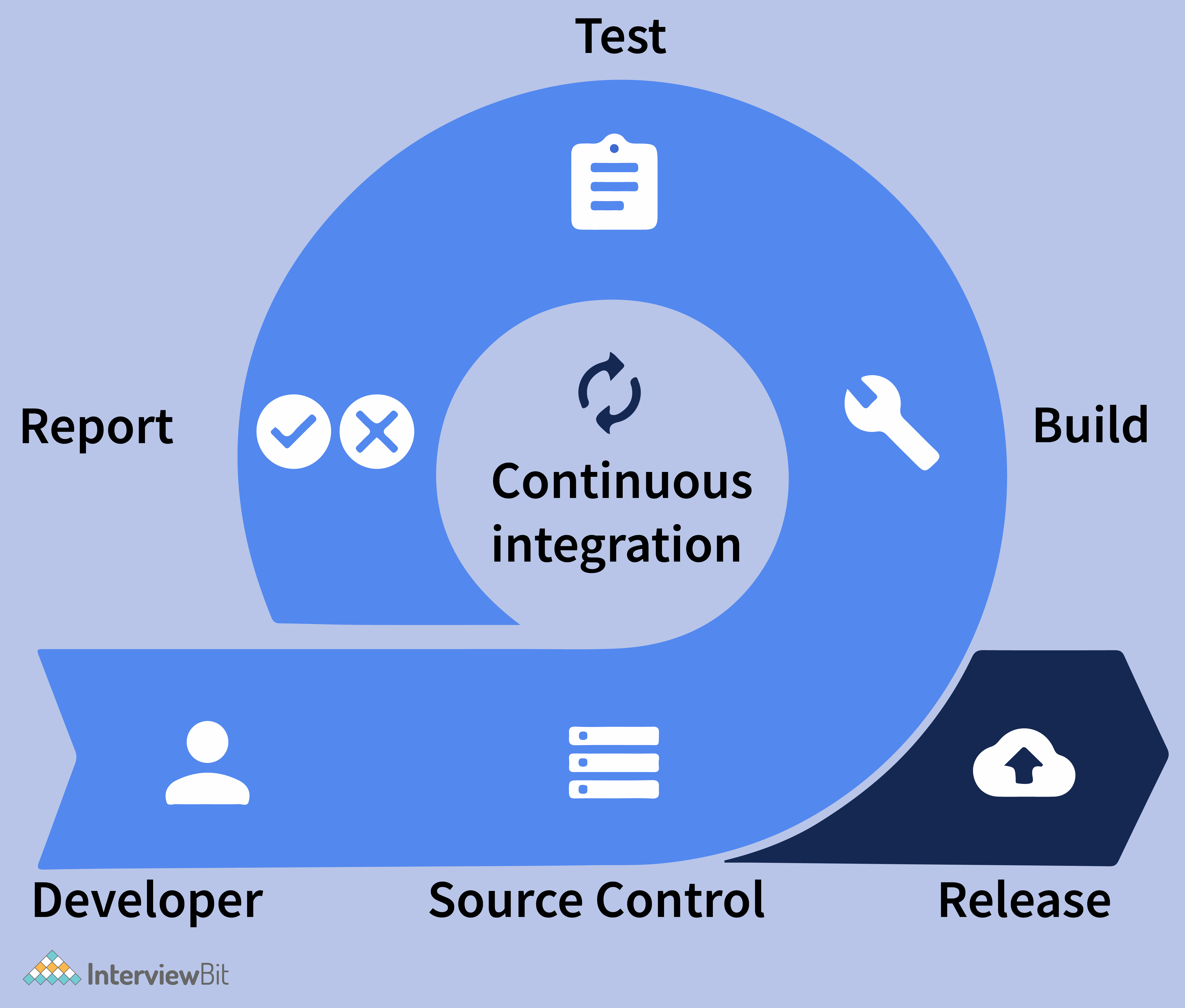
CI (Continuous Integration), as its name implies, is the process of automating and integrating code changes into a single software project, often several times a day. The purpose of this DevOps practice is to enable developers to merge their code changes into a central repository where automated tests and builds can run. Automated tools are used to assert the new code’s correctness before integration. A source code version control system is the crux of the CI process. The version control system is also supplemented with other checks like automated code quality tests, syntax style review tools, and more.
Advantages:
- Integrating regularly has the main benefit of detecting errors quickly and more easily. Since most changes introduced are small, pinpointing the specific change that caused a defect is easy.
- As a result of the smaller code changes and easier fault isolations, CI reduces MTTR (Mean Time to Resolution).
- When CI is incorporated into your organization's development process, you are less likely to have noncritical defects on your backlog. Before production, these small defects are detected and fixed before they are released to the public.
9. Explain the meaning of multithreading.
The thread is an independent part or unit of a process (or an application) that is being executed. Whenever multiple threads execute in a process at the same time, we call this "multithreading". You can think of it as a way for an application to multitask.

Advantages:
- By multithreading, computing resources are also minimized and used more effectively.
- The response time of the application is improved since requests from one thread do not block requests from other threads.
- Consequently, if one of the threads encounters an exception, it will not affect the other threads.
- Multithreading, on the other hand, uses fewer resources than running multiple processes simultaneously.
- The overhead, time usage, and management associated with creating processes are much higher when compared to creating and managing threads.
10. Explain the benefits and drawbacks of using "use strict".
In ECMAScript5, a new feature known as strict mode allows you to run a program or function within a strict operating context. Certain actions, therefore, cannot be taken due to this strict context, and more exceptions are thrown. When the "use strict" statement is used, the browser is instructed to use "strict" mode, which is a more restricted and safer JavaScript feature set. You can specify "use strict" at the top of a function to evaluate the JS in strict mode. In strict mode, more errors are thrown and some features are disabled to make your code more robust, clear, and accurate.

Advantages:
- Errors are thrown when some common coding mistakes are detected.
- By having strict mode, mistakes that make JavaScript engines tough to optimize can be fixed. Sometimes, strict mode code runs faster than similar, non-strict mode code.
- Generally, it prevents or throws an error when an "unsafe" action is taken (for example, accessing the global object).
- It disables poorly thought-out or confusing features.
- Strict mode simplifies the process of writing "secure" JavaScript.
Disadvantages:
- Many of the functions that most developers use are absent.
- It is not possible to access function.caller or function.arguments anymore.
- If you concatenate scripts written in different strict modes, you may encounter problems.
11. What are some of the uses of Docker?
One of the thorniest problems in software development is dealing with the different environments across different machines and platforms. Using Docker, you can isolate your applications from your infrastructure, which is crucial to delivering software quickly. Developers can package and run their applications into containers, executable components that have all the OS (Operating System) libraries and dependencies needed to run the application in any environment. It does not matter what is installed on the host—containers are lightweight and include everything needed to run applications.
- The code has to pass through many different environments as it travels from the developer's machine to production. Consequently, each of these environments may be slightly different. Using Docker streamlines code development and deployment, as it provides a consistent environment from development to production.
- Docker's primary purpose is to simplify configuration. With VM (Virtual Machine), you can run any platform with its configuration on top of your infrastructure. Docker offers the same functionality without the overhead of virtual machines.
12. Explain event loop in Node.js.
The event loop in JavaScript enables asynchronous programming. With JS, every operation takes place on a single thread, but through smart data structures, we can create the illusion of multi-threading. With the Event Loop, any async work is handled by a queue and listener. Consider the diagram below:

Therefore, when an async function (or an I/O) needs to be executed, the main thread relays it to another thread, allowing v8 (Javascript engine) to continue processing or running its code. In the event loop, there are different phases, like pending callbacks, closing callbacks, timers, idle or preparing, polling, and checking, with different FIFO (First-In-First-Out) queues.
13. Is there a way to decrease the load time of a web application?
Here are some ways to reduce load times for web applications:
- Image Optimization: The file size of an image can be dramatically reduced by switching to a different file format. For example, GIFs work well for images with few colors, such as logos, JPEG is ideal for images with lots of colors and details, such as photographs, and PNG format is ideal for transparent images with high quality.
- Keep JavaScript and CSS in external files: Embedding JavaScript and CSS in HTML documents forces them to be downloaded every time the HTML document is loaded. In this case, browser caching is not utilized, and the HTML document becomes larger. This is why you should always place CSS and JavaScript in external files; it is a best practice and simplifies maintenance.
- Reducing redirects: Too many redirects will delay the loading time of a website. HTTP requests and responses are delayed each time a page redirects. Getting rid of unnecessary redirects on your site will reduce the load time of your site significantly.
- Load CSS and JavaScript files asynchronously: Your website contains CSS and JavaScript files that can be loaded either synchronously or asynchronously. As part of synchronous loading, each file is loaded sequentially, in the order it appears on your site. As opposed to synchronous loading, asynchronous loading allows multiple files to be loaded simultaneously, boosting the performance of a website.
- Minify HTML, CSS, and JavaScript: If you optimize the way your files load, your pages will load more quickly. You can do the same when it comes to HTML, CSS, and JavaScript code. By eliminating unnecessary spaces, characters, and comments, you can reduce the size of your files. This will make your web pages load faster.
14. Explain dependency injection.
The Dependency Injection (DI) pattern is a design pattern for implementing the Inversion of Control (IoC). Dependent objects can be created outside of classes and made available to classes in different ways. Three types of classes are involved in Dependency Injection as follows:
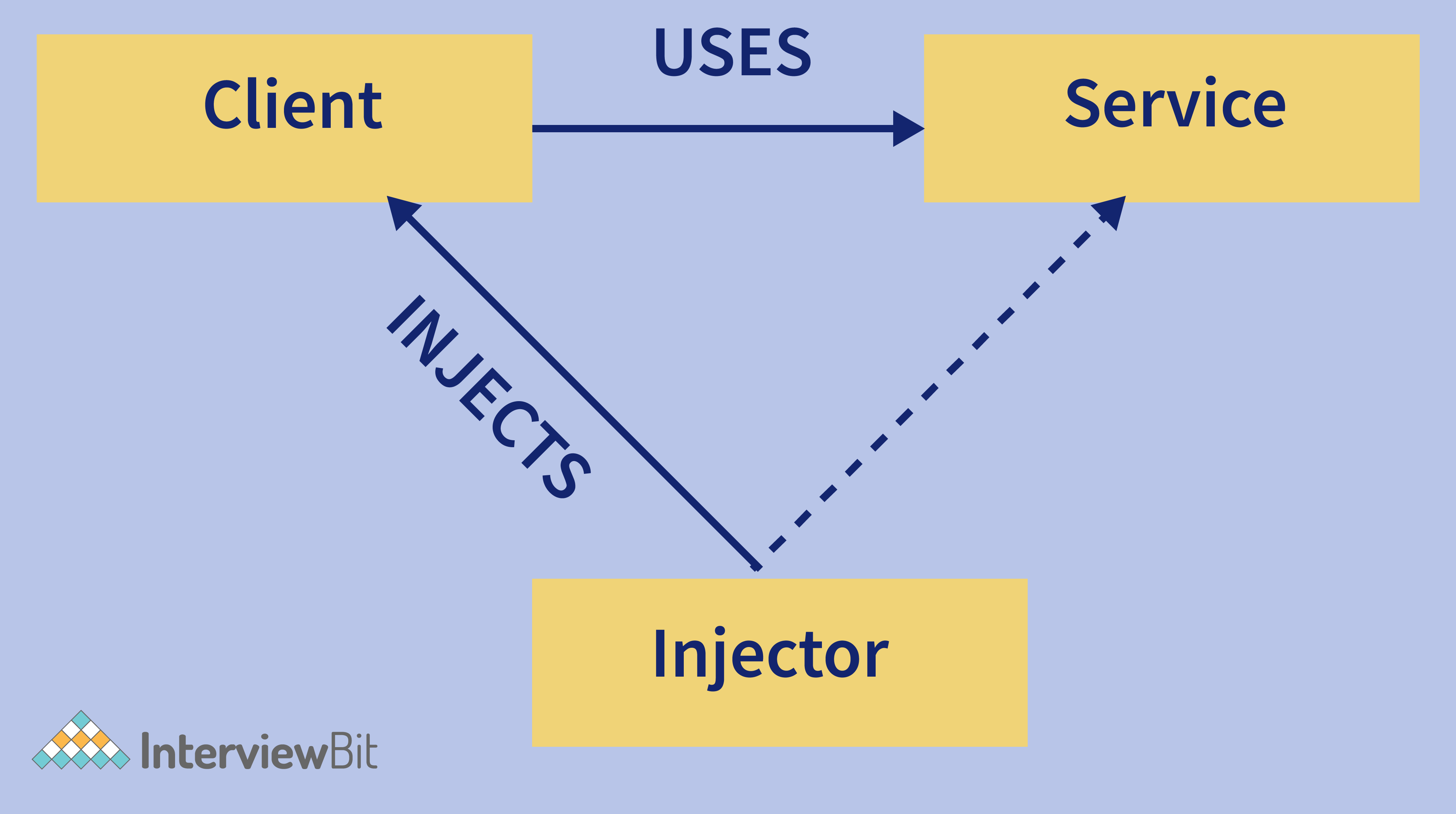
- Client Class: A client class (dependent class) is one that depends on the service class.
- Service Class: Service (dependency) classes provide services to client classes.
- Injector Class: This class injects the objects from the service class into the client class.
15. What do you mean by observer pattern?
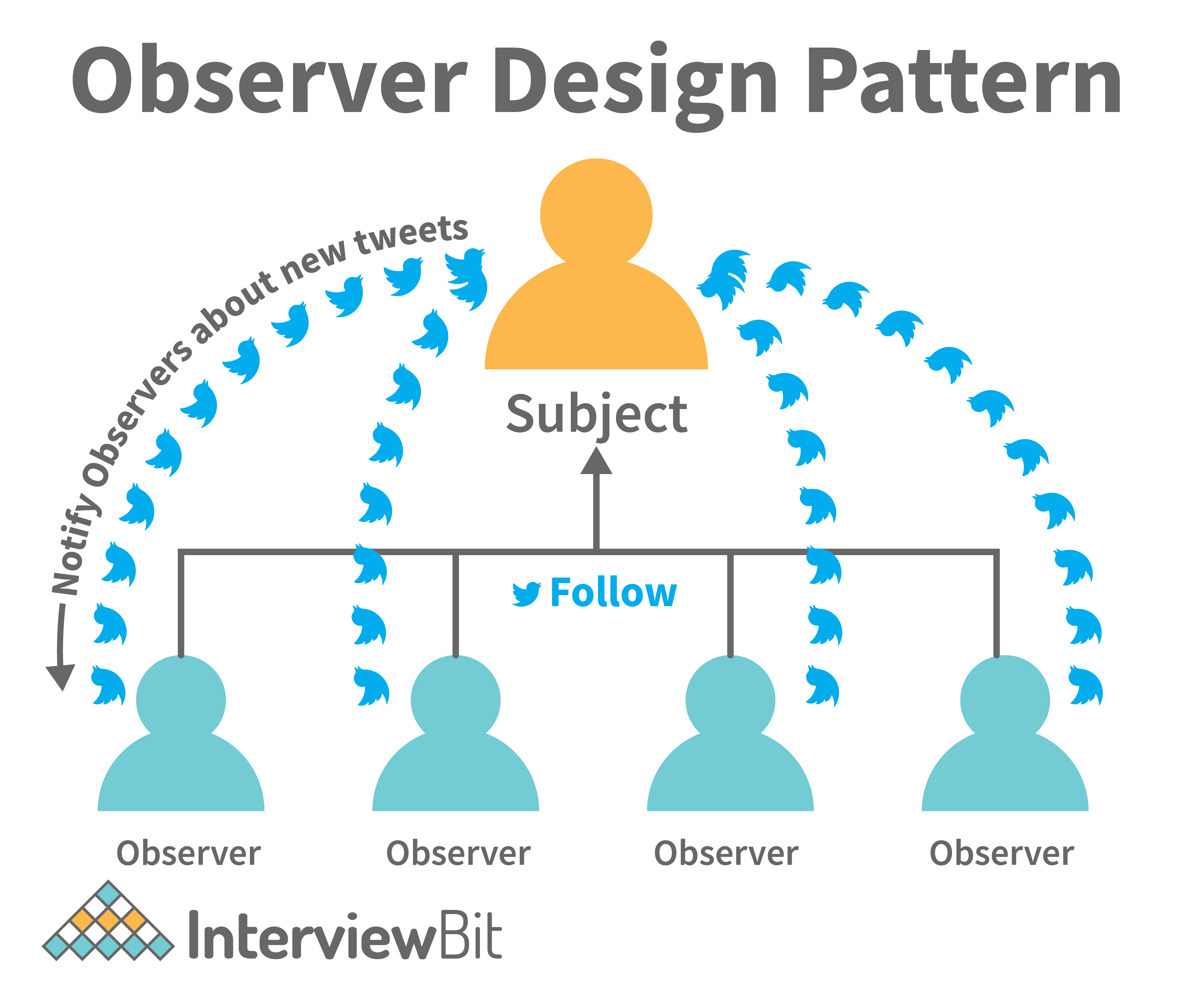
If several objects are tied together in one-to-many relationships, the observer pattern is used. Every time one object is modified, then all of its dependent objects are automatically notified and updated. It falls under the behavioural pattern category. It describes the coupling between the objects and the observer and provides support for broadcast-type communication. The object that observes the state of another object is known as the observer, and the object that is being observed is known as the subject as shown below:
16. To develop a project from scratch, what technologies and languages would you need or what skills a full stack developer should have?
A full-stack developer must be familiar with the following:
- Programming Languages: Full-stack developers should be competent in more than one programming language, such as Java, Python, PHP, Ruby, C++, etc.
- Front End technologies: You should be familiar with front-end technologies such as HTML5, CSS3, JavaScript, etc. Knowledge of third-party libraries such as jQuery, Ajax, Angular, ReactJS, etc., is also important.
- Frameworks: This requires proficiency in a variety of development frameworks, including Spring, Spring Boot, Django, MyBatis, PHP, Hibernate, and others.
- Databases and caches: As a full stack developer, you should also know about various DBMS (Database Management Systems) technologies like MySQL, SQLite, Oracle, and MongoDB. It is helpful to have a basic understanding of caching mechanisms like redis, memcached, varnish.
- Design Ability: Having a good understanding of design is also important if you wish to become a successful Full-Stack web developer. Moreover, the person should be aware of the principles of prototyping and UX/UI design.
- Server: Experience with Apache or NGINX would be beneficial. Good knowledge of Linux helps enormously when administering servers.
Full Stack Developer Interview Questions for Experienced
1. In the past, what was the best implementation or debugging you did?
By asking this question, the hiring manager will get an idea of the type and complexity of past projects you have completed. You should clearly state the problems you encountered and the steps you took to overcome them. In addition, you can talk about the lessons you learned from the issue.
Conclusion
A potential employer doesn't expect applicants to know everything, whether they're freshers or experienced. However, a well-prepared and enthusiastic candidate will undoubtedly stand out. In a full stack developer interview, candidates should be able to demonstrate excellent organizational skills and precision in their work. Also, honesty and transparency pay dividends over the long run.
In this article, we have covered the top 30+ Full-Stack developer interview questions & answers for freshers and experienced candidates so you can succeed in your next full-stack developer interview. Questions like those listed above are quick, insightful, and provide key cues that are vital to the interview process. If you review frequently asked full stack developer interview questions and answers, you increase your chances of getting hired. Make sure you review all the questions and answers.
We hope to have cleared up your doubts and guided you in the right direction. Good luck with your full stack developer interview!
Useful Resources
- Best Full Stack Developer Courses
- Best Full Stack Projects With Source Code
- Full Stack Engineer Salary – For Freshers and Experienced
- Full Stack Developer Resume
- Best Web Development Courses
- Software Engineer / Developer Salary in India
- Angular Interview Questions and Answers
- Software Developer vs Software Engineer
2. State difference between blue/green deployment and rolling deployment.
Today, the software is rapidly created and features are often changed based on customer needs, and then it is deployed into production. Each organization has its unique way of getting new applications into the production environment. Most organizations follow the standard deployment and release strategies such as Blue-Green and Rolling Deployment.
- Blue-Green Deployment Strategy:
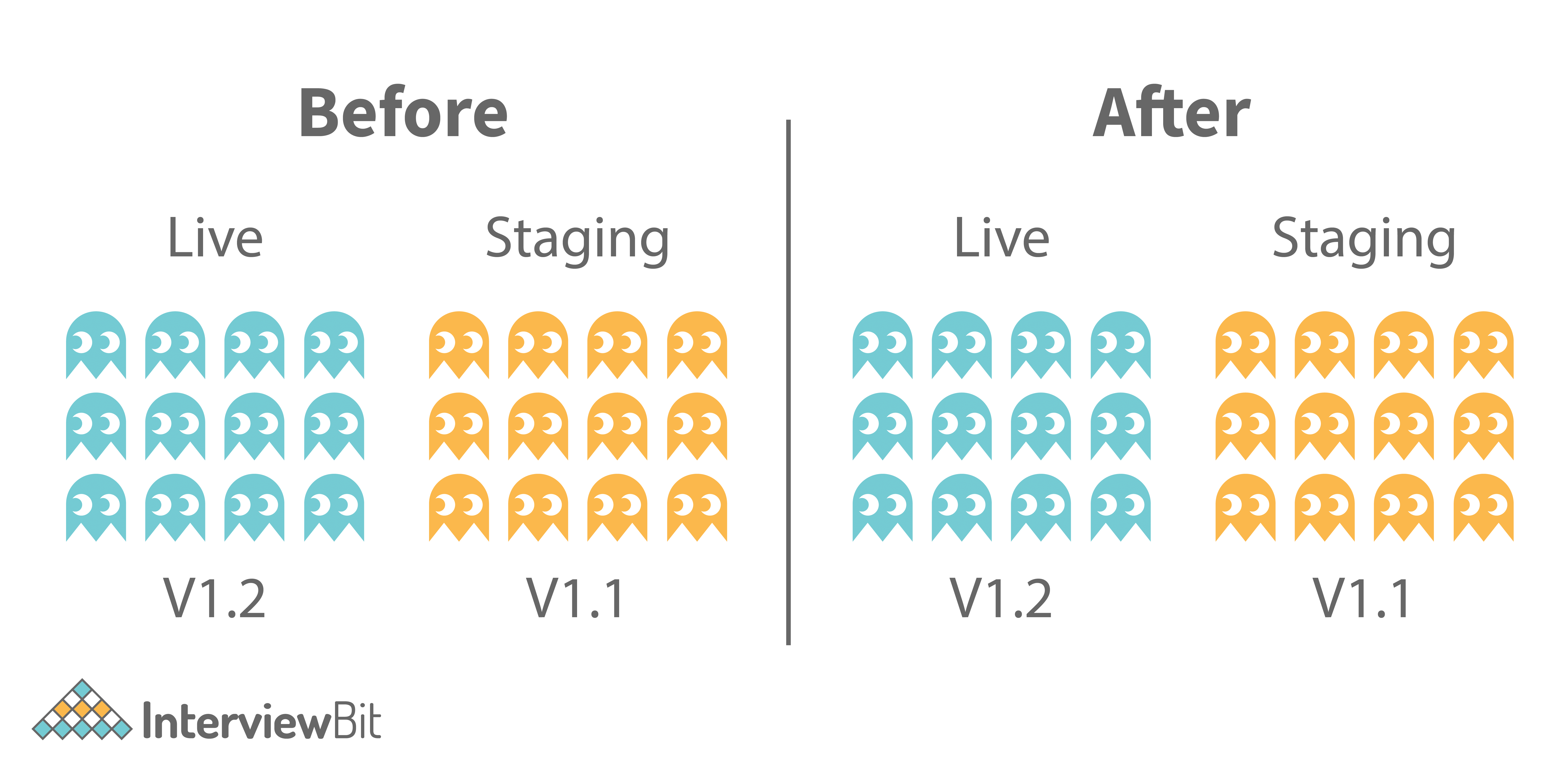
A deployment strategy like this creates two separate infrastructure environments i.e., blue and green. A blue environment contains older code (old version), while a green environment (production) contains the latest code (new version). There is only one live production environment at any given time.
Example: For instance, the green environment is live and is receiving all user traffic, while the clone (blue) is idle. Once a new version of an application is ready for release, it can be deployed to the blue environment for testing. As soon as the new release passes testing, application traffic is switched from green to blue. Blue then becomes the live production environment, and Green becomes idle, ready for testing the next release.
- Rolling Deployment Strategy
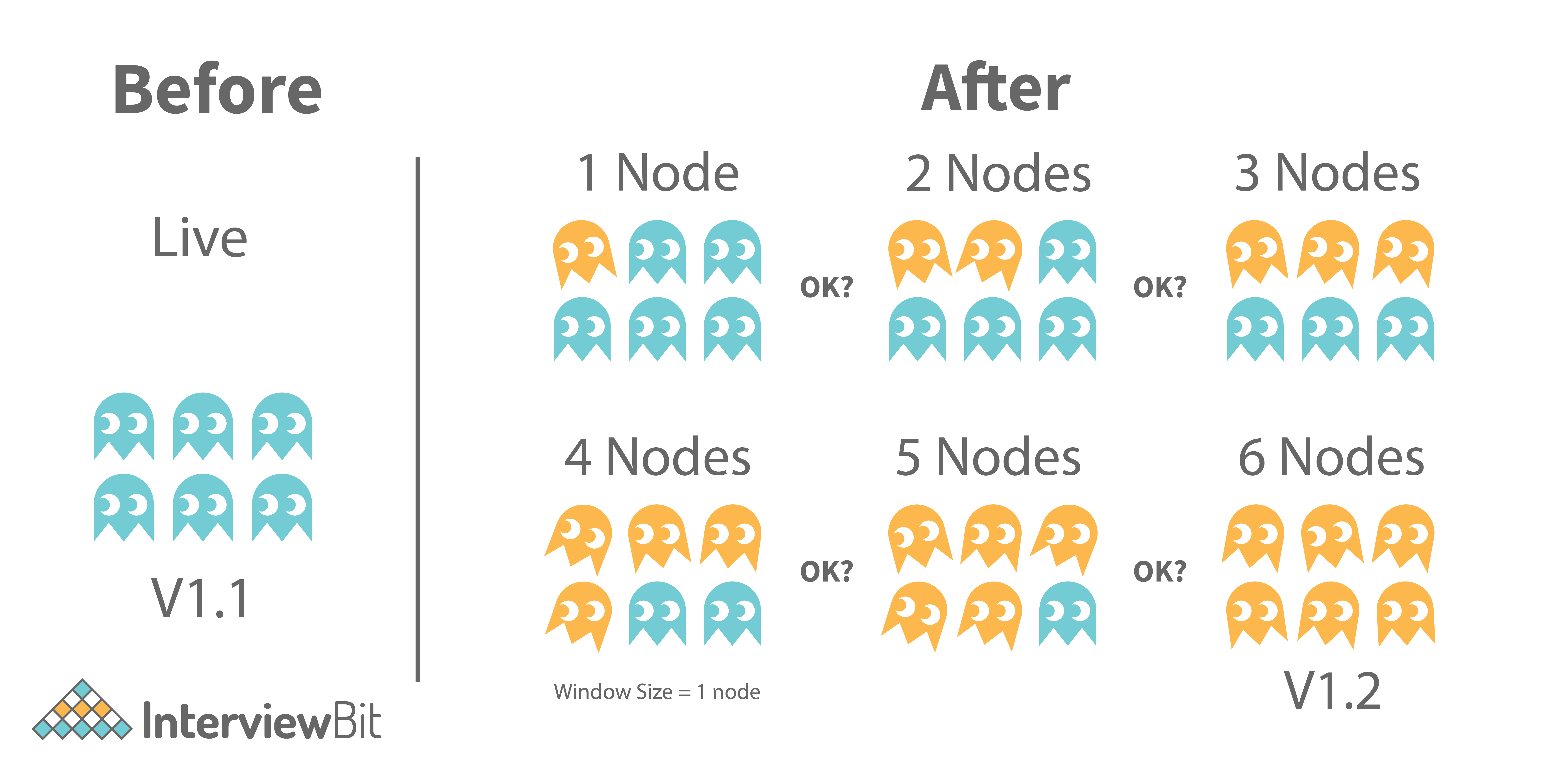
Using this deployment strategy, old versions of an application are completely replaced with the new versions by completely replacing the infrastructure on which they run.
Example: When a new version must be deployed to all nodes, the new version is deployed to the first node while all other nodes handle end-user traffic. As soon as the new version is successfully installed on the first node, it will begin managing end-user traffic while the new version is being installed on the second node. The process is repeated until all nodes have been successfully upgraded to the new version.
3. Explain inversion of control.
IoC (Inversion of Control), as the name suggests, is a design principle in software engineering. With IoC, different kinds of controls can be inverted in an object-oriented design to attain loose coupling. The term "controls" refers to any other responsibilities a class may have other than its primary responsibility. These include controlling the flow of an application, controlling the creation of objects, or controlling the binding and creation of dependent objects. IoC allows classes to be loosely coupled, making testing and maintenance easier.
4. What do you mean by referential transparency in functional programming?
In functional programming, referential transparency is the key differentiating factor. An expression is considered referential transparent if it can be replaced or substituted with the corresponding value it computes or vice-versa without affecting the program’s result.
Example: Imagine that we have an expression called four: val four= add(1,3)
If four is used anywhere in our code, it can safely be replaced with add(1,3), 1 + 3 or 4 wherever it appears. Thus, all the expressions below are equivalent in meaning and output:
val eight = four + four
val eight_v2 = add(1,3) + add(1,3)
val eight_v3 = 4 + add(1,3)
val eight_v4 = 8
If we can swap back-and-forth between these expressions anytime, anywhere, without altering their meaning or output, then an expression is referentially transparent.
5. State difference between normalization and denormalization.
Normalization and denormalization are the two main methods of altering the structure of a database.

| Normalization | Denormalization |
|---|---|
| Normalization involves removing redundant data (multiple copies of data) from a database and storing consistent, non-redundant data. | It involves combining data from multiple tables into a single so that it can be queried quickly. |
| It primarily focuses on clearing out unused data and reducing duplicate data and inconsistencies from a database. | On the other hand, denormalization aims to achieve faster query execution by adding data redundancy. |
| During normalization, tables are reduced in number due to the reduction of data in the database. | Denormalization, on the other hand, involves integrating data into the same database and therefore the number of tables to store the data increases. |
| Data integrity is maintained by normalization. A change to the data in the table will not impact its relationship with the other table. | Data integrity is not maintained by denormalization. |
| It optimizes the use of disk space. | It does not optimize disk space. |
6. In Java, what is a connection leak? How can you fix this?
If a connection is opened and forgotten about, this is known as a "leak" since each time it occurs, a connection is no longer available for reuse. Connection leaks occur when some database requests or transactions are not closed properly or are not committed, causing the connections to be abandoned and closed permanently.
Java developers commonly experience Connection Leaks when using Connection Pools. In the case where there is a section of code that fails to close a connection properly, a connection will leak from the pool each time the section of code is executed. Eventually, if this situation continues, the pool will run out of connections, which is known as Pool Exhaustion. The application will hang once all available connections have been leaked. We can fix this by closing the connection and paying particular attention to any error handling code.
7. What is Promise and explain its states?
Callback functions are functions that can be passed to another function as arguments and executed there to complete a routine or action. Those functions depend on one another, so it could get quite messy with so many callback functions nested in so many layers. This is what is referred to as callback hell.
As an alternative to callbacks in JavaScript, promises are used to handle asynchronous operations. In addition to handling multiple asynchronous operations, they provide better error handling than callbacks. Promises can be a better way for a user to read the code effectively and efficiently, especially when that particular code performs multiple asynchronous operations. The Promise object represents the result of an asynchronous operation (or its failure) and the resulting value. The promise is in one of the following states:
- Pending: In its initial state, neither fulfilled nor rejected.
- Fulfilled: Indicating that the operation was successful.
- Rejected: Indicating that the operation failed.
8. State the difference between GET and POST.
GET and POST are two different HTTP request methods.
| GET | POST |
|---|---|
| This method is used to request data from a certain resource (via some API URL). | This method is used to send or write data to be processed to a specific resource (via some API URL). |
| If you use the GET method to send data, the data is added to the URL, and a URL can be up to 2048 characters in length. Therefore, it has restrictions on data length. | It does not impose such limitations. |
| In comparison to POST, GET is less secure since data is sent as part of the URL. Passwords and other sensitive information should never be sent using GET. | It is a little safer to use POST than GET because the parameters are not saved in the browser history or the web server logs. |
| Everyone can see the data in the URL. | There is no data displayed in the URL. |
9. Explain the Restful API and write its usage.
APIs (Application Programming Interfaces) are sets of rules and protocols that define how software programs or devices can communicate with each other. APIs that conform to the design principles of REST, or representational state transfer, are known as REST APIs. REST APIs may also be referred to as RESTful APIs. Using RESTful APIs, developers can create requests and receive responses via an HTTP request. REST API can also be used for mapping data from a cloud platform to a data warehouse or vice versa.
10. What do you mean by MEAN Stack?
MEAN stands for MongoDB, ExpressJS, AngularJS, and Node.js. It is a collection of JavaScript-based technologies for developing web applications. Despite being a stack of different technologies, all of them are based on the JavaScript language. It is an ideal solution for building dynamic websites and applications as it is a very user-friendly stack. With this free and open-source stack, you can quickly and easily build web-based prototypes.
11. Do you know how to prevent a bot from scraping your publicly accessible API?
As long as the data within the API is accessible to the public, it will technically not be possible to completely prevent data scraping. It is possible, however, to minimize bot activity (automated computer programs on the internet that perform certain tasks) by throttling or rare limiting. Rare limiting will be able to prevent a certain device from making an unlimited number of requests within a defined time. If too many requests are made beyond the defined limit, a 429 Too Many Attempts HTTP error is thrown. It is vital to record more than just the IP address of the device since the IP address is not unique to each device and can stop the whole network from accessing the API.
12. What makes MVC (Model View Controller) different from MVP (Model View Presenter)?
Developers prefer to develop Android applications by utilizing a software architecture pattern. Architecture patterns allow you to express and define a structural schema for software systems. Developers can easily maintain the software and continue to add features to the software in the future. The two most popular android architecture patterns are MVC (Model View Controller) and MVP (Model View Presenter).
| MVC | MVP |
|---|---|
| MVC suggests splitting the code into three components. As soon as the developer creates a class or file for an application, he or she must categorize it into one of three layers: Model, View, and Controller. | This is an architectural pattern that helps compensate for some of the shortcomings of MVC. It is composed of three components i.e., Model, View, and Presenter. |
| The controller serves as a bridge between the view and model layers and therefore provides the application's user interface. As soon as the Model changes, the Controller updates the View. | The presenter pulls data from the model and applies the UI (user interface) logic to determine what to show. In response to the user's input notification, it manages the state of the View and takes appropriate actions. |
| Controllers and views have a many-to-one relationship since one Controller can select different Views depending on the operation required. | Presenter and View have a one-to-one relationship since the Presenter class manages only one View at a time. |
| Support for unit testing is limited. | The unit testing process is highly supported. |
13. What do you mean by Temporal Dead Zone in ES6?
Before ES6, variable declarations were only possible using var. With ES6, we got let and const. Both let and const declarations are block-scoped, i.e., they can only be accessed within the " { } " surrounding them. On the other hand, var doesn't have such a restriction. Unlike var, which can be accessed before its declaration, you cannot access the let or const variables until they are initialized with some value. Temporal Dead Zone is the time from the beginning of the execution of a block in which let or const variables are declared until these variables are initialized. If anyone tries to access those variables during that zone, Javascript will always throw a reference error as given below.
console.log(varNumber); // undefined
console.log(letNumber); // Throws the reference error letNumber is not defined
var varNumber = 3;
let letNumber = 4;
Both let and const variables are in the TDZ from the moment their enclosing scope starts to the moment they are declared.
14. Why should arrow functions not be used in ES6?
One of the most popular features of ES6 is the "arrow functions" (also known as "fat arrow functions"). Arrow functions are a new way to write concise functions. Arrow functions offer a compact alternative to traditional function expressions, but they have limitations and cannot be used in every case.
The following is an ES5 function:
function timesTwo(params) {
        return params * 2
     }
timesTwo(5);  // 10
The same function can also be expressed as an arrow function in ES6 as follows:
var timesTwo = params => params * 2
timesTwo(5);  // 10
Differences & Limitations:
- Has no bindings to 'this' or 'super', so it shouldn't be used as a method.
- Has no new.target keyword.
- The call, apply, and bind methods are not suitable since they rely on establishing scope.
- Not suitable for use as constructors.
- Not possible for an arrow function to use the yield keyword within its body, etc.
15. What is event bubbling and capturing in JavaScript?
The propagation of events inside the DOM (Document Object Model) is known as 'Event Flow' in JavaScript. The event flow defines the order or sequence in which a particular web page receives an event. Accordingly, event flow (propagation) in JS is dependent on the following aspects:
- Event Bubbling: With Event Bubbling, the event is captured and handled first by the innermost element, and then propagates to the outermost element. Events propagate up the DOM tree from child elements until the topmost element is handled.
- Event Capturing: With Event Capturing, the event is captured and handled first by the outermost element, and then propagates to the innermost element. Event cycles propagate starting with the wrapper elements and ending with the target elements that initiated the event cycle.
The following diagram will help you to understand the event propagation life cycle.

16. Tell me about a project that you worked on and the technologies you used. Why did you choose them?
With this question, the interviewer can figure out the methodology of the full stack web developer and determine if he is sharp and precise in selecting the right toolset.
While explaining the reasons for choosing a particular toolset, you should be as specific as possible. You must demonstrate that you can develop both the front and backend of the web application. Having more experience on one side of the development game than the other is okay, but you should show you are capable of handling both ends of the application.
Frequently Asked Questions
1. How to be a full stack developer?
To become a full stack developer, follow these six steps:
- Plan your learning path according to your career goals
- Learn the fundamentals, necessary technologies, and develop the skills you need to be a full-stack developer and necessary technologies.
- Learn from tutorials and videos, but learn to code as well.
- Based on what you learn, create your own project.
- Make a portfolio of your work.
- Start your job search and nail the interview.
2. How many types of full-stack developers are there?
Following are the most common types of full-stack developers based on their specific stacks:
- MEAN Stack (MongoDB-ExpressJS-AngularJS-NodeJS).
- MERN Stack (MongoDB-ExpressJS-ReactJS-NodeJS).
- LAMP Stack (Linux, Apache, MySQL, PHP).
- LEMP Stack (Linux, Nginx, MySQL, PHP).
- Full-Stack Python.
- Full-Stack Elixir.
- Full-Stack Django.
- Full-Stack Java.
- Full-Stack Ruby on Rails.
3. Which full stack is best?
One of the most popular tech stacks is the MEAN stack (MongoDB-ExpressJS-AngularJS-NodeJS). MEAN stack has many applications, including cloud application development. MongoDB, Express.js, AngularJS, and Node.js are among the JavaScript technologies in MEAN used to build web applications.
4. Is full-stack development a good career?
Definitely, it's a great career choice. Having a full-stack developer job is one of the most productive careers you can have, and its high level of responsibility makes it one of the most important careers in tech. Full-stack developers do not only specialize in front-end and back-end development but are also experts with a wide range of skill sets and knowledge. Full Stack Developers are in high demand and companies are willing to pay handsomely for those with the right skillset and diverse knowledge. Here's a Resume Sample.
5. How much do full stack developers earn?
A Full Stack Developer is one of the most highly paid professionals. In India, the average annual salary for a Full Stack Developer is around ₹6,66,697. With 1-4 years of experience, a full-stack developer earns an average of INR 6,53,006-10,00,000. Employees with between 5 and 9 years of experience can expect to earn between INR 12 and 17 lakhs per year. Learn More.
Java Full Stack Developer Interview Questions
1. Explain the Spring Boot architecture and how it simplifies Java full stack development.
Spring Boot is built on top of the Spring Framework and follows a layered architecture approach used in modern enterprise applications. The architecture mainly consists of the Presentation Layer, Business Layer, Persistence Layer, and Database Layer. The Presentation Layer contains Controllers that manage HTTP requests and responses. The Business Layer contains Services responsible for implementing business logic. The Persistence Layer contains Repositories that communicate with the database through Spring Data JPA and Hibernate. Finally, the Database Layer contains databases such as MySQL or PostgreSQL.
One of the biggest reasons why spring boot full stack interview questions are frequently asked in interviews is because Spring Boot simplifies Java development significantly. It removes complex XML configuration through auto configuration and annotation driven development. The @SpringBootApplication annotation combines @Configuration, @EnableAutoConfiguration, and @ComponentScan into a single annotation. This reduces boilerplate code and improves developer productivity.
Spring Boot also provides embedded servers such as Tomcat and Jetty. Developers no longer need to deploy WAR files manually on external servers. Starter dependencies such as spring-boot-starter-web and spring-boot-starter-data-jpa simplify dependency management. These features make Spring Boot one of the most important topics in java full stack developer interview questions.
2. What is the difference between JPA and Hibernate? How do they work together in a full stack Java application?
JPA or Java Persistence API is a specification used for object relational mapping in Java applications. Hibernate is one of the most popular implementations of the JPA specification. In simple terms, JPA defines the rules while Hibernate provides the actual implementation.
In java full stack developer interview questions and answers, candidates are often expected to explain annotations such as @Entity, @Table, @Id, @GeneratedValue, and relationship annotations like @OneToMany and @ManyToOne. These annotations help map Java classes to relational database tables. Hibernate internally converts Java objects into SQL queries and manages persistence operations.
Spring Data JPA further simplifies development by allowing developers to extend JpaRepository interfaces. This automatically provides CRUD operations without writing repetitive SQL code. Hibernate also provides advanced features such as caching, HQL, lazy loading, eager loading, and batch processing. This makes JPA and Hibernate an extremely important topic in java full stack interview questions for experienced developers.
3. How do you secure a Spring Boot REST API? Explain Spring Security with JWT authentication.
Security is one of the most important topics in spring boot full stack interview questions. Spring Security is widely used to handle authentication and authorization in enterprise Java applications. Authentication verifies the identity of the user, while authorization checks what resources the user can access.
JWT or JSON Web Token based authentication is commonly used in modern full stack applications. The client sends credentials to the server, and after validation, the server generates a signed JWT token containing user details and expiration information. The frontend stores this token and sends it with every request in the Authorization header.
Spring Security uses components such as SecurityFilterChain, UserDetailsService, PasswordEncoder, and filters to validate tokens. Developers also use annotations like @PreAuthorize for role based access control. Proper JWT implementation improves scalability because the server remains stateless. This is why authentication and authorization are frequently discussed in java full stack developer interview questions.
4. What is the difference between @Controller and @RestController in Spring Boot?
@Controller is used for server side rendered applications where views such as JSP or Thymeleaf templates are returned. @RestController is used for REST APIs where data is returned directly in JSON or XML format.
In spring boot full stack interview questions, candidates are expected to understand that @RestController internally combines @Controller and @ResponseBody. A method inside a @Controller class may return a view name like home.html, while a method inside a @RestController returns serialized JSON data.
Modern frontend frameworks such as React and Angular usually consume REST APIs from @RestController classes. Spring Boot automatically configures Jackson for JSON serialization. Understanding the distinction between MVC based rendering and REST based APIs is essential in java full stack developer interview questions.
5. Explain the differences between monolithic and microservices architecture.
A monolithic architecture contains all application modules within a single deployable application. In contrast, microservices architecture divides the application into independent services that communicate through APIs or message queues.
Monolithic applications are easier to develop and deploy initially. They are suitable for smaller teams and startup projects. However, scaling a monolithic application becomes difficult as the application grows. Microservices provide independent deployment, better scalability, and fault isolation.
Java full stack developer interview questions often include topics such as Spring Cloud, API Gateway, Eureka Discovery Server, Docker, and Kubernetes in the context of microservices. Candidates should also understand when not to use microservices because operational complexity increases significantly.
6. What are Spring Boot Actuator endpoints?
Spring Boot Actuator provides production ready endpoints for monitoring and managing applications. These endpoints help developers track application health, metrics, logs, environment variables, and mappings.
Common endpoints include /health, /metrics, /info, /env, and /loggers. Developers integrate Actuator with monitoring tools such as Prometheus and Grafana. This helps teams observe JVM memory usage, CPU utilization, request latency, and database connectivity.
Production monitoring is a major topic in java full stack developer interview questions because modern systems require observability and real time monitoring. Actuator simplifies this process significantly.
7. How does Spring Data JPA simplify database operations?
Spring Data JPA reduces boilerplate code by providing built in CRUD methods through JpaRepository interfaces. Developers can perform save, update, delete, and retrieval operations without writing repetitive DAO code.
Derived query methods are another important feature. For example, methods such as findByEmailAndStatus automatically generate SQL queries based on naming conventions. Developers can also use the @Query annotation for custom JPQL or native SQL queries.
Pagination, sorting, and auditing are also supported directly by Spring Data JPA. These capabilities make Spring Data JPA one of the most frequently asked concepts in java full stack developer interview questions and answers.
8. What is the N+1 query problem in Hibernate?
The N+1 query problem occurs when Hibernate executes one query for parent entities and additional queries for each child entity. This results in excessive database calls and major performance issues.
For example, loading 100 orders and their items may result in 101 queries instead of a single optimized query. Developers usually detect this issue through Hibernate SQL logs and profiling tools.
Solutions include JOIN FETCH queries, @EntityGraph, lazy loading optimization, and batch fetching. Performance optimization related questions are very common in java full stack interview questions for experienced developers.
.NET Full Stack Developer Interview Questions
1. What is the difference between Razor Pages and Blazor?
Razor Pages is a page focused framework designed for server side rendering. Each page contains a .cshtml file along with a PageModel class for handling requests.
Blazor is a component based framework that allows developers to build interactive applications using C# instead of JavaScript. Blazor supports both Server and WebAssembly hosting models.
C# full stack developer interview questions commonly include comparisons between Blazor, Angular, and React because frontend architecture decisions are critical in enterprise applications.
2. Explain the ASP.NET Core request pipeline and middleware concept.
ASP.NET Core processes HTTP requests through a middleware pipeline. Middleware components are executed sequentially, and each component can handle requests, modify responses, or pass control to the next middleware.
Common middleware includes authentication, authorization, routing, static files, HTTPS redirection, and exception handling. The order of middleware is extremely important because incorrect ordering can cause security and routing issues.
Asp.net full stack developer interview questions often focus on app.Use(), app.Run(), and app.Map() concepts. Candidates are expected to understand how custom middleware is created and how request flow works internally.
3. What is Entity Framework Core?
Entity Framework Core is Microsoft’s ORM framework for .NET applications. It maps C# classes to relational database tables and simplifies data access operations.
Entity Framework Core supports Code First and Database First approaches. Developers use DbContext and DbSet classes to interact with databases. LINQ queries are converted into SQL queries internally.
In .net full stack developer interview questions, interviewers frequently ask about migrations, lazy loading, eager loading, and performance optimization techniques in EF Core.
4. How does Dependency Injection work in ASP.NET Core?
ASP.NET Core includes a built in dependency injection container. Services are registered using AddTransient, AddScoped, or AddSingleton methods.
Transient services create new instances every time they are requested. Scoped services create one instance per request, while Singleton services create a single instance for the entire application lifetime.
Dependency injection improves maintainability, testing, and modularity. This topic appears frequently in .net core interview questions full stack discussions.
5. Explain LINQ and its role in .NET full stack development.
LINQ or Language Integrated Query allows developers to query collections and databases using C# syntax. It supports filtering, grouping, sorting, joins, aggregation, and projection.
Developers can use query syntax or method syntax for LINQ operations. LINQ queries against Entity Framework Core are translated into SQL queries at runtime.
Performance optimization, deferred execution, IQueryable, and IEnumerable are important topics in .net full stack developer interview questions.
6. What is SignalR in ASP.NET Core?
SignalR enables real time communication between clients and servers. It automatically uses the best available transport such as WebSockets or Long Polling.
SignalR applications include live chat systems, collaborative editing tools, notifications, and dashboards. Developers use Hub classes for managing client server communication.
Real time architecture questions are increasingly common in asp.net full stack developer interview questions because modern applications require instant updates.
7. How do you implement Repository pattern and Unit of Work pattern?
The Repository pattern abstracts data access logic behind interfaces, while the Unit of Work pattern coordinates transactions across repositories.
Repositories improve maintainability and testability. Unit of Work ensures all related operations succeed or fail together within a transaction.
These design patterns are frequently discussed in c# full stack developer interview questions because they represent enterprise architecture best practices.
8. What is the difference between .NET Framework and .NET Core?
.NET Framework is Windows specific and supports technologies such as Web Forms and WPF. .NET Core and .NET 5+ are cross platform, open source, and optimized for cloud native development.
.NET Core supports Docker containers, Linux hosting, and side by side deployment. It also offers significantly better performance compared to older .NET Framework applications.
Modern enterprise applications primarily use .NET 8 and .NET 9, making this one of the most important .net core interview questions full stack topics.
Python Full Stack Developer Interview Questions
1. Compare Django, Flask, and FastAPI.
Django is a batteries included framework that provides ORM, authentication, admin panel, and migrations out of the box. Flask is a lightweight micro framework offering flexibility and simplicity. FastAPI is a modern asynchronous framework optimized for high performance APIs.
Django is best for large scale web applications and content management systems. Flask is suitable for lightweight services and custom architectures. FastAPI is ideal for asynchronous APIs, machine learning deployments, and microservices.
Python full stack developer interview questions often compare these frameworks based on productivity, scalability, performance, and ecosystem support.
2. Explain Django’s MVT architecture.
Django follows the Model View Template architecture. Models define database structure, Views contain business logic, and Templates manage presentation.
The framework itself handles controller responsibilities through URL routing and request processing. Django templates support inheritance, reusable layouts, and dynamic rendering.
Django full stack developer interview questions frequently focus on differences between MVC and MVT architecture.
3. What is Django REST Framework?
Django REST Framework is a toolkit for building APIs in Django applications. It provides serializers, viewsets, routers, authentication systems, and pagination.
Serializers convert model instances into JSON and validate incoming data. Viewsets simplify CRUD operations while routers automatically generate URL patterns.
Authentication, JWT integration, permissions, and filtering are important topics in django full stack developer interview questions.
4. Explain Django ORM and query optimization.
Django ORM maps Python classes to database tables and allows developers to write database queries using Python syntax.
Optimization techniques include select_related, prefetch_related, indexing, query profiling, and caching. Developers also use annotate, aggregate, and Q objects for advanced queries.
Database optimization is one of the most common python web development interview questions because poorly optimized queries impact scalability.
5. What is the GIL in Python?
The Global Interpreter Lock allows only one thread to execute Python bytecode at a time within a process.
This limits true parallelism for CPU intensive tasks but does not heavily affect I O bound operations such as API calls or database communication.
Python full stack developer interview questions often discuss multiprocessing, Gunicorn workers, and asynchronous programming in relation to the GIL.
6. How do you handle background tasks in Python applications?
Celery is the most commonly used framework for background task processing in Python applications. It works with message brokers such as Redis and RabbitMQ.
Background tasks include sending emails, processing uploads, generating reports, and machine learning inference tasks. Celery supports retries, scheduling, and distributed task execution.
Asynchronous processing is frequently asked in flask interview questions and fastapi interview questions.
7. What are Django migrations?
Django migrations track database schema changes and apply them consistently across environments.
Developers generate migrations using makemigrations and apply them using migrate commands. Migrations are version controlled and can include data migration logic.
Complex migration handling and zero downtime deployment strategies are common django full stack developer interview questions.
8. How do you deploy a Python full stack application?
Production deployment usually includes Nginx, Gunicorn or Uvicorn, Django or FastAPI, and PostgreSQL.
Nginx acts as a reverse proxy and serves static files. Gunicorn is used for WSGI applications while Uvicorn is used for ASGI based asynchronous applications.
Docker, Kubernetes, environment variables, SSL configuration, and load balancing are major topics in python web development interview questions.
9. How do you implement authentication and authorization in Django?
Django provides a built in authentication framework with session management, password hashing, and permissions.
Developers use login_required decorators, groups, roles, and JWT authentication for securing applications. Social authentication and multi factor authentication are also common in modern systems.
Authentication and authorization are among the most important django full stack developer interview questions because security is critical for production applications.
Full Stack Developer MCQ Questions
CORS stands for ___.


In what ways can developers reduce the loading time of their web applications?
The use of callback functions leaves you with code that is difficult to read and maintain. True or False.
What are the skills a full-stack developer should possess?
What software deployment strategy creates two separate infrastructure environments?
What type of class does Dependency Injection not involve?
Which JavaScript-based technologies are part of MEAN for developing web applications?
Which of the following are limitations of the arrow function in ES6?
Which of the following involves removing redundant data from a database?
______ can be used as an alternative to callback functions in JavaScript.